Chebotareva Natalia, Cao Venzsin, Vinogradov Anatoliy, Alentov Igor, Sergeeva Natalia, Kononikhin Alexey, Moiseev Sergey
Sechenov First Moscow State Medical University, Tareev Clinic of Internal Diseases, Moscow, Russia.
Lomonosov Moscow State University, Faculty of Medicine, Moscow, Russia.
Front Med (Lausanne). 2023 Jun 20;10:1189017. doi: 10.3389/fmed.2023.1189017. eCollection 2023.
Minimal change disease and focal segmental glomerulosclerosis are primary podocytopathies that are clinically presented in adults presenting with severe nephrotic syndrome. The pathogenesis of these diseases is not clear and many questions remain to be answered. A new concept about the role of changes in the antigenic determinant of podocytes and the production of anti-podocyte antibodies that cause podocyte damage is being developed. The aim of the study is to evaluate the levels of anti-CD40 and anti-ubiquitin carboxyl-terminal hydrolase L1 (anti-UCH-L1) antibodies in patients with podocytopathies in comparison with other glomerulopathies.
One hundred and six patients with glomerulopathy and 11 healthy subjects took part in the study. A histological study revealed primary FSGS in 35 patients (genetic cases of FSGS and secondary FSGS in the absence of NS were excluded), 15 had MCD, 21 - MN, 13 - MPGN, 22 patients - IgA nephropathy. The effect of steroid therapy was evaluated in patients with podocytopathies (FSGS and MCD). The serum levels of anti-UCH-L1 and anti-CD40 antibodies were measured by ELISA before steroid treatment.
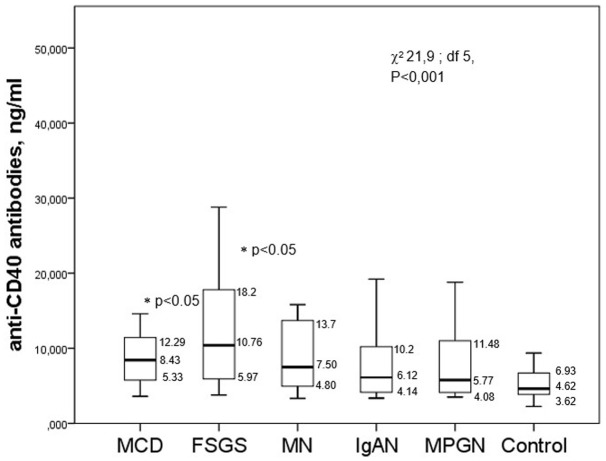
The levels of anti-UCH-L1 antibodies were significantly higher in MCD patients and anti-CD40 antibodies were higher in MCD and FSGS than in the control group and other groups of glomerulopathies. In addition, the level of anti-UCH-L1 antibodies was higher in patients with steroid-sensitive FSGS and MCD, and anti-CD40 antibodies were lower than in patients with steroid-resistant FSGS. An increase in anti-UCH-L1 antibody levels above 6.44 ng/mL may be a prognostic factor of steroid-sensitivity. The ROC curve (AUC = 0.875 [95% CI 0.718-0.999]) for response to therapy showed a sensitivity of 75% and specificity of 87.5%.
An increase in the level of anti-UCH-L1 antibodies is specific for steroid-sensitive FSGS and MCD, while an increase in anti-CD40 antibodies - for steroid-resistant FSGS, compared with other glomerulopathies. It suggests that these antibodies could be a potential factor for differential diagnosis and treatment prognosis.
微小病变病和局灶节段性肾小球硬化是原发性足细胞病,临床上表现为重度肾病综合征的成人患者。这些疾病的发病机制尚不清楚,仍有许多问题有待解答。关于足细胞抗原决定簇变化的作用以及导致足细胞损伤的抗足细胞抗体产生的新概念正在形成。本研究的目的是评估足细胞病患者与其他肾小球病患者相比抗CD40和抗泛素羧基末端水解酶L1(抗UCH-L1)抗体的水平。
106例肾小球病患者和11名健康受试者参与了本研究。组织学研究显示35例患者为原发性局灶节段性肾小球硬化(排除局灶节段性肾小球硬化的遗传病例和无肾病综合征的继发性局灶节段性肾小球硬化),15例为微小病变病,21例为膜性肾病,13例为膜增生性肾小球肾炎,22例为IgA肾病。对足细胞病(局灶节段性肾小球硬化和微小病变病)患者评估了类固醇治疗的效果。在类固醇治疗前通过酶联免疫吸附测定法测量抗UCH-L1和抗CD40抗体的血清水平。
微小病变病患者抗UCH-L1抗体水平显著高于对照组和其他肾小球病组,微小病变病和局灶节段性肾小球硬化患者的抗CD40抗体水平高于对照组和其他肾小球病组。此外,类固醇敏感的局灶节段性肾小球硬化和微小病变病患者的抗UCH-L1抗体水平较高,而抗CD40抗体水平低于类固醇抵抗的局灶节段性肾小球硬化患者。抗UCH-L1抗体水平高于6.44 ng/mL可能是类固醇敏感性的一个预后因素。治疗反应的ROC曲线(AUC = 0.875 [95% CI 0.718 - 0.999])显示敏感性为75%,特异性为87.5%。
与其他肾小球病相比,抗UCH-L1抗体水平升高对类固醇敏感的局灶节段性肾小球硬化和微小病变病具有特异性,而抗CD40抗体水平升高对类固醇抵抗的局灶节段性肾小球硬化具有特异性。这表明这些抗体可能是鉴别诊断和治疗预后的潜在因素。