Erasmus School of Health Policy and Management, Erasmus University Rotterdam, P.O. Box 1738, 3000 DR, Rotterdam, The Netherlands.
Erasmus Centre for Health Economics Research (EsCHER), Erasmus University Rotterdam, Rotterdam, The Netherlands.
Eur J Health Econ. 2024 Jun;25(4):563-578. doi: 10.1007/s10198-023-01604-8. Epub 2023 Jul 6.
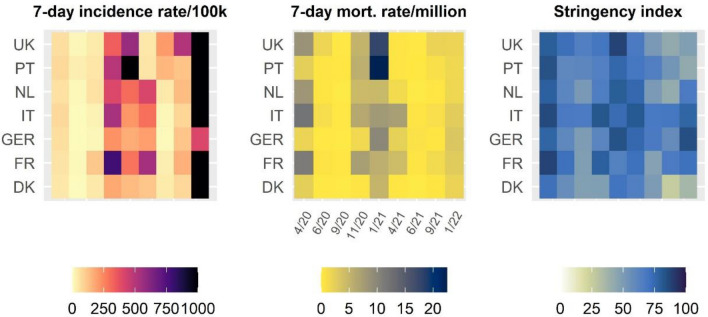
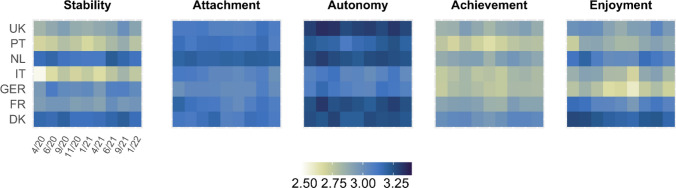
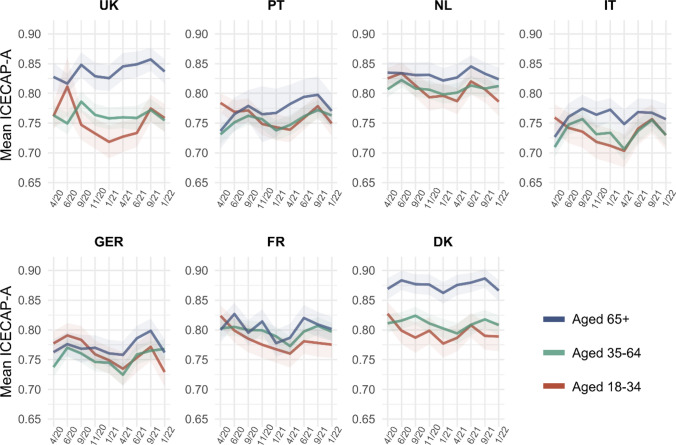
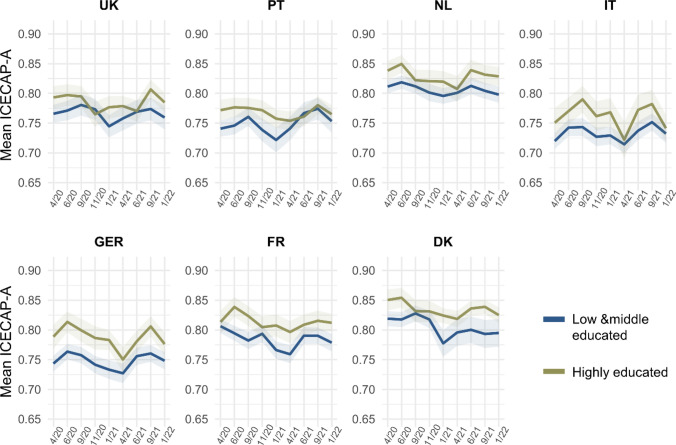
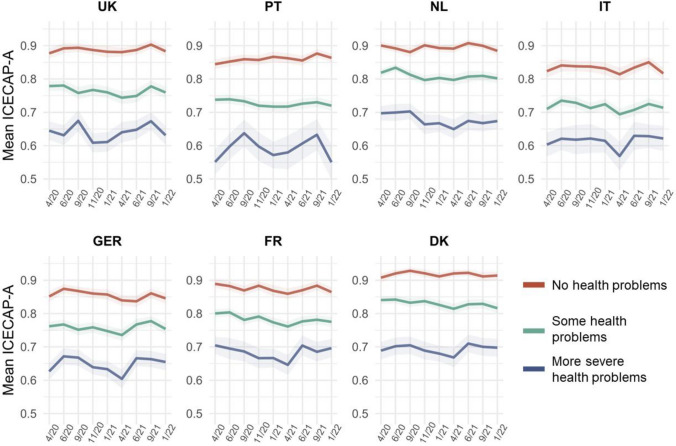
The COVID-19 pandemic considerably impacted the lives of European citizens. This study aims to provide a nuanced picture of well-being patterns during the pandemic across Europe with a special focus on relevant socio-economic sub-groups. This observational study uses data from a repeated, cross-sectional, representative population survey with nine waves of data from seven European countries from April 2020 to January 2022. The analysis sample contains a total of 25,062 individuals providing 64,303 observations. Well-being is measured using the ICECAP-A, a multi-dimensional instrument for approximating capability well-being. Average levels of ICECAP-A index values and sub-dimension scores were calculated across waves, countries, and relevant sub-groups. In a fixed effects regression framework, associations of capability well-being with COVID-19 incidence, mortality, and the stringency of the imposed lockdown measures were estimated. Denmark, the Netherlands, and France experienced a U-shaped pattern in well-being (lowest point in winter 2020/21), while well-being in the UK, Germany, Portugal, and Italy followed an M-shape, with increases after April 2020, a drop in winter 2020, a recovery in the summer of 2021, and a decline in winter 2021. However, observed average well-being reductions were generally small. The largest declines were found in the well-being dimensions attachment and enjoyment and among individuals with a younger age, a financially unstable situation, and lower health. COVID-19 mortality was consistently negatively associated with capability well-being and its sub-dimensions, while stringency and incidence rate were generally not significantly associated with well-being. Further investigation is needed to understand underlying mechanisms of presented patterns.
COVID-19 大流行极大地影响了欧洲公民的生活。本研究旨在通过特别关注相关社会经济亚组,为欧洲大流行期间的幸福感模式提供一个细致入微的图景。本观察性研究使用了来自七个欧洲国家的重复、横截面、代表性人口调查的九轮数据。分析样本包含总共 25062 名个体,提供了 64303 个观测值。幸福感使用 ICECAP-A 进行衡量,这是一种用于近似能力幸福感的多维工具。在跨波、国家和相关亚组的基础上计算了 ICECAP-A 指数值和子维度得分的平均水平。在固定效应回归框架中,对能力幸福感与 COVID-19 发病率、死亡率和实施封锁措施的严格程度的关联进行了估计。丹麦、荷兰和法国的幸福感呈现出 U 形模式(2020/21 年冬季最低点),而英国、德国、葡萄牙和意大利的幸福感则呈现出 M 形模式,在 2020 年 4 月之后增加,2020 年冬季下降,2021 年夏季恢复,2021 年冬季再次下降。然而,观察到的平均幸福感下降幅度通常较小。幸福感维度的依恋和享受以及年龄较小、经济不稳定和健康状况较差的个体中,幸福感下降幅度最大。COVID-19 死亡率与能力幸福感及其子维度始终呈负相关,而严格程度和发病率通常与幸福感没有显著相关。需要进一步研究以了解所呈现模式的潜在机制。