Department of Chemistry, University of Oxford, Oxford, UK.
Department of Chemistry, University College London, London, UK.
Nat Chem Biol. 2023 Sep;19(9):1138-1146. doi: 10.1038/s41589-023-01374-7. Epub 2023 Jul 6.
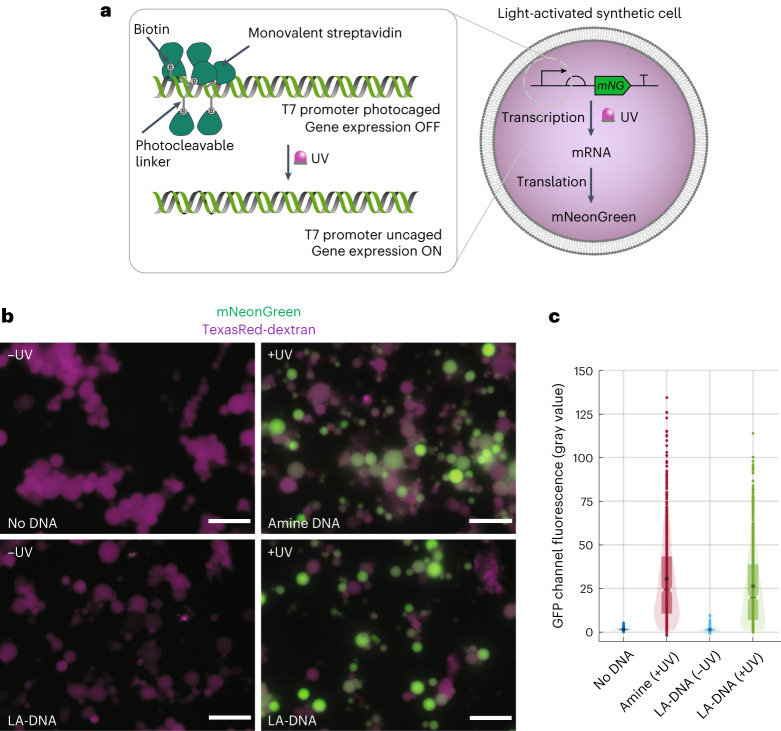
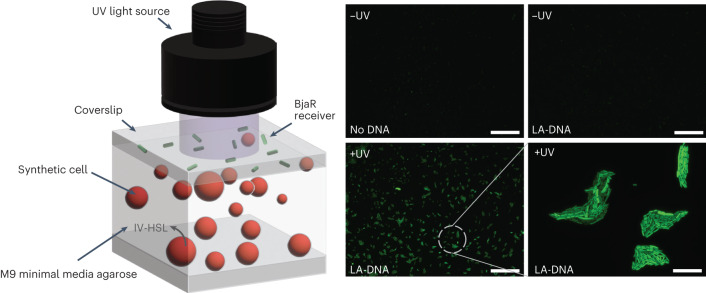
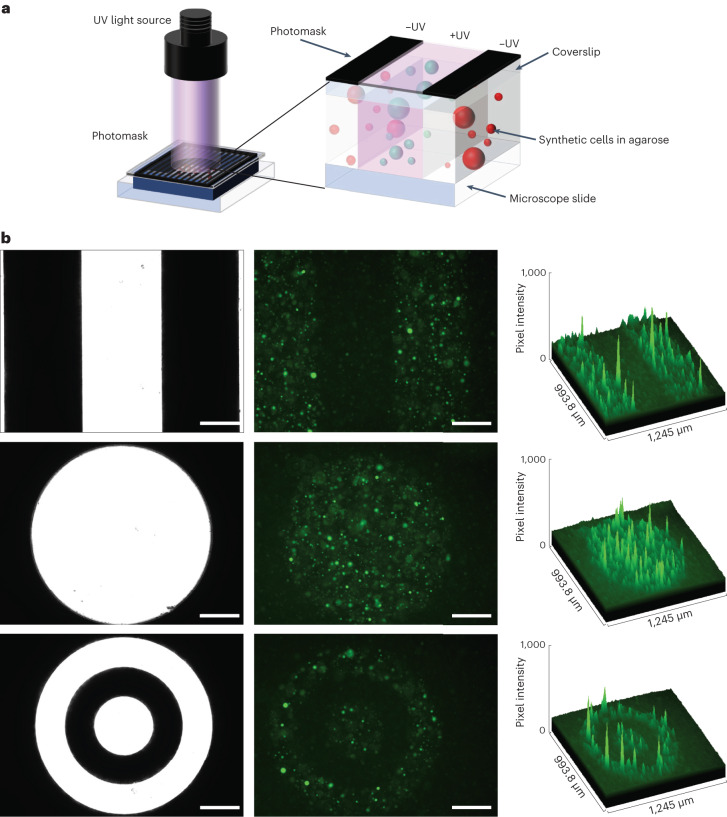
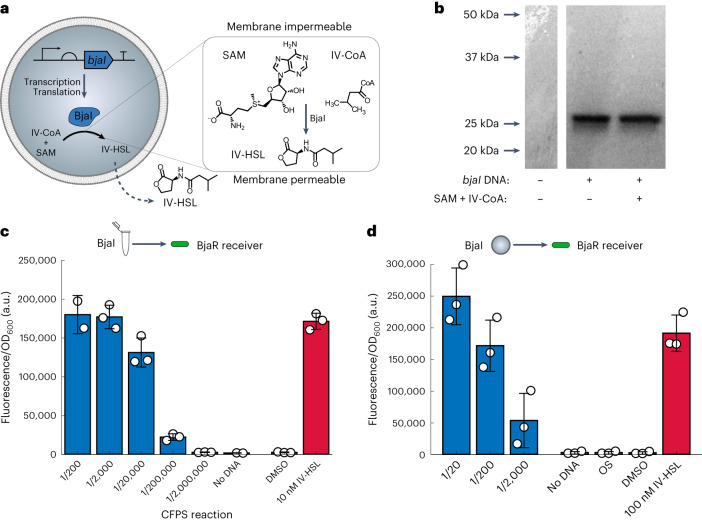
Gene-expressing compartments assembled from simple, modular parts, are a versatile platform for creating minimal synthetic cells with life-like functions. By incorporating gene regulatory motifs into their encapsulated DNA templates, in situ gene expression and, thereby, synthetic cell function can be controlled according to specific stimuli. In this work, cell-free protein synthesis within synthetic cells was controlled using light by encoding genes of interest on light-activated DNA templates. Light-activated DNA contained a photocleavable blockade within the T7 promoter region that tightly repressed transcription until the blocking groups were removed with ultraviolet light. In this way, synthetic cells were activated remotely, in a spatiotemporally controlled manner. By applying this strategy to the expression of an acyl homoserine lactone synthase, BjaI, quorum-sensing-based communication between synthetic cells and bacteria was controlled with light. This work provides a framework for the remote-controlled production and delivery of small molecules from nonliving matter to living matter, with applications in biology and medicine.
从简单的模块化部分组装的基因表达隔室是创建具有类似生命功能的最小合成细胞的多功能平台。通过将基因调控基序纳入其封装的 DNA 模板中,可以根据特定的刺激来控制原位基因表达和因此合成细胞的功能。在这项工作中,通过用光激活 DNA 模板上编码感兴趣基因的方法来控制合成细胞内的无细胞蛋白质合成。光激活 DNA 在 T7 启动子区域内包含一个光可裂解的封锁物,该封锁物在阻断基团被紫外线去除之前严格抑制转录。通过这种方式,以时空可控的方式远程激活合成细胞。通过将这种策略应用于酰基高丝氨酸内酯合酶 BjaI 的表达,用光控制了合成细胞和细菌之间基于群体感应的通信。这项工作为从小分子非生物物质到生物物质的远程控制生产和输送提供了一个框架,在生物学和医学中有应用。