Department of Medical Oncology (Lab.), Dr. BRAIRCH, All India Institute of Medical Sciences (AIIMS), New Delhi, Delhi, 110029, India.
Laboratory of Cancer Immunology and Genetics, Sidra Medicine, Doha, Qatar.
J Transl Med. 2023 Jul 7;21(1):449. doi: 10.1186/s12967-023-04292-3.
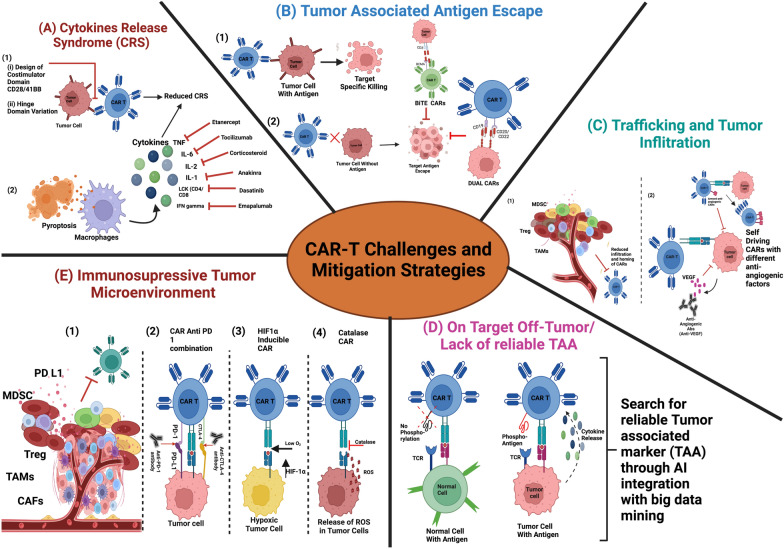
Traditional cancer treatments use nonspecific drugs and monoclonal antibodies to target tumor cells. Chimeric antigen receptor (CAR)-T cell therapy, however, leverages the immune system's T-cells to recognize and attack tumor cells. T-cells are isolated from patients and modified to target tumor-associated antigens. CAR-T therapy has achieved FDA approval for treating blood cancers like B-cell acute lymphoblastic leukemia, large B-cell lymphoma, and multiple myeloma by targeting CD-19 and B-cell maturation antigens. Bi-specific chimeric antigen receptors may contribute to mitigating tumor antigen escape, but their efficacy could be limited in cases where certain tumor cells do not express the targeted antigens. Despite success in blood cancers, CAR-T technology faces challenges in solid tumors, including lack of reliable tumor-associated antigens, hypoxic cores, immunosuppressive tumor environments, enhanced reactive oxygen species, and decreased T-cell infiltration. To overcome these challenges, current research aims to identify reliable tumor-associated antigens and develop cost-effective, tumor microenvironment-specific CAR-T cells. This review covers the evolution of CAR-T therapy against various tumors, including hematological and solid tumors, highlights challenges faced by CAR-T cell therapy, and suggests strategies to overcome these obstacles, such as utilizing single-cell RNA sequencing and artificial intelligence to optimize clinical-grade CAR-T cells.
传统的癌症治疗方法使用非特异性药物和单克隆抗体来靶向肿瘤细胞。然而,嵌合抗原受体 (CAR)-T 细胞疗法利用免疫系统的 T 细胞来识别和攻击肿瘤细胞。T 细胞从患者体内分离出来,并经过修饰以靶向肿瘤相关抗原。CAR-T 疗法已通过靶向 CD-19 和 B 细胞成熟抗原获得 FDA 批准,用于治疗血液癌,如 B 细胞急性淋巴细胞白血病、大 B 细胞淋巴瘤和多发性骨髓瘤。双特异性嵌合抗原受体可能有助于减轻肿瘤抗原逃逸,但在某些肿瘤细胞不表达靶向抗原的情况下,其疗效可能有限。尽管在血液癌方面取得了成功,但 CAR-T 技术在实体瘤中面临挑战,包括缺乏可靠的肿瘤相关抗原、缺氧核心、免疫抑制性肿瘤环境、增强的活性氧和减少的 T 细胞浸润。为了克服这些挑战,目前的研究旨在确定可靠的肿瘤相关抗原,并开发具有成本效益、针对肿瘤微环境的 CAR-T 细胞。本综述涵盖了针对各种肿瘤(包括血液肿瘤和实体肿瘤)的 CAR-T 疗法的发展,强调了 CAR-T 细胞疗法面临的挑战,并提出了克服这些障碍的策略,例如利用单细胞 RNA 测序和人工智能来优化临床级 CAR-T 细胞。