Department of System Dynamics and Friction Physics, Institute of Mechanics, Technische Universität Berlin, 10623 Berlin, Germany.
Department of Nanoelectronics and Surface Modification, Faculty of Electronics and Information Technology, Sumy State University, 40007 Sumy, Ukraine.
Sensors (Basel). 2023 Jun 10;23(12):5478. doi: 10.3390/s23125478.
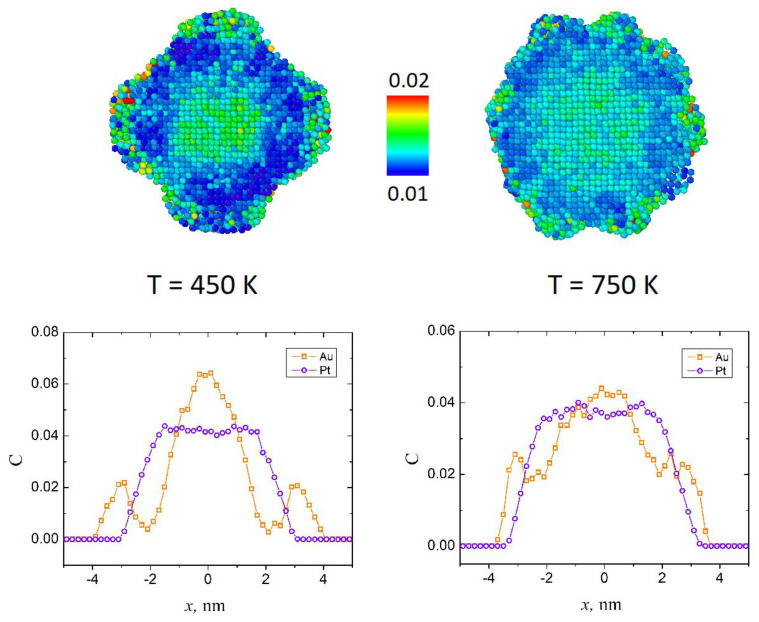
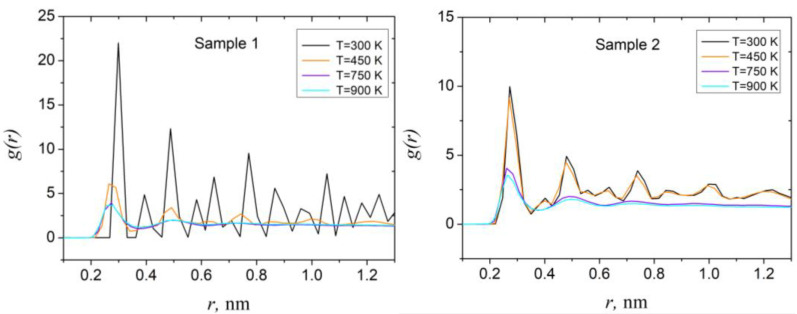
Thermal stability is an important feature of the materials used as components and parts of sensors and other devices of nanoelectronics. Here we report the results of the computational study of the thermal stability of the triple layered Au@Pt@Au core-shell nanoparticles, which are promising materials for HO bi-directional sensing. A distinct feature of the considered sample is the raspberry-like shape, due to the presence of Au nanoprotuberances on its surface. The thermal stability and melting of the samples were studied within classical molecular dynamics simulations. Interatomic forces were computed within the embedded atom method. To investigate the thermal properties of Au@Pt@Au nanoparticles, structural parameters such as Lindemann indexes, radial distribution functions, linear distributions of concentration, and atomistic configurations were calculated. As the performed simulations showed, the raspberry-like structure of the nanoparticle was preserved up to approximately 600 K, while the general core-shell structure was maintained up to approximately 900 K. At higher temperatures, the destruction of the initial fcc crystal structure and core-shell composition was observed for both considered samples. As Au@Pt@Au nanoparticles demonstrated high sensing performance due to their unique structure, the obtained results may be useful for the further design and fabrication of the nanoelectronic devices that are required to work within a certain range of temperatures.
热稳定性是作为纳米电子学传感器和其他器件的组件和部分使用的材料的一个重要特征。在这里,我们报告了计算研究具有三明治结构的 Au@Pt@Au 核壳纳米粒子热稳定性的结果,该纳米粒子是用于 HO 双向传感的有前途的材料。所考虑的样品的一个显著特点是由于其表面存在 Au 纳米突起而呈现出覆盆子状的形状。在经典分子动力学模拟中研究了样品的热稳定性和熔化。原子间力是在嵌入原子方法中计算的。为了研究 Au@Pt@Au 纳米粒子的热性能,计算了结构参数,如 Lindemann 指数、径向分布函数、浓度线性分布和原子构型。如所进行的模拟所示,纳米粒子的覆盆子状结构在大约 600 K 之前保持不变,而一般的核壳结构在大约 900 K 之前保持不变。在更高的温度下,观察到两种考虑的样品的初始 fcc 晶体结构和核壳组成被破坏。由于 Au@Pt@Au 纳米粒子因其独特的结构而表现出高的传感性能,因此获得的结果可能对进一步设计和制造需要在一定温度范围内工作的纳米电子器件有用。