Department of Neurosurgery, The Second Hospital of Zhejiang University School of Medicine, Hangzhou, 310009, People's Republic of China.
Department of Oncology, Shengli Oilfield Central Hospital, Dongying, 257034, People's Republic of China.
Sci Rep. 2023 Jul 9;13(1):11097. doi: 10.1038/s41598-023-38158-x.
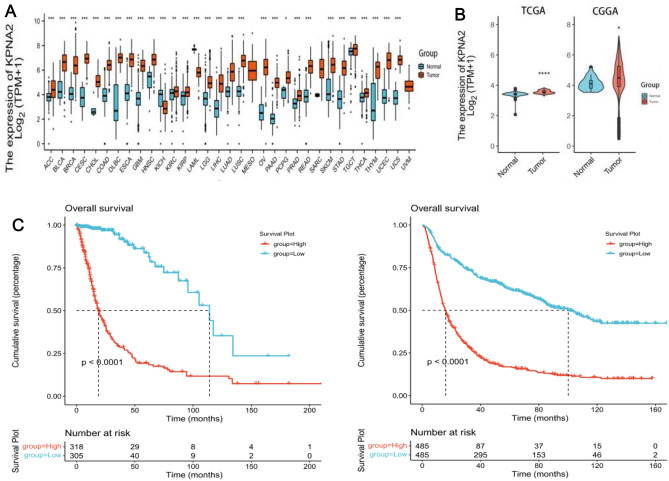
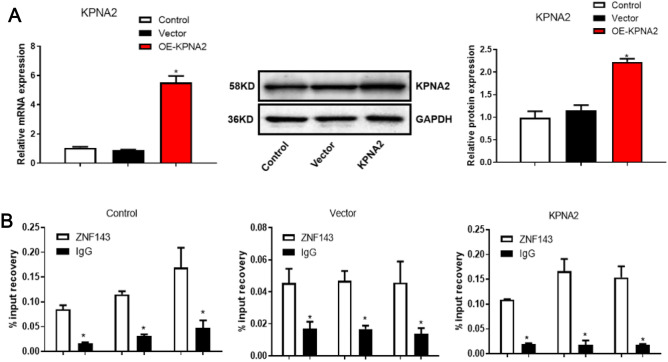
The disordered expression of ZNF143 is closely related to the malignant progression of tumours. However, the basic control mechanism of ZNF143 in glioma has not yet been clarified. Therefore, we tried to find a new pathway to illustrate the function of ZNF143 in glioma. To explore the function of KPNA2 in the development of glioma, we used survival analysis by the Kaplan‒Meier method to assess the overall survival (OS) of patients with low and high KPNA2 expression in the TCGA and CGGA cohorts. Western blotting assays and RT‒PCR assays were utilized to determine the expression level of KPNA2 in glioma cells. The interaction between ZNF143 and KPNA2 was confirmed by ChIP assays. Proliferation was assessed by CCK-8 assays, and migration was evaluated by wound healing and Transwell assays. Apoptosis was determined by flow cytometry, and the expression level of YAP/TAZ was visualized using an immunofluorescence assay. The expression levels of LATS1, LATS2, YAP1, and p-YAP1 were determined. Patients with low KPNA2 expression showed a better prognosis than those with high KPNA2 expression. KPNA2 was found to be upregulated in human glioma cells. ZNF143 can bind to the promoter region of KPNA2. Downregulation of ZNF143 and KPNA2 can activate the Hippo signalling pathway and reduce YAP/TAZ expression in human glioma cells, thus inducing apoptosis of human glioma cells and weakening their proliferation, migration and invasion. In conclusion, ZNF143 mediates the Hippo/YAP signalling pathway and inhibits the growth and migration of glioma cells by regulating KPNA2.
锌指蛋白 143 的失调表达与肿瘤的恶性进展密切相关。然而,锌指蛋白 143 在神经胶质瘤中的基本调控机制尚不清楚。因此,我们试图寻找新的途径来阐明锌指蛋白 143 在神经胶质瘤中的功能。为了探讨 KPNA2 在神经胶质瘤发生发展中的作用,我们利用 Kaplan-Meier 法进行生存分析,评估 TCGA 和 CGGA 队列中 KPNA2 低表达和高表达患者的总生存期(OS)。利用 Western blot 检测和 RT-PCR 检测来确定神经胶质瘤细胞中 KPNA2 的表达水平。利用 ChIP 检测来证实 ZNF143 和 KPNA2 之间的相互作用。通过 CCK-8 检测来评估增殖,通过划痕愈合和 Transwell 检测来评估迁移。通过流式细胞术来检测细胞凋亡,通过免疫荧光检测来可视化 YAP/TAZ 的表达水平。检测 LATS1、LATS2、YAP1 和 p-YAP1 的表达水平。KPNA2 低表达的患者预后比 KPNA2 高表达的患者要好。发现 KPNA2 在人神经胶质瘤细胞中上调。ZNF143 可以结合 KPNA2 的启动子区域。下调 ZNF143 和 KPNA2 可以激活 Hippo 信号通路,降低人神经胶质瘤细胞中 YAP/TAZ 的表达,从而诱导人神经胶质瘤细胞凋亡,减弱其增殖、迁移和侵袭能力。总之,ZNF143 通过调节 KPNA2 介导 Hippo/YAP 信号通路,抑制神经胶质瘤细胞的生长和迁移。