Vora Paayal S, Li Shufeng, Oh Gabriel, Webb Taylor, Perry Warren M, Park Caroline, Chang Anne Lynn S
Dermatology, Northeast Ohio Medical University, Rootstown, USA.
Dermatology, Stanford University School of Medicine, Redwood City, USA.
Cureus. 2023 Jun 7;15(6):e40099. doi: 10.7759/cureus.40099. eCollection 2023 Jun.
Non-melanoma skin cancer (NMSC) is the most common human malignancy worldwide, with increasing incidence in the United States (US). Recent environmental data have shown that ultraviolet radiation (UVR) levels have increased in the US, particularly in the higher latitudes, but the potential impact of this on NMSC incidence is not well known, despite estimates that 90% of NMSC is due to sun exposure. Our exploratory study synthesizes environmental data with demographic and clinical data to determine whether UV indices (UVIs) and non-sunbelt (non-SB) locale (latitudes >40 degrees, which comprises most of the US) might contribute to incidence rates of two types of NMSC: cutaneous squamous cell and Merkel cell carcinomas.
UVIs from 2010 to 2017 were obtained from the National Oceanic and Atmospheric Administration database and meshed with corresponding locales in the National Cancer Institute's Surveillance, Epidemiology, and End Results (SEER) database (version 8.4.0.1). Four SB and five NSB locales contained sufficient data for analysis. Linear mixed modeling was performed with the outcome variable of the age-adjusted incidence of NMSC cancer (comprised of cutaneous squamous cell carcinoma of the head and neck (CSCCHN) and Merkel cell carcinoma (MCC)), the two most common types of NMSC contained within SEER). Non-SB locale and percent of days with UVI >3 were independent variables.
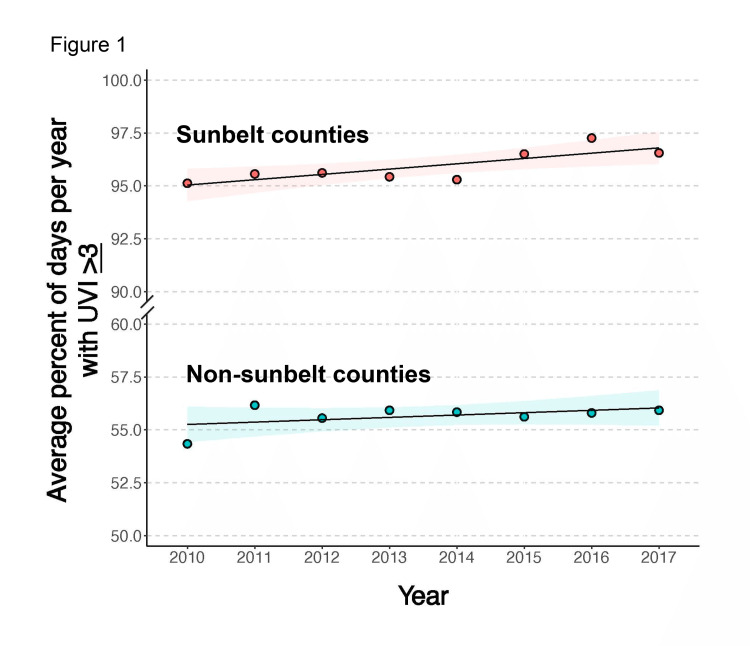
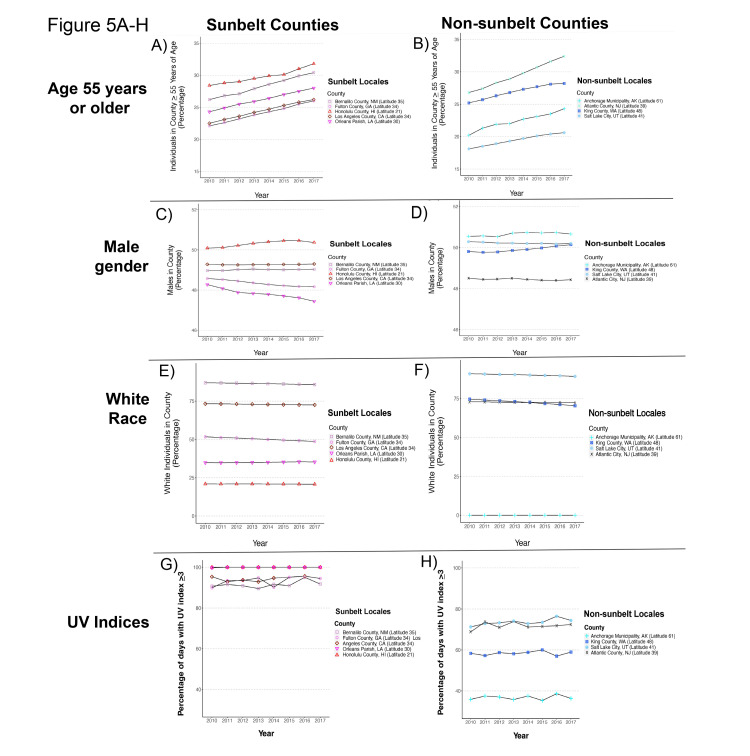
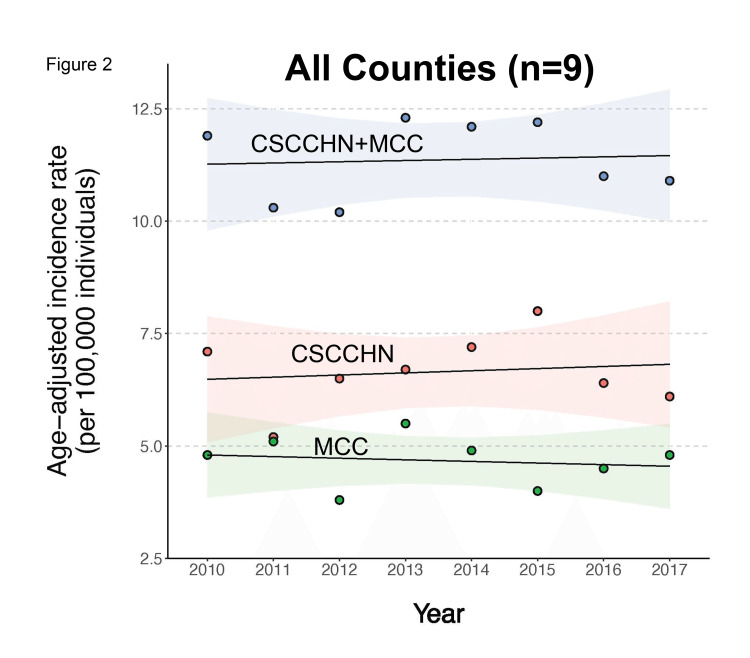
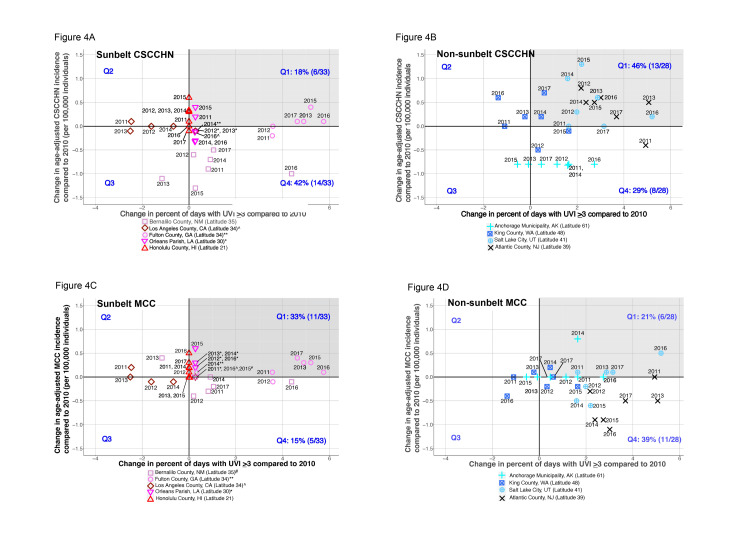
Percent of days with UVI >3 increased during this period, as did the overall NMSC (combined CSCCHN and MCC) skin cancer incidence, though MCC incidence alone did not increase during our study period. Environmental factors that significantly contributed to the age-adjusted overall NMSC (combined CSCCHN and MCC) cancer incidence (per 100,000 individuals) included NSB locale (b=1.227, p=0.0019) and percent of days with UVIs >3 (b=0.028, p<0.0001), as well as clinical factors of percent white race and percent male, by linear mixed modeling.
Our results are limited by the completeness of the NOAA and SEER databases, and do not include basal cell carcinoma. Nevertheless, our data demonstrate that environmental factors, such as latitude in NSB locale and UVI indices, can affect the age-adjusted overall NMSC (defined as CSCCHN and MCC in this study) incidence even in this relatively short period of time. Prospective studies over longer time periods are needed to identify the extent to which these findings are clinically significant so that increased educational efforts to promote sun-safe behaviors can be maximally effective.
非黑色素瘤皮肤癌(NMSC)是全球最常见的人类恶性肿瘤,在美国其发病率呈上升趋势。最近的环境数据显示,美国的紫外线辐射(UVR)水平有所增加,特别是在高纬度地区,但尽管估计90%的NMSC是由阳光照射引起的,但其对NMSC发病率的潜在影响尚不清楚。我们的探索性研究将环境数据与人口统计学和临床数据相结合,以确定紫外线指数(UVIs)和非阳光带(非SB)地区(纬度>40度,涵盖美国大部分地区)是否可能导致两种类型的NMSC发病率上升:皮肤鳞状细胞癌和默克尔细胞癌。
从美国国家海洋和大气管理局数据库中获取2010年至2017年的UVIs,并与美国国立癌症研究所的监测、流行病学和最终结果(SEER)数据库(版本8.4.0.1)中的相应地区进行匹配。四个SB地区和五个NSB地区包含足够的数据用于分析。采用线性混合模型,以NMSC癌症(由头颈部皮肤鳞状细胞癌(CSCCHN)和默克尔细胞癌(MCC)组成,这是SEER中包含的两种最常见的NMSC类型)的年龄调整发病率作为结果变量。非SB地区和UVI>3的天数百分比为自变量。
在此期间,UVI>3的天数百分比增加,NMSC(CSCCHN和MCC合并)皮肤癌的总体发病率也增加,不过在我们的研究期间,仅MCC发病率没有增加。通过线性混合模型,对年龄调整后的总体NMSC(CSCCHN和MCC合并)癌症发病率(每10万人)有显著贡献的环境因素包括非SB地区(b=1.227,p=0.0019)和UVIs>3的天数百分比(b=0.028,p<0.0001),以及白人种族百分比和男性百分比等临床因素。
我们的结果受到美国国家海洋和大气管理局数据库及SEER数据库完整性的限制,且未包括基底细胞癌。尽管如此,我们的数据表明,环境因素,如非SB地区的纬度和UVI指数,即使在相对较短的时间内也会影响年龄调整后的总体NMSC(在本研究中定义为CSCCHN和MCC)发病率。需要进行更长时间的前瞻性研究,以确定这些发现具有临床意义的程度,从而使加强促进阳光安全行为的教育努力能够发挥最大效果。