Dale Marian L, Silva-Batista Carla, de Almeida Filipe Oliveira, Horak Fay B
Balance Disorders Laboratory, Department of Neurology, Oregon Health and Science University, Portland, OR, United States.
Neurology Section, VA Portland Health Care System, Veterans Health Administration, Portland, OR, United States.
Front Neurol. 2023 Jun 23;14:1212185. doi: 10.3389/fneur.2023.1212185. eCollection 2023.
The use of objective gait and balance metrics is rapidly expanding for evaluation of atypical parkinsonism, and these measures add to clinical observations. Evidence for rehabilitation interventions to improve objective measures of balance and gait in atypical parkinsonism is needed.
Our aim is to review, with a narrative approach, current evidence on objective metrics for gait and balance and exercise interventions in progressive supranuclear palsy (PSP).
Literature searches were conducted in four computerized databases from the earliest record up to April 2023: PubMed, ISI's Web of Knowledge, Cochrane's Library, and Embase. Data were extracted for study type (cross-sectional, longitudinal, and rehabilitation interventions), study design (e.g., experimental design and case series), sample characteristics, and gait and balance measurements.
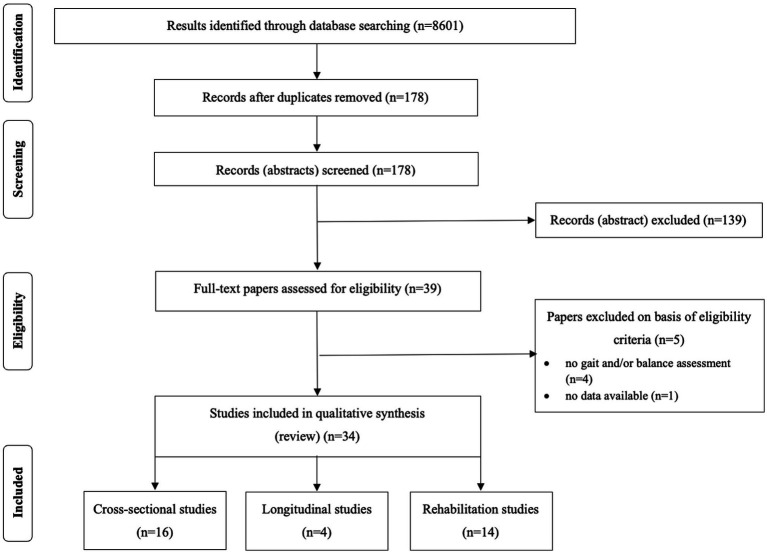
Eighteen gait and balance (16 cross-sectional and 4 longitudinal) and 14 rehabilitation intervention studies were included. Cross-sectional studies showed that people with PSP have impairments in gait initiation and steady-state gait using wearable sensors, and in static and dynamic balance assessed by posturography when compared to Parkinson's disease (PD) and healthy controls. Two longitudinal studies observed that wearable sensors can serve as objective measures of PSP progression, using relevant variables of change in turn velocity, stride length variability, toe off angle, cadence, and cycle duration. Rehabilitation studies investigated the effect of different interventions (e.g., balance training, body-weight supported treadmill gait, sensorimotor training, and cerebellar transcranial magnetic stimulation) on gait, clinical balance, and static and dynamic balance assessed by posturography measurements. No rehabilitation study in PSP used wearable sensors to evaluate gait and balance impairments. Although clinical balance was assessed in 6 rehabilitation studies, 3 of these studies used a quasi-experimental design, 2 used a case series, only 1 study used an experimental design, and sample sizes were relatively small.
Wearable sensors to quantify balance and gait impairments are emerging as a means of documenting progression of PSP. Robust evidence for improving balance and gait in PSP was not found for rehabilitation studies. Future powered, prospective and robust clinical trials are needed to investigate the effects of rehabilitation interventions on objective gait and balance outcomes in people with PSP.
客观步态和平衡指标在非典型帕金森病评估中的应用正在迅速扩展,这些指标为临床观察提供了补充。需要有证据证明康复干预措施能够改善非典型帕金森病患者平衡和步态的客观指标。
我们旨在采用叙述性方法回顾目前关于进行性核上性麻痹(PSP)步态和平衡的客观指标以及运动干预的证据。
在四个计算机化数据库中进行文献检索,检索时间从最早记录到2023年4月:PubMed、ISI的Web of Knowledge、Cochrane图书馆和Embase。提取的数据包括研究类型(横断面研究、纵向研究和康复干预研究)、研究设计(如实验设计和病例系列)、样本特征以及步态和平衡测量结果。
纳入了18项步态和平衡研究(16项横断面研究和4项纵向研究)以及14项康复干预研究。横断面研究表明,与帕金森病(PD)患者和健康对照相比,PSP患者在使用可穿戴传感器进行步态起始和稳态步态评估时存在损伤,在通过姿势描记法评估的静态和动态平衡方面也存在损伤。两项纵向研究观察到,可穿戴传感器可以作为PSP进展的客观指标,通过转弯速度、步幅长度变异性、离地角度、步频和周期持续时间等相关变化变量来衡量。康复研究调查了不同干预措施(如平衡训练、体重支持跑步机步态训练、感觉运动训练和小脑经颅磁刺激)对步态、临床平衡以及通过姿势描记法测量评估的静态和动态平衡的影响。PSP康复研究中没有使用可穿戴传感器来评估步态和平衡损伤。虽然有6项康复研究评估了临床平衡,但其中3项研究采用了准实验设计,2项采用了病例系列,只有1项研究采用了实验设计,且样本量相对较小。
用于量化平衡和步态损伤的可穿戴传感器正在成为记录PSP进展的一种手段。康复研究未发现改善PSP患者平衡和步态的有力证据。未来需要开展有足够动力、前瞻性且有力的临床试验,以研究康复干预对PSP患者客观步态和平衡结果的影响。