
公众偏好异质性与中国农村上消化道癌筛查项目的预期参与率:离散选择实验和潜在类别分析。
Public Preference Heterogeneity and Predicted Uptake Rate of Upper Gastrointestinal Cancer Screening Programs in Rural China: Discrete Choice Experiments and Latent Class Analysis.
机构信息
Center for Health Management and Policy Research, School of Public Health, Cheeloo College of Medicine, Shandong University, Jinan, China.
National Health Commission Key Lab of Health Economics and Policy Research, Shandong University, Jinan, China.
出版信息
JMIR Public Health Surveill. 2023 Jul 10;9:e42898. doi: 10.2196/42898.
BACKGROUND
Rapid increases in the morbidity and mortality of patients with upper gastrointestinal cancer (UGC) in high-incidence countries in Asia have raised public health concerns. Screening can effectively reduce the incidence and mortality of patients with UGC, but the low population uptake rate seriously affects the screening effect.
OBJECTIVE
We aimed to determine the characteristics that influence residents' preference heterogeneity for a UGC-screening program and the extent to which these characteristics predict residents' uptake rates.
METHODS
A discrete choice experiment was conducted in 1000 residents aged 40-69 years who were randomly selected from 3 counties (Feicheng, Linqu, and Dongchangfu) in Shandong Province, China. Each respondent was repeatedly asked to choose from 9 discrete choice questions of 2 hypothetical screening programs comprising 5 attributes: screening interval, screening technique, regular follow-up for precancerous lesions, mortality reduction, and out-of-pocket costs. The latent class logit model was used to estimate residents' preference heterogeneity for each attribute level, their willingness to pay, and the expected uptake rates.
RESULTS
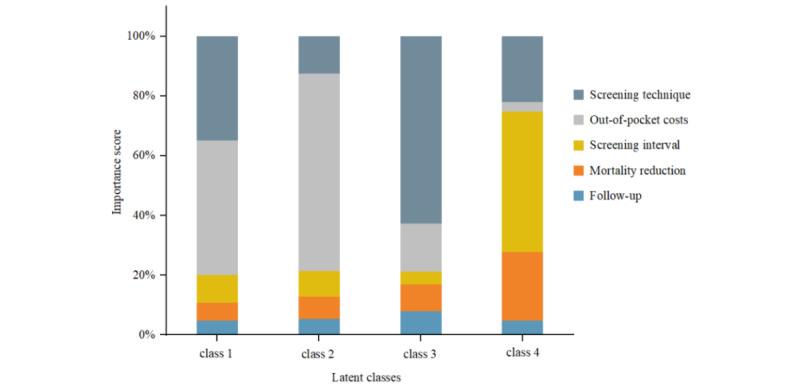
Of the 1000 residents invited, 926 (92.6%) were included in the final analyses. The mean age was 57.32 (SD 7.22) years. The best model contained 4 classes of respondents (Akaike information criterion=7140.989, Bayesian information criterion=7485.373) defined by different preferences for the 5 attributes. In the 4-class model, out of 926 residents, 88 (9.5%) were assigned to class 1, named as the negative latent type; 216 (3.3%) were assigned to class 2, named as the positive integrated type; 434 (46.9%) were assigned to class 3, named as the positive comfortable type; and 188 (20.3%) were assigned to class 4, named as the neutral quality type. For these 4 latent classes, "out-of-pocket cost" is the most preferred attribute in negative latent type and positive integrated type residents (45.04% vs 66.04% importance weights), whereas "screening technique" is the most preferred factor in positive comfortable type residents (62.56% importance weight) and "screening interval" is the most valued attribute in neutral quality type residents (47.05% importance weight). Besides, residents in different classes had common preference for painless endoscopy, and their willingness to pay were CNY ¥385.369 (US $59.747), CNY ¥93.44 (US $14.486), CNY ¥1946.48 (US $301.810), and CNY ¥3566.60 (US $552.961), respectively. Residents' participation rate could increase by more than 89% (except for the 60.98% in class 2) if the optimal UGC screening option with free, follow-up for precancerous lesions, 45% mortality reduction, screening every year, and painless endoscopy was implemented.
CONCLUSIONS
Public preference heterogeneity for UGC screening does exist. Most residents have a positive attitude toward UGC screening, but their preferences vary in selected attributes and levels, except for painless endoscopy. Policy makers should consider these heterogeneities to formulate UGC-screening programs that incorporate the public's needs and preferences to improve participation rates.
背景
亚洲高发国家上消化道癌(UGC)患者的发病率和死亡率迅速上升,引起了公众健康的关注。筛查可以有效降低 UGC 患者的发病率和死亡率,但低人群参与率严重影响了筛查效果。
目的
旨在确定影响居民对 UGC 筛查计划偏好异质性的特征,以及这些特征对居民参与率的预测程度。
方法
在山东省肥城、临朐和东昌府 3 个县随机抽取 1000 名 40-69 岁的居民进行离散选择实验。每个受访者被反复要求从 2 个假设筛查方案的 9 个离散选择问题中进行选择,这两个方案包括 5 个属性:筛查间隔、筛查技术、对癌前病变的定期随访、死亡率降低和自付费用。使用潜在类别逻辑模型来估计居民对每个属性水平的偏好异质性、他们的支付意愿以及预期的参与率。
结果
在邀请的 1000 名居民中,926 名(92.6%)被纳入最终分析。平均年龄为 57.32(SD 7.22)岁。最佳模型包含 4 类受访者(Akaike 信息准则=7140.989,贝叶斯信息准则=7485.373),由 5 个属性的不同偏好定义。在 4 类模型中,926 名居民中,有 88 名(9.5%)被归为第 1 类,命名为消极潜在类型;216 名(3.3%)被归为第 2 类,命名为积极综合类型;434 名(46.9%)被归为第 3 类,命名为积极舒适类型;188 名(20.3%)被归为第 4 类,命名为中性质量类型。对于这 4 个潜在类别,“自付费用”是消极潜在类型和积极综合类型居民最看重的属性(45.04% vs 66.04%的重要性权重),而积极舒适类型居民最看重的是“筛查技术”(62.56%的重要性权重),中性质量类型居民最看重的是“筛查间隔”(47.05%的重要性权重)。此外,不同类别居民对无痛内镜有共同的偏好,他们的支付意愿分别为人民币 385.369 元(59.747 美元)、人民币 93.44 元(14.486 美元)、人民币 1946.48 元(301.810 美元)和人民币 3566.60 元(552.961 美元)。如果实施最佳 UGC 筛查方案,包括免费、癌前病变随访、45%死亡率降低、每年筛查和无痛内镜,居民参与率可提高 89%以上(除第 2 类的 60.98%)。
结论
UGC 筛查确实存在公众偏好异质性。大多数居民对 UGC 筛查持积极态度,但除了无痛内镜外,他们对选定属性和水平的偏好存在差异。政策制定者应考虑这些异质性,制定符合公众需求和偏好的 UGC 筛查计划,以提高参与率。

 Zotero 插件