School of Public Health, Nanjing Medical University, Nanjing, Jiangsu, P.R China.
National Health Commission (NHC) Key Laboratory of Enteric Pathogenic Microbiology, Jiangsu Provincial Center for Disease Control and Prevention, Nanjing, Jiangsu, P.R China.
Hum Vaccin Immunother. 2023 Aug 1;19(2):2230760. doi: 10.1080/21645515.2023.2230760.
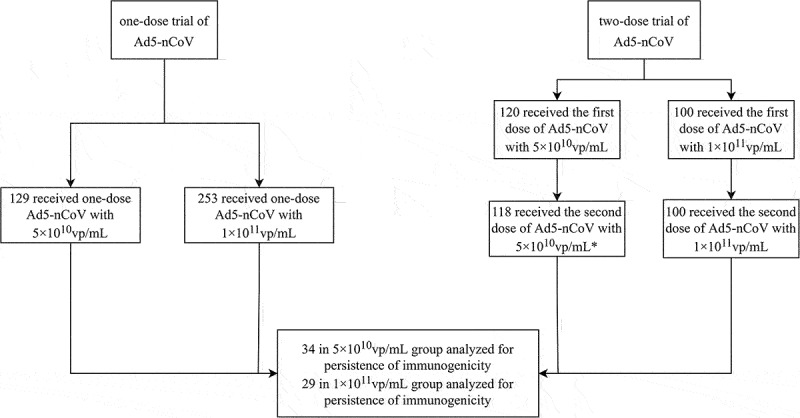
This post-hoc analysis compared the receptor-binding domain (RBD)-specific and pseudovirus neutralizing antibodies against the wild-type SARS-CoV-2 strain elicited by one or two doses (56-d interval) of Ad5-nCoV vaccine regimen (NCT04341389 and NCT04566770). Both trials had low-dose and high-dose groups. Propensity score matching was used to adjust the baseline between one- and two-dose regimens. To predict the decrease in antibody titers 1 y after vaccination, half-lives of RBD-binding antibodies and pseudovirus neutralizing antibodies were computed. We obtained 34 and 29 pairs of participants in the low- and high-dose groups based on the propensity score matching. The two-dose regimen of Ad5-nCoV increased the peaking level of neutralizing antibodies compared to the one-dose regimen at day 28, but the responses of the neutralizing antibodies were not consistent with those of the RBD antibodies. Half-lives of the RBD-binding antibodies in the two-dose Ad5-nCoV regimen (202-209 days) were longer than those in the one-dose regimen (136-137 d); half-lives of the pseudovirus neutralizing antibody in the one-dose Ad5-nCoV regimen (177 d) were longer than those in the two-dose regimen (116-131 d). The predicted positive rates of RBD-binding antibodies in the one-dose regimen (34.1%-38.3%) would be lower than those in the two-dose Ad5-nCoV regimen (67.0%-84.0%), while the positive rates of pseudovirus neutralizing antibodies in the one-dose regimen (65.4%-66.7%) would be higher than those in the two-dose regimen (48.3%-58.0%). The two-dose Ad5-nCoV regimen with a 56-d interval had no effect on the persistence of neutralizing antibodies but slowed decay trend of RBD-binding antibodies.
本事后分析比较了一剂(56 天间隔)和两剂(Ad5-nCoV 疫苗方案的 NCT04341389 和 NCT04566770)Ad5-nCoV 疫苗方案引起的针对野生型 SARS-CoV-2 株的受体结合域(RBD)特异性和假病毒中和抗体。两项试验均有低剂量组和高剂量组。采用倾向评分匹配调整一剂和两剂方案之间的基线。为了预测接种后 1 年抗体滴度的下降,计算了 RBD 结合抗体和假病毒中和抗体的半衰期。根据倾向评分匹配,我们在低剂量和高剂量组中分别获得了 34 对和 29 对参与者。与一剂方案相比,Ad5-nCoV 的两剂方案在第 28 天增加了中和抗体的峰值水平,但中和抗体的反应与 RBD 抗体不一致。两剂 Ad5-nCoV 方案中 RBD 结合抗体的半衰期(202-209 天)长于一剂方案(136-137 天);一剂 Ad5-nCoV 方案中假病毒中和抗体的半衰期(177 天)长于两剂方案(116-131 天)。一剂方案中 RBD 结合抗体的预测阳性率(34.1%-38.3%)将低于两剂 Ad5-nCoV 方案(67.0%-84.0%),而一剂方案中假病毒中和抗体的阳性率(65.4%-66.7%)将高于两剂方案(48.3%-58.0%)。56 天间隔的两剂 Ad5-nCoV 方案对中和抗体的持久性没有影响,但减缓了 RBD 结合抗体的衰减趋势。