Department of Health Policy Planning and Management, School of Public Health, College of Health Sciences, Makerere University- Kampala, Kampala, Uganda.
Department of Statistics and Population Studies, College of Business and Management Studies, Makerere University- Kampala, Kampala, Uganda.
Global Health. 2023 Jul 10;19(1):48. doi: 10.1186/s12992-023-00945-6.
The transition of donor-supported health programmes to country ownership is gaining increasing attention due to reduced development assistance for health globally. It is further accelerated by the ineligibility of previously Low-Income Countries' elevation into Middle-income status. Despite the increased attention, little is known about the long-term impact of this transition on the continuity of maternal and child health service provision. Hence, we conducted this study to explore the impact of donor transition on the continuity of maternal and newborn health service provision at the sub-national level in Uganda between 2012 and 2021.
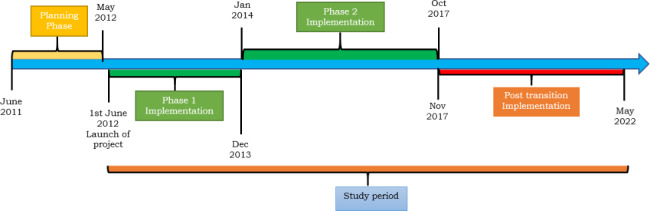
We conducted a qualitative case study of the Rwenzori sub-region in mid-western Uganda which benefited from a USAID project to reduce maternal and newborn deaths between 2012 and 2016. We purposively sampled three districts. Data were collected between January and May 2022 among subnational key informants (n = 26), national level key informants at the Ministry of Health [3], national level donor representatives [3] and subnational level donor representatives [4] giving a total of 36 respondents. Thematic analysis was deductively conducted with findings structured along the WHO's health systems building blocks (Governance, Human resources for health, Health financing, Health information systems, medical products, Vaccines and Technologies and service delivery) framework.
Overall, continuity of maternal and newborn health service provision was to a greater extent maintained post-donor support. The process was characterised by a phased implementation approach. The embedded learning offered the opportunity to plough back lessons into intervention modification which reflected contextual adaptation. The availability of successor grants from other donors (such as Belgian ENABEL), counterpart funding from the government to bridge the gaps left behind, absorption of USAID-project salaried workforce (such as midwives) onto the public sector payroll, harmonisation of salary structures, the continued use of infrastructure (such as newborn intensive care units), and support for MCH services under PEPFAR support post-transition contributed to the maintenance of coverage. The demand creation for MCH services pre-transition ensured patient demand post-transition. Challenges to the maintenance of coverage were drug stockouts and sustainability of the private sector component among others.
A general perception of the continuity of maternal and newborn health service provision post-donor transition was observed with internal (government counterpart funding) and external enablers (successor donor funding) contributing to this performance. Opportunities for the continuity of maternal and newborn service delivery performance post-transition exist when harnessed well within the prevailing context. The ability to learn and adapt, the presence of government counterpart funding and commitment to carry on with implementation were major ingredients signalling a crucial role of government in the continuity of service provision post-transition.
由于全球卫生发展援助减少,受捐助者支持的卫生方案向国家所有权过渡的问题越来越受到关注。这一趋势进一步加速,因为以前的低收入国家提升为中等收入国家,使其失去了获得援助的资格。尽管越来越关注这一问题,但对于这种过渡对母婴保健服务提供的连续性的长期影响,人们知之甚少。因此,我们进行了这项研究,以探讨在 2012 年至 2021 年期间,捐助者过渡对乌干达次国家一级母婴保健服务提供的连续性的影响。
我们对乌干达中西部的鲁文佐里地区进行了一项定性案例研究,该地区受益于美国国际开发署(USAID)在 2012 年至 2016 年期间开展的一个旨在减少母婴死亡的项目。我们在三个地区进行了有针对性的抽样。2022 年 1 月至 5 月期间,我们在次国家一级与关键利益攸关方(n=26)、卫生部的国家一级关键利益攸关方[3]、国家一级捐助方代表[3]和次国家一级捐助方代表[4]进行了访谈,共 36 名受访者。我们采用了演绎式主题分析方法,研究结果按照世卫组织的卫生系统构建模块(治理、卫生人力、卫生筹资、卫生信息系统、药品、疫苗和技术以及服务提供)框架进行了构建。
总体而言,母婴保健服务的提供在很大程度上得以维持。这一过程的特点是采用了分阶段实施的方法。所提供的嵌入式学习机会使人们能够将经验教训纳入干预措施的修改之中,从而反映出对具体情况的适应。其他捐助者(如比利时 ENABEL)提供的后续赠款、政府提供的弥补缺口的配套资金、将美国国际开发署项目中的受薪工作人员(如助产士)纳入公共部门工资单、统一工资结构、继续使用基础设施(如新生儿重症监护室),以及在过渡后继续支持母婴健康服务的 PEPFAR 支持,都有助于维持服务的覆盖面。在过渡前创造母婴保健服务需求确保了过渡后患者的需求。药物库存不足和私营部门部分的可持续性等因素对覆盖面的维持构成了挑战。
人们普遍认为,在内部(政府配套资金)和外部(后继捐助者资金)因素的推动下,母婴保健服务的提供在捐助者过渡后得以继续。在现有背景下,充分利用这些机会,就有可能保持母婴服务提供的连续性。学习和适应的能力、政府配套资金的存在以及继续实施的承诺,都是政府在过渡后继续提供服务方面发挥关键作用的主要因素。
