Department of Epidemiology, Erasmus MC University Medical Center, Dr Molewaterplein 40, 3015 GD, Rotterdam, The Netherlands.
Vall d'Hebron Institute of Oncology (VHIO), 08035, Barcelona, Spain.
Hum Genomics. 2023 Jul 10;17(1):61. doi: 10.1186/s40246-023-00504-5.
MicroRNAs (miRNAs) are post-transcriptional regulators of gene expression. Differential miRNA expression, which is widely shown to be associated with the pathogenesis of various diseases, can be influenced by lifestyle factors, including smoking. This study aimed to investigate the plasma miRNA signature of smoking habits, the potential effect of smoking cessation on miRNA levels, and relate the findings with lung cancer incidence.
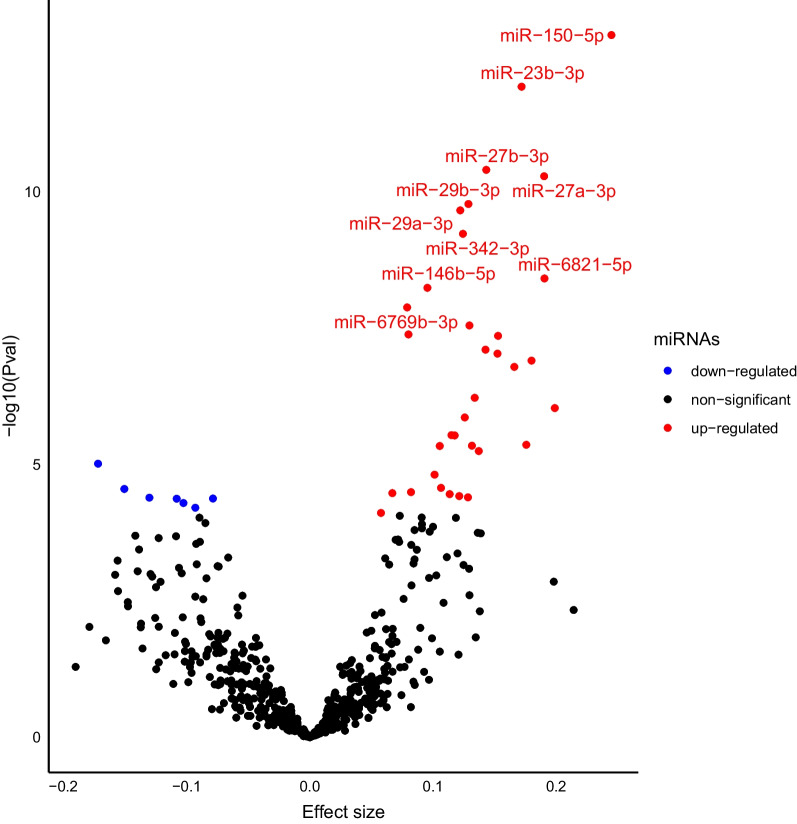
A targeted RNA-sequencing approach measured plasma miRNA levels in 2686 participants from the population-based Rotterdam study cohort. The association between cigarette smoking (current versus never) and 591 well-expressed miRNAs was assessed via adjusted linear regression models, identifying 41 smoking-associated miRNAs that passed the Bonferroni-corrected threshold (P < 0.05/591 = 8.46 × 10). Moreover, we found 42 miRNAs with a significant association (P < 8.46 × 10) between current (reference group) and former smokers. Then, we used adjusted linear regression models to explore the effect of smoking cessation time on miRNA expression levels. The expression levels of two miRNAs were significantly different within 5 years of cessation (P < 0.05/41 = 1.22 × 10) from current smokers, while for cessation time between 5 and 15 years we found 19 miRNAs to be significantly different from current smokers, and finally, 38 miRNAs were significantly different after more than 15 years of cessation time (P < 1.22 × 10). These results imply the reversibility of the smoking effect on plasma levels of at least 38 out of the 41 smoking-miRNAs following smoking cessation. Next, we found 8 out of the 41 smoking-related miRNAs to be nominally associated (P < 0.05) with the incidence of lung cancer.
This study demonstrates smoking-related dysregulation of plasma miRNAs, which might have a potential for reversibility when comparing different smoking cessation groups. The identified miRNAs are involved in several cancer-related pathways and include 8 miRNAs associated with lung cancer incidence. Our results may lay the groundwork for further investigation of miRNAs as potential mechanism linking smoking, gene expression and cancer.
微小 RNA(miRNA)是基因表达的转录后调控因子。广泛表明,miRNA 的差异表达与各种疾病的发病机制有关,而生活方式因素,包括吸烟,会对其产生影响。本研究旨在探讨吸烟习惯的血浆 miRNA 特征、戒烟对 miRNA 水平的潜在影响,并将这些发现与肺癌的发生联系起来。
采用靶向 RNA 测序方法测量了来自基于人群的鹿特丹研究队列的 2686 名参与者的血浆 miRNA 水平。通过调整后的线性回归模型评估了吸烟(当前与从不)与 591 个表达良好的 miRNA 之间的关联,确定了 41 个通过 Bonferroni 校正阈值(P < 0.05/591 = 8.46×10)的与吸烟相关的 miRNA。此外,我们还发现了 42 个与当前吸烟者(参考组)和前吸烟者之间具有显著关联(P < 8.46×10)的 miRNA。然后,我们使用调整后的线性回归模型来探索戒烟时间对 miRNA 表达水平的影响。在停止吸烟 5 年内,有两个 miRNA 的表达水平有显著差异(P < 0.05/41 = 1.22×10),而在停止吸烟 5 至 15 年内,有 19 个 miRNA 与当前吸烟者有显著差异,最后,在停止吸烟 15 年以上后,有 38 个 miRNA 有显著差异(P < 1.22×10)。这些结果表明,至少有 38 个与吸烟相关的 miRNA (41 个 miRNA 中的 38 个)在戒烟后其血浆水平的吸烟效应具有逆转性。接下来,我们发现了 41 个与吸烟相关的 miRNA 中有 8 个与肺癌的发病率有显著关联(P < 0.05)。
本研究表明,吸烟会导致血浆 miRNA 的失调,而在比较不同的戒烟组时,这种失调可能具有逆转性。所鉴定的 miRNA 参与了几个与癌症相关的途径,包括 8 个与肺癌发病率相关的 miRNA。我们的研究结果可能为进一步研究 miRNA 作为吸烟、基因表达和癌症之间潜在机制的联系奠定基础。