Department of Epidemiology, Erasmus MC University Medical Center, Rotterdam, The Netherlands.
Vall d'Hebron Institute of Oncology (VHIO), Barcelona, Spain.
J Nutr. 2023 Jan 14;152(12):2677-2688. doi: 10.1093/jn/nxac216.
MicroRNAs (miRNAs) represent a class of noncoding RNAs that regulate gene expression and are implicated in the pathogenesis of different diseases. Alcohol consumption might affect the expression of miRNAs, which in turn could play a role in risk of diseases.
We investigated whether plasma concentrations of miRNAs are altered by alcohol consumption. Given the existing evidence showing the link between alcohol and liver diseases, we further explored the extent to which these associations are mediated by miRNAs.
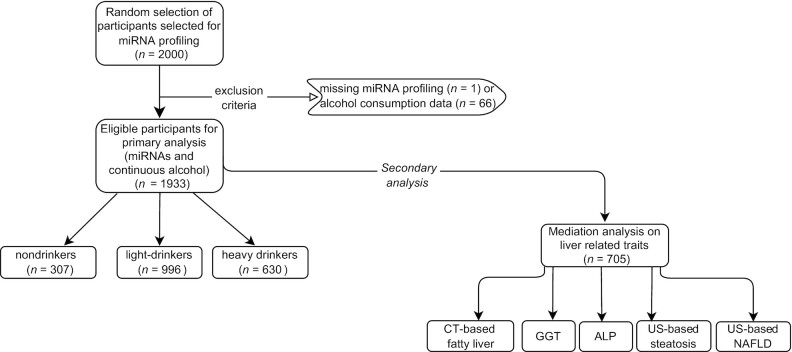
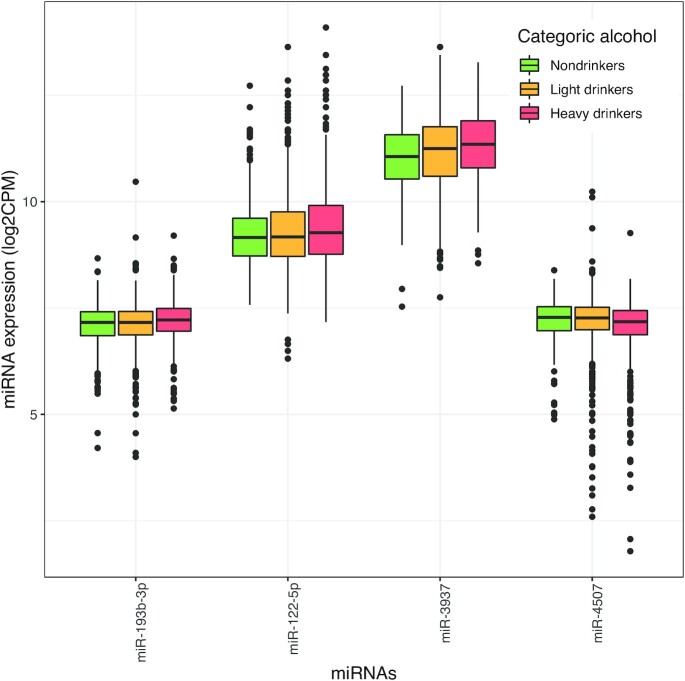
Profiling of plasma miRNAs was conducted using the HTG EdgeSeq miRNA Whole Transcriptome Assay in 1933 participants of the Rotterdam Study. Linear regression was implemented to explore the link between alcohol consumption (glasses/d) and miRNA concentrations, adjusted for age, sex, cohort, BMI, and smoking. Sensitivity analysis for alcohol categories (nondrinkers, light drinkers, and heavy drinkers) was performed, where light drinkers corresponded to 0-2 glasses/d in men and 0-1 glasses/d in women, and heavy drinkers to >2 glasses/d in men and >1 glass/d in women. Moreover, we utilized the alcohol-associated miRNAs to explore their potential mediatory role between alcohol consumption and liver-related traits. Finally, we retrieved putative target genes of identified miRNAs to gain an understanding of the molecular pathways concerning alcohol consumption.
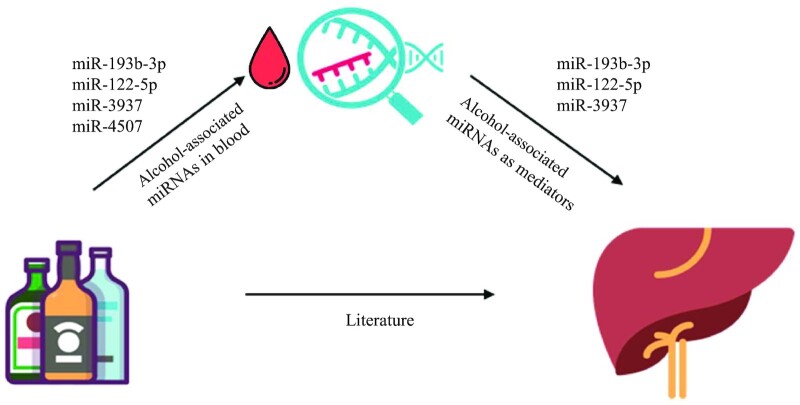
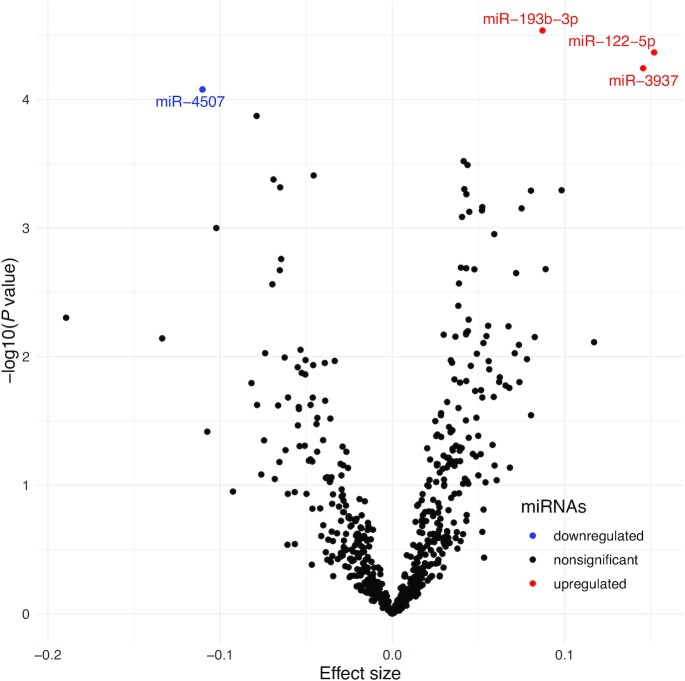
Plasma concentrations of miR-193b-3p, miR-122-5p, miR-3937, and miR-4507 were significantly associated with alcohol consumption surpassing the Bonferroni-corrected P < 8.46 × 10⁻⁵. The top significant association was observed for miR-193b-3p (β = 0.087, P = 2.90 × 10⁻⁵). Furthermore, a potential mediatory role of miR-3937 and miR-122-5p was observed between alcohol consumption and liver traits. Pathway analysis of putative target genes revealed involvement in biological regulation and cellular processes.
This study indicates that alcohol consumption is associated with plasma concentrations of 4 miRNAs. We outline a potential mediatory role of 2 alcohol-associated miRNAs (miR-3937 and miR-122-5p), laying the groundwork for further exploration of miRNAs as potential mediators between lifestyle factors and disease development.
微小 RNA(miRNA)是一类非编码 RNA,可调节基因表达,与多种疾病的发病机制有关。饮酒可能会影响 miRNA 的表达,进而可能在疾病风险中发挥作用。
我们研究了饮酒是否会改变血浆 miRNA 的浓度。鉴于现有证据表明酒精与肝脏疾病之间存在关联,我们进一步探讨了这些关联在多大程度上是由 miRNA 介导的。
使用 HTG EdgeSeq miRNA 全转录组分析在鹿特丹研究中的 1933 名参与者中进行血浆 miRNA 分析。线性回归用于探索饮酒(杯/天)与 miRNA 浓度之间的关系,调整年龄、性别、队列、BMI 和吸烟因素。对饮酒类别(不饮酒者、轻度饮酒者和重度饮酒者)进行了敏感性分析,其中男性轻度饮酒者为 0-2 杯/天,女性为 0-1 杯/天,男性重度饮酒者为 >2 杯/天,女性为 >1 杯/天。此外,我们利用与酒精相关的 miRNA 来探讨它们在酒精摄入与肝脏相关特征之间的潜在中介作用。最后,我们检索了已鉴定 miRNA 的潜在靶基因,以了解与酒精摄入相关的分子途径。
miR-193b-3p、miR-122-5p、miR-3937 和 miR-4507 的血浆浓度与饮酒显著相关,超过 Bonferroni 校正 P < 8.46 × 10⁻⁵。miR-193b-3p 的最高显著关联(β = 0.087,P = 2.90 × 10⁻⁵)。此外,miR-3937 和 miR-122-5p 在饮酒与肝脏特征之间可能具有潜在的中介作用。假定靶基因的通路分析显示其参与了生物调节和细胞过程。
本研究表明,饮酒与 4 种 miRNA 的血浆浓度有关。我们概述了 2 种与酒精相关的 miRNA(miR-3937 和 miR-122-5p)的潜在中介作用,为进一步探索 miRNA 作为生活方式因素与疾病发展之间的潜在中介物奠定了基础。