Department of Computer Science and Engineering, Chittagong University of Engineering & Technology, Chattogram 4349, Bangladesh.
Department of Computer Science and Engineering, International Islamic University Chittagong, Chattogram 4318, Bangladesh.
Sensors (Basel). 2023 May 18;23(10):4875. doi: 10.3390/s23104875.
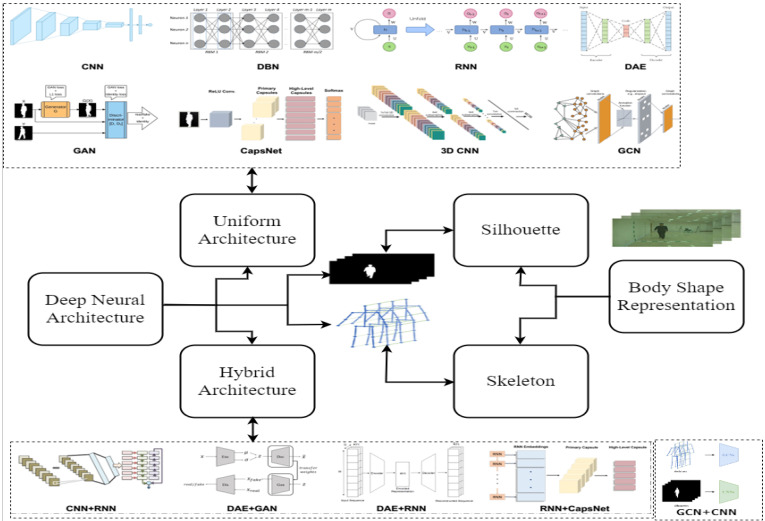
Gait recognition, also known as walking pattern recognition, has expressed deep interest in the computer vision and biometrics community due to its potential to identify individuals from a distance. It has attracted increasing attention due to its potential applications and non-invasive nature. Since 2014, deep learning approaches have shown promising results in gait recognition by automatically extracting features. However, recognizing gait accurately is challenging due to the covariate factors, complexity and variability of environments, and human body representations. This paper provides a comprehensive overview of the advancements made in this field along with the challenges and limitations associated with deep learning methods. For that, it initially examines the various gait datasets used in the literature review and analyzes the performance of state-of-the-art techniques. After that, a taxonomy of deep learning methods is presented to characterize and organize the research landscape in this field. Furthermore, the taxonomy highlights the basic limitations of deep learning methods in the context of gait recognition. The paper is concluded by focusing on the present challenges and suggesting several research directions to improve the performance of gait recognition in the future.
步态识别,又称行走模式识别,由于能够远距离识别个体,引起了计算机视觉和生物识别领域的浓厚兴趣。由于其潜在的应用和非侵入性,步态识别受到了越来越多的关注。自 2014 年以来,深度学习方法通过自动提取特征,在步态识别方面取得了有前景的成果。然而,由于协变量因素、环境的复杂性和可变性以及人体表示,准确识别步态具有挑战性。本文全面概述了该领域的最新进展,以及深度学习方法所面临的挑战和局限性。为此,它首先检查了文献综述中使用的各种步态数据集,并分析了最先进技术的性能。然后,提出了一种深度学习方法分类法,以描述和组织该领域的研究格局。此外,该分类法强调了深度学习方法在步态识别背景下的基本局限性。最后,本文重点关注当前的挑战,并提出了几个研究方向,以提高未来步态识别的性能。