Institute of Brain Science, Brain Research Center, and Sleep Research Center, National Yang Ming Chiao Tung University, No. 155, Sec. 2, Li-Nong St., Taipei, 11221, Taiwan.
Sleep Research Center, National Yang Ming Chiao Tung University, Taipei, Taiwan.
Sci Rep. 2023 Jul 11;13(1):11231. doi: 10.1038/s41598-023-38214-6.
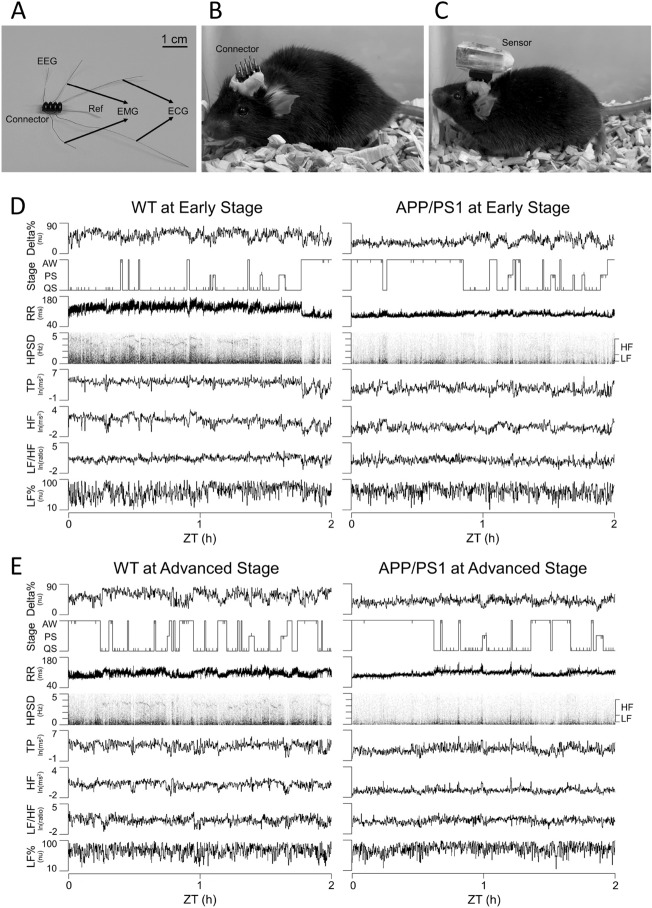
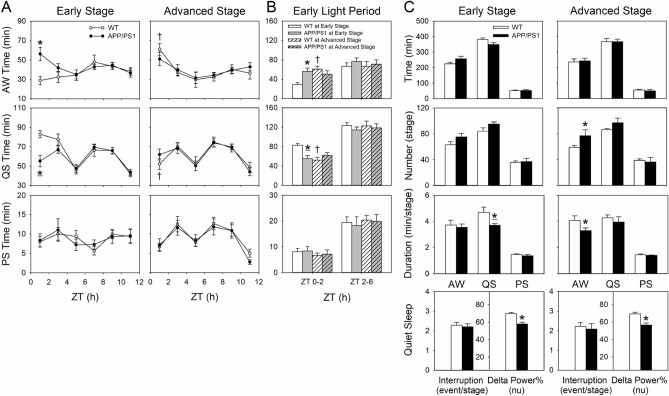
Occurrence of amyloid-β (Aβ) aggregation in brain begins before the clinical onset of Alzheimer's disease (AD), as preclinical AD. Studies have reported that sleep problems and autonomic dysfunction associate closely with AD. However, whether they, especially the interaction between sleep and autonomic function, play critical roles in preclinical AD are unclear. Therefore, we investigated how sleep patterns and autonomic regulation at different sleep-wake stages changed and whether they were related to cognitive performance in pathogenesis of AD mice. Polysomnographic recordings in freely-moving APP/PS1 and wild-type (WT) littermates were collected to study sleep patterns and autonomic function at 4 (early disease stage) and 8 months of age (advanced disease stage), cognitive tasks including novel object recognition and Morris water maze were performed, and Aβ levels in brain were measured. APP/PS1 mice at early stage of AD pathology with Aβ aggregation but without significant differences in cognitive performance had frequent sleep-wake transitions, lower sleep-related delta power percentage, lower overall autonomic activity, and lower parasympathetic activity mainly during sleep compared with WT mice. The same phenomenon was observed in advanced-stage APP/PS1 mice with significant cognitive deficits. In mice at both disease stages, sleep-related delta power percentage correlated positively with memory performance. At early stage, memory performance correlated positively with sympathetic activity during wakefulness; at advanced stage, memory performance correlated positively with parasympathetic activity during both wakefulness and sleep. In conclusion, sleep quality and distinction between wake- and sleep-related autonomic function may be biomarkers for early AD detection.
淀粉样蛋白-β(Aβ)在阿尔茨海默病(AD)临床发病前就开始聚集,这一阶段被称为临床前 AD。研究表明,睡眠问题和自主神经功能障碍与 AD 密切相关。然而,它们是否——尤其是睡眠和自主神经功能之间的相互作用——在临床前 AD 中起着关键作用还不清楚。因此,我们研究了 AD 模型小鼠在疾病发生过程中不同睡眠-觉醒阶段的睡眠模式和自主神经调节如何变化,以及它们与认知表现是否相关。我们对自由活动的 APP/PS1 小鼠及其野生型(WT)同窝仔鼠进行多导睡眠描记术记录,以研究 4 个月(疾病早期)和 8 个月(疾病晚期)时的睡眠模式和自主神经功能,同时进行新物体识别和 Morris 水迷宫等认知任务,并测量大脑中的 Aβ 水平。在 AD 病理早期有 Aβ聚集但认知表现无显著差异的 APP/PS1 小鼠,与 WT 小鼠相比,睡眠-觉醒转换频繁,睡眠相关的 δ 功率百分比较低,整体自主神经活动较低,主要在睡眠期间副交感神经活动较低。在有明显认知缺陷的晚期 APP/PS1 小鼠中也观察到了同样的现象。在两个疾病阶段的小鼠中,睡眠相关的 δ 功率百分比与记忆表现呈正相关。在早期,记忆表现与清醒时的交感神经活动呈正相关;在晚期,记忆表现与清醒和睡眠时的副交感神经活动呈正相关。总之,睡眠质量和睡眠与觉醒相关的自主神经功能之间的差异可能是早期 AD 检测的生物标志物。