Department of Obstetrics and Gynecology, The Third Affiliated Hospital of Guangzhou Medical University, Guangzhou, China.
Guangdong Provincial Key Laboratory of Major Obstetric Diseases; Guangdong Provincial Clinical Research Center for Obstetrics and Gynecology; Guangdong-Hong Kong-Macao Greater Bay Area Higher Education Joint Laboratory of Maternal-Fetal Medicine, The Third Affiliated Hospital of Guangzhou Medical University, Guangzhou, China.
BMC Pregnancy Childbirth. 2023 Jul 11;23(1):508. doi: 10.1186/s12884-023-05784-2.
Placenta accreta spectrum (PAS) disorder is a major cause of postpartum hemorrhage-associated maternal and fetal death, and novel methods for PAS screening are urgently needed for clinical application.
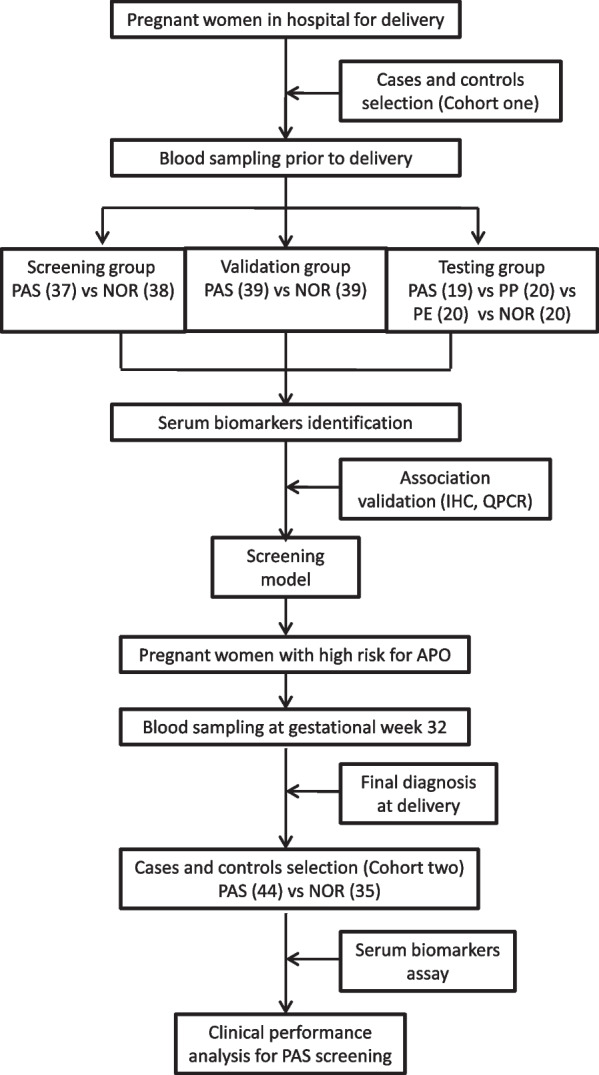
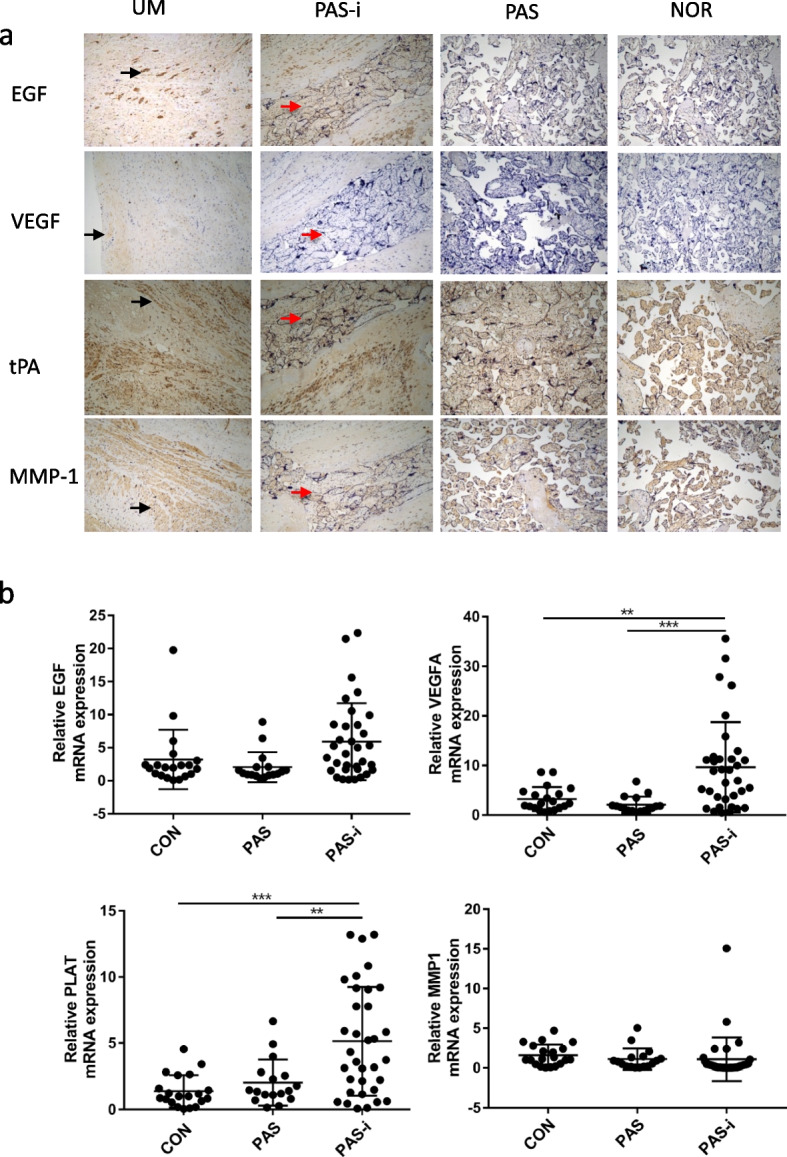
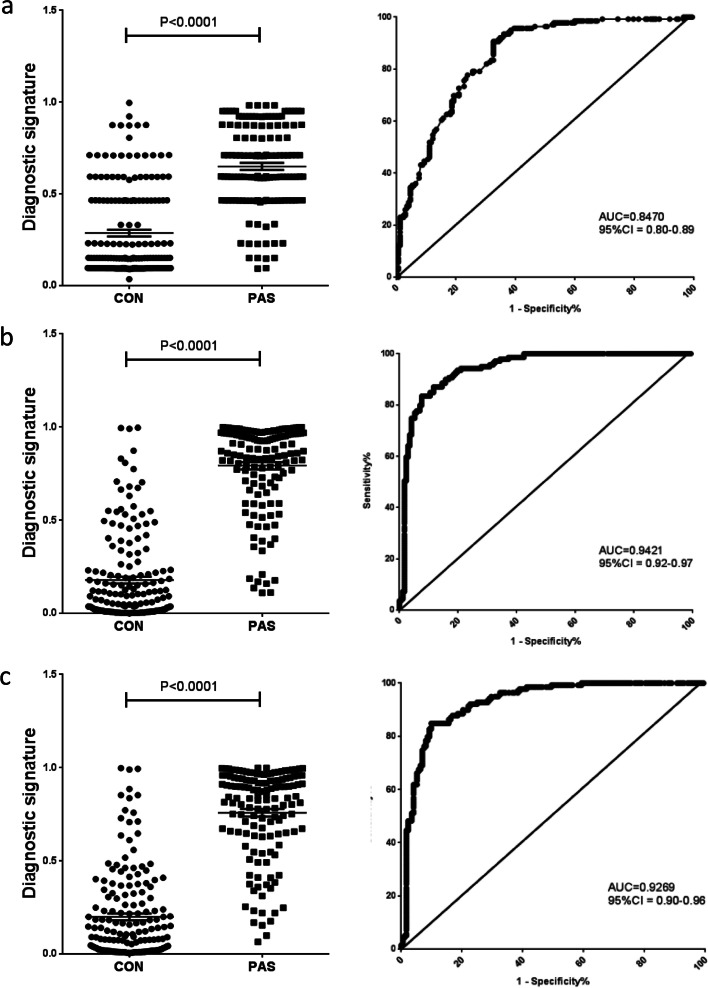
The purpose of this study was to develop new methods for PAS screening using serum biomarkers and clinical indicators. A total of 95 PAS cases and 137 controls were enrolled in a case-control study as cohort one, and 44 PAS cases and 35 controls in a prospective nested case-control study were enrolled as cohort two. All subjects were pregnant women of Chinese Han population. Biomarkers for PAS from maternal blood samples were screened based on high-throughput immunoassay and were further validated in three phases of cohort one. Screening models for PAS were generated using maternal serum biomarkers and clinical indicators, and were validated in two cohorts. The expression levels of biomarkers were analyzed using histopathological and immunohistochemical (IHC) techniques, and gene expression was examined by QPCR in the human placenta. Binary logistic regression models were built, and the area under the curve (AUC), sensitivity, specificity, and Youden index were calculated. Statistical analyses and model building were performed in SPSS and graphs were generated in GraphPad Prism. The independent-sample t test was used to compare numerical data between two groups. For nonparametric variables, a Mann-Whitney U test or a X test was used.
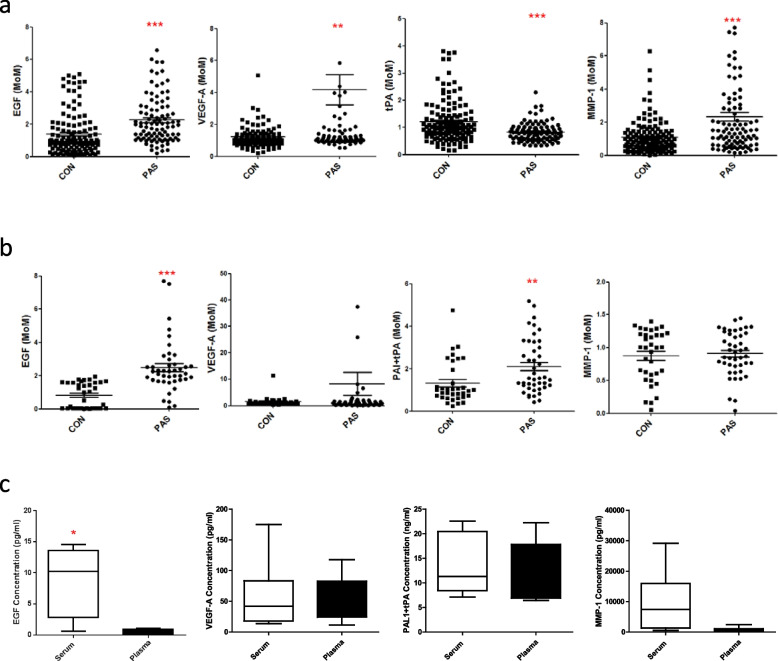
The results demonstrated that the serum levels of matrix metalloproteinase-1 (MMP-1), epidermal growth factor (EGF), and vascular endothelial growth factor-A (VEGF-A) were consistently higher, while the level of tissue-type plasminogen activator (tPA) was significantly lower in PAS patients compared with normal term controls and patients with pre-eclampsia (PE) and placenta previa (PP). IHC and QPCR analysis confirmed that the expression of the identified biomarkers significantly changed during the third trimester in human placenta. The generated screening model combining serum biomarkers and clinical indicators detected 87% of PAS cases with AUC of 0.94.
Serum biomarkers can be used for PAS screening with low expense and high clinical performance; therefore, it may help to develop a practicable method for clinical prenatal PAS screening.
胎盘部位滋养细胞肿瘤谱(PAS)疾病是产后出血相关母婴死亡的主要原因,迫切需要新的方法进行 PAS 筛查以供临床应用。
本研究旨在使用血清生物标志物和临床指标开发 PAS 筛查的新方法。共纳入 95 例 PAS 病例和 137 例对照进行病例对照研究作为队列 1,纳入 44 例 PAS 病例和 35 例对照进行前瞻性巢式病例对照研究作为队列 2。所有受试者均为汉族孕妇。基于高通量免疫测定法筛选来自母体血液样本的 PAS 生物标志物,并在队列 1 的三个阶段进行进一步验证。使用母体血清生物标志物和临床指标生成 PAS 筛查模型,并在两个队列中进行验证。使用组织病理学和免疫组织化学(IHC)技术分析生物标志物的表达水平,并通过 QPCR 检查人胎盘的基因表达。建立二项逻辑回归模型,计算曲线下面积(AUC)、敏感性、特异性和 Youden 指数。统计分析和模型构建在 SPSS 中进行,图形在 GraphPad Prism 中生成。两组间数值数据的比较采用独立样本 t 检验。对于非参数变量,使用 Mann-Whitney U 检验或 X 检验。
结果表明,与正常足月对照组和子痫前期(PE)和前置胎盘(PP)患者相比,PAS 患者的基质金属蛋白酶-1(MMP-1)、表皮生长因子(EGF)和血管内皮生长因子-A(VEGF-A)血清水平持续升高,而组织型纤溶酶原激活物(tPA)水平显著降低。IHC 和 QPCR 分析证实,在人胎盘的第三个三个月中,鉴定的生物标志物的表达明显改变。结合血清生物标志物和临床指标的生成筛查模型检测到 87%的 PAS 病例,AUC 为 0.94。
血清生物标志物可用于 PAS 筛查,费用低,临床性能高;因此,它可能有助于开发一种可行的临床产前 PAS 筛查方法。