Alsahafi Akram, Ling Davina Li Xin, Newell Micheál, Kropmans Thomas
College of Medicine, Nursing and Health Sciences - School of Medicine, National University of Ireland, Galway, Galway, Galway. Co, H91 V4AY, Ireland.
Department of Medical Education, College of Medicine, Taif University, Saudi Arabia, P.O Box 11099, Taif 21944, Saudi Arabia.
MedEdPublish (2016). 2023 Jun 19;12:11. doi: 10.12688/mep.18940.2. eCollection 2022.
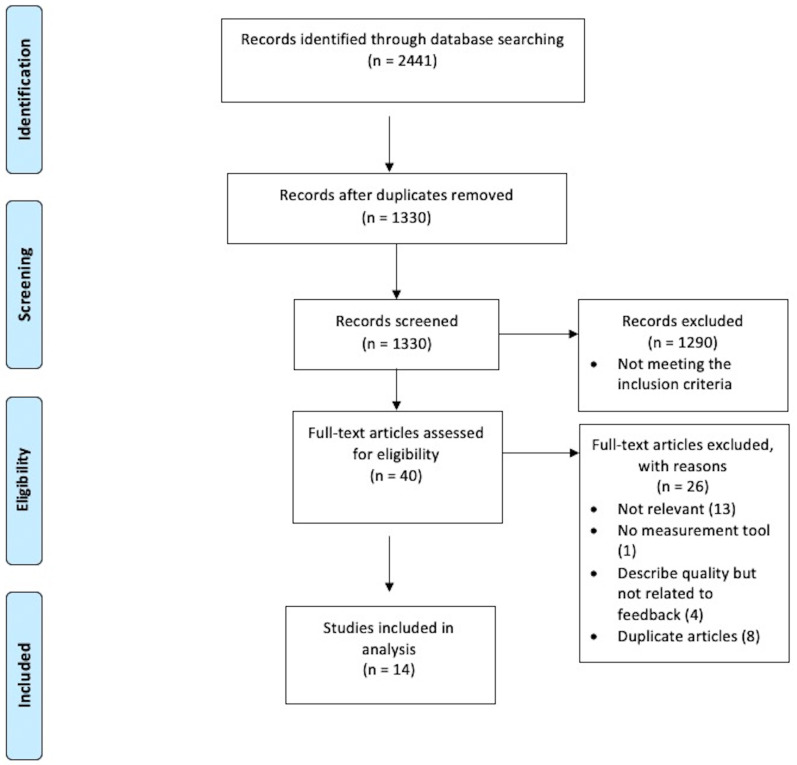
Objective Structured Clinical Examination (OSCE) is a valid tool to assess the clinical skills of medical students. Feedback after OSCE is essential for student improvement and safe clinical practice. Many examiners do not provide helpful or insightful feedback in the text space provided after OSCE stations, which may adversely affect learning outcomes. The aim of this systematic review was to identify the best determinants for quality written feedback in the field of medicine. Methods: PubMed, Medline, Embase, CINHAL, Scopus, and Web of Science were searched for relevant literature up to February 2021. We included studies that described the quality of good/effective feedback in clinical skills assessment in the field of medicine. Four independent reviewers extracted determinants used to assess the quality of written feedback. The percentage agreement and kappa coefficients were calculated for each determinant. The ROBINS-I (Risk Of Bias In Non-randomized Studies of Interventions) tool was used to assess the risk of bias.
14 studies were included in this systematic review. 10 determinants were identified for assessing feedback. The determinants with the highest agreement among reviewers were specific, described gap, balanced, constructive and behavioural; with kappa values of 0.79, 0.45, 0.33, 0.33 and 0.26 respectively. All other determinants had low agreement (kappa values below 0.22) indicating that even though they have been used in the literature, they might not be applicable for good quality feedback. The risk of bias was low or moderate overall.
This work suggests that good quality written feedback should be specific, balanced, and constructive in nature, and should describe the gap in student learning as well as observed behavioural actions in the exams. Integrating these determinants in OSCE assessment will help guide and support educators for providing effective feedback for the learner.
客观结构化临床考试(OSCE)是评估医学生临床技能的有效工具。OSCE后的反馈对于学生的进步和安全临床实践至关重要。许多考官在OSCE考站后的文本空间中没有提供有用或有见地的反馈,这可能会对学习成果产生不利影响。本系统评价的目的是确定医学领域高质量书面反馈的最佳决定因素。
检索了截至2021年2月的PubMed、Medline、Embase、CINHAL、Scopus和Web of Science等数据库中的相关文献。我们纳入了描述医学领域临床技能评估中良好/有效反馈质量的研究。四位独立评审员提取了用于评估书面反馈质量的决定因素。计算每个决定因素的百分比一致性和kappa系数。使用ROBINS-I(干预非随机研究中的偏倚风险)工具评估偏倚风险。
本系统评价纳入了14项研究。确定了10个评估反馈的决定因素。评审员之间一致性最高的决定因素是具体的、描述差距的、平衡的、建设性的和行为方面的;kappa值分别为0.79、0.45、0.33、0.33和0.26。所有其他决定因素的一致性较低(kappa值低于0.22),这表明尽管它们已在文献中使用,但可能不适用于高质量反馈。总体偏倚风险较低或中等。
这项工作表明,高质量的书面反馈应具有针对性、平衡性和建设性,应描述学生学习中的差距以及考试中观察到的行为表现。将这些决定因素纳入OSCE评估将有助于指导和支持教育工作者为学习者提供有效的反馈。