• 文献检索
  • 文档翻译
  • 深度研究
  • 学术资讯
  • Suppr Zotero 插件Zotero 插件
  • 邀请有礼
  • 套餐&价格
  • 历史记录
应用&插件
Suppr Zotero 插件Zotero 插件浏览器插件Mac 客户端Windows 客户端微信小程序
定价
高级版会员购买积分包购买API积分包
服务
文献检索文档翻译深度研究API 文档MCP 服务
关于我们
关于 Suppr公司介绍联系我们用户协议隐私条款
关注我们

Suppr 超能文献

核心技术专利:CN118964589B侵权必究
粤ICP备2023148730 号-1Suppr @ 2026

文献检索

告别复杂PubMed语法,用中文像聊天一样搜索,搜遍4000万医学文献。AI智能推荐,让科研检索更轻松。

立即免费搜索

文件翻译

保留排版,准确专业,支持PDF/Word/PPT等文件格式,支持 12+语言互译。

免费翻译文档

深度研究

AI帮你快速写综述,25分钟生成高质量综述,智能提取关键信息,辅助科研写作。

立即免费体验

新生儿重症监护病房耐多药菌医院感染预测风险模型的构建与验证:一项多中心观察性研究

Construction and validation of a predictive risk model for nosocomial infections with MDRO in NICUs: a multicenter observational study.

作者信息

Zhou Jinyan, Luo Feixiang, Liang Jianfeng, Cheng Xiaoying, Chen Xiaofei, Li Linyu, Chen Shuohui

机构信息

Administration Department of Nosocomial Infection, Children's Hospital, Zhejiang University School of Medicine, National Clinical Research Center for Child Health, Hangzhou, China.

Neonatal Intensive Care Unit, Children's Hospital, Zhejiang University School of Medicine, National Clinical Research Center for Child Health, Hangzhou, China.

出版信息

Front Med (Lausanne). 2023 Jun 26;10:1193935. doi: 10.3389/fmed.2023.1193935. eCollection 2023.

DOI:10.3389/fmed.2023.1193935
PMID:37435538
原文链接:https://pmc.ncbi.nlm.nih.gov/articles/PMC10332151/
Abstract

OBJECTIVES

This study aimed to construct and validate a predictive risk model (PRM) for nosocomial infections with multi-drug resistant organism (MDRO) in neonatal intensive care units (NICUs), in order to provide a scientific and reliable prediction tool, and to provide reference for clinical prevention and control of MDRO infections in NICUs.

METHODS

This multicenter observational study was conducted at NICUs of two tertiary children's hospitals in Hangzhou, Zhejiang Province. Using cluster sampling, eligible neonates admitted to NICUs of research hospitals from January 2018 to December 2020 (modeling group) or from July 2021 to June 2022 (validation group) were included in this study. Univariate analysis and binary logistic regression analysis were used to construct the PRM. H-L tests, calibration curves, ROC curves and decision curve analysis were used to validate the PRM.

RESULTS

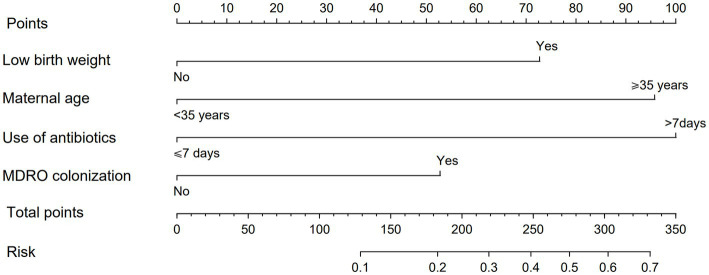
Four hundred and thirty-five and one hundred fourteen neonates were enrolled in the modeling group and validation group, including 89 and 17 neonates infected with MDRO, respectively. Four independent risk factors were obtained and the PRM was constructed, namely: P = 1/ (1+ ),  = -4.126 + 1.089× (low birth weight) +1.435× (maternal age ≥ 35 years) +1.498× (use of antibiotics >7 days) + 0.790× (MDRO colonization). A nomogram was drawn to visualize the PRM. Through internal and external validation, the PRM had good fitting degree, calibration, discrimination and certain clinical validity. The prediction accuracy of the PRM was 77.19%.

CONCLUSION

Prevention and control strategies for each independent risk factor can be developed in NICUs. Moreover, clinical staff can use the PRM to early identification of neonates at high risk, and do targeted prevention to reduce MDRO infections in NICUs.

摘要

目的

本研究旨在构建并验证新生儿重症监护病房(NICU)耐多药菌(MDRO)医院感染的预测风险模型(PRM),以提供科学可靠的预测工具,为NICU中MDRO感染的临床预防与控制提供参考。

方法

本多中心观察性研究在浙江省杭州市两家三级儿童医院的NICU进行。采用整群抽样,纳入2018年1月至2020年12月入住研究医院NICU的符合条件的新生儿(建模组)或2021年7月至2022年6月入住的新生儿(验证组)。采用单因素分析和二元逻辑回归分析构建PRM。采用H-L检验、校准曲线、ROC曲线和决策曲线分析对PRM进行验证。

结果

建模组和验证组分别纳入435例和114例新生儿,其中分别有89例和17例感染MDRO。获得4个独立危险因素并构建PRM,即:P = 1 / (1 + ), = -4.126 + 1.089×(低出生体重) + 1.435×(母亲年龄≥35岁) + 1.498×(使用抗生素>7天) + 0.790×(MDRO定植)。绘制列线图以直观显示PRM。通过内部和外部验证,PRM具有良好的拟合度、校准度、区分度和一定的临床有效性。PRM的预测准确率为77.19%。

结论

NICU可针对各独立危险因素制定防控策略。此外,临床工作人员可利用PRM早期识别高危新生儿,并进行针对性预防,以减少NICU中MDRO感染。

https://cdn.ncbi.nlm.nih.gov/pmc/blobs/d33e/10332151/4ba8255800ec/fmed-10-1193935-g004.jpg
https://cdn.ncbi.nlm.nih.gov/pmc/blobs/d33e/10332151/9af3635f86e6/fmed-10-1193935-g001.jpg
https://cdn.ncbi.nlm.nih.gov/pmc/blobs/d33e/10332151/d372bf89996f/fmed-10-1193935-g002.jpg
https://cdn.ncbi.nlm.nih.gov/pmc/blobs/d33e/10332151/19ff25391a63/fmed-10-1193935-g003.jpg
https://cdn.ncbi.nlm.nih.gov/pmc/blobs/d33e/10332151/4ba8255800ec/fmed-10-1193935-g004.jpg
https://cdn.ncbi.nlm.nih.gov/pmc/blobs/d33e/10332151/9af3635f86e6/fmed-10-1193935-g001.jpg
https://cdn.ncbi.nlm.nih.gov/pmc/blobs/d33e/10332151/d372bf89996f/fmed-10-1193935-g002.jpg
https://cdn.ncbi.nlm.nih.gov/pmc/blobs/d33e/10332151/19ff25391a63/fmed-10-1193935-g003.jpg
https://cdn.ncbi.nlm.nih.gov/pmc/blobs/d33e/10332151/4ba8255800ec/fmed-10-1193935-g004.jpg

相似文献

1
Construction and validation of a predictive risk model for nosocomial infections with MDRO in NICUs: a multicenter observational study.新生儿重症监护病房耐多药菌医院感染预测风险模型的构建与验证:一项多中心观察性研究
Front Med (Lausanne). 2023 Jun 26;10:1193935. doi: 10.3389/fmed.2023.1193935. eCollection 2023.
2
Knowledge, Attitudes, and Practices of NICU Doctors and Nurses Toward Prevention and Control of Nosocomial Infection With Multidrug Resistant Organism.新生儿重症监护室医生和护士对多重耐药菌医院感染防控的知识、态度和实践
Front Pediatr. 2022 Apr 19;10:817030. doi: 10.3389/fped.2022.817030. eCollection 2022.
3
Development of a model to predict the risk of multi-drug resistant organism infections in ruptured intracranial aneurysms patients with hospital-acquired pneumonia in the neurological intensive care unit.建立模型预测神经重症监护病房因医院获得性肺炎而发生颅内破裂动脉瘤患者发生多重耐药菌感染的风险。
Clin Neurol Neurosurg. 2024 Nov;246:108568. doi: 10.1016/j.clineuro.2024.108568. Epub 2024 Sep 21.
4
Nosocomial infections in a Dutch neonatal intensive care unit: surveillance study with definitions for infection specifically adapted for neonates.荷兰一家新生儿重症监护病房的医院感染:采用专门为新生儿调整的感染定义进行的监测研究。
J Hosp Infect. 2005 Dec;61(4):300-11. doi: 10.1016/j.jhin.2005.03.014. Epub 2005 Oct 10.
5
Determinants of nosocomial infection in 6 neonatal intensive care units: an Italian multicenter prospective cohort study.6 家新生儿重症监护病房医院感染的决定因素:意大利多中心前瞻性队列研究。
Infect Control Hosp Epidemiol. 2010 Sep;31(9):926-33. doi: 10.1086/655461.
6
Association of Exposure to High-risk Antibiotics in Acute Care Hospitals With Multidrug-Resistant Organism Burden in Nursing Homes.急性护理医院中接触高危抗生素与疗养院中多重耐药菌负担的关联。
JAMA Netw Open. 2022 Feb 1;5(2):e2144959. doi: 10.1001/jamanetworkopen.2021.44959.
7
[Pathogen Distribution,Imaging Characteristics,and Establishment and Verification of Risk Prediction Model of Pulmonary Infection with Multi-drug Resistant Organism in Patients with Severe Craniocerebral Injury].[重型颅脑损伤患者多重耐药菌肺部感染的病原菌分布、影像学特征及风险预测模型的建立与验证]
Zhongguo Yi Xue Ke Xue Yuan Xue Bao. 2022 Aug;44(4):636-642. doi: 10.3881/j.issn.1000-503X.14670.
8
Multi-drug resistant organism infections in a medical ICU: Association to clinical features and impact upon outcome.医学重症监护病房中的多重耐药菌感染:与临床特征的关联及对预后的影响。
Med Intensiva (Engl Ed). 2018 May;42(4):225-234. doi: 10.1016/j.medin.2017.07.006. Epub 2017 Oct 13.
9
[Prognostic factors of multi-drug resistant organism infection in infected pancreatic necrosis patients].[感染性胰腺坏死患者多重耐药菌感染的预后因素]
Zhonghua Wai Ke Za Zhi. 2019 Oct 1;57(10):25-30. doi: 10.3760/cma.j.issn.0529-5815.2019.10.006.
10
Impact of multicenter unified enhanced environmental cleaning and disinfection measures on nosocomial infections among patients in intensive care units.多中心统一强化环境清洁与消毒措施对重症监护病房患者医院感染的影响
J Int Med Res. 2020 Aug;48(8):300060520949766. doi: 10.1177/0300060520949766.

本文引用的文献

1
Artificial Intelligence and Machine Learning in Clinical Medicine, 2023.临床医学中的人工智能与机器学习,2023年。
N Engl J Med. 2023 Mar 30;388(13):1201-1208. doi: 10.1056/NEJMra2302038.
2
Machine Learning to Calculate Heparin Dose in COVID-19 Patients with Active Cancer.机器学习用于计算患有活动性癌症的COVID-19患者的肝素剂量。
J Clin Med. 2021 Dec 31;11(1):219. doi: 10.3390/jcm11010219.
3
Construction of a Risk Prediction Model for Subsequent Bloodstream Infection in Intestinal Carriers of Carbapenem-Resistant Enterobacteriaceae: A Retrospective Study in Hematology Department and Intensive Care Unit.
耐碳青霉烯类肠杆菌科细菌肠道携带者后续血流感染风险预测模型的构建:血液科和重症监护病房的回顾性研究
Infect Drug Resist. 2021 Mar 2;14:815-824. doi: 10.2147/IDR.S286401. eCollection 2021.
4
Development of a Risk Prediction Model for Carbapenem-resistant Enterobacteriaceae Infection After Liver Transplantation: A Multinational Cohort Study.肝移植后碳青霉烯类耐药肠杆菌科感染风险预测模型的建立:一项多国队列研究。
Clin Infect Dis. 2021 Aug 16;73(4):e955-e966. doi: 10.1093/cid/ciab109.
5
Developing a risk prediction model for multidrug-resistant bacterial infection in patients with biliary tract infection.建立胆道感染患者多重耐药菌感染的风险预测模型。
Saudi J Gastroenterol. 2020 Aug 8;26(6):326-36. doi: 10.4103/sjg.SJG_128_20.
6
A multidrug-resistant microorganism infection risk prediction model: development and validation in an emergency medicine population.一种多重耐药微生物感染风险预测模型:在急诊人群中的开发和验证。
Eur J Clin Microbiol Infect Dis. 2020 Feb;39(2):309-323. doi: 10.1007/s10096-019-03727-4. Epub 2019 Nov 13.
7
Surviving Sepsis Campaign: International Guidelines for Management of Sepsis and Septic Shock: 2016.拯救脓毒症运动:脓毒症和脓毒性休克管理国际指南:2016 年版。
Intensive Care Med. 2017 Mar;43(3):304-377. doi: 10.1007/s00134-017-4683-6. Epub 2017 Jan 18.
8
Health-care-associated infections in neonates, children, and adolescents: an analysis of paediatric data from the European Centre for Disease Prevention and Control point-prevalence survey.医疗机构相关感染在新生儿、儿童和青少年中的情况:欧洲疾病预防控制中心进行的儿科数据点患病率调查分析。
Lancet Infect Dis. 2017 Apr;17(4):381-389. doi: 10.1016/S1473-3099(16)30517-5. Epub 2017 Jan 13.
9
Transparent reporting of a multivariable prediction model for individual prognosis or diagnosis (TRIPOD): the TRIPOD statement. The TRIPOD Group.个体预后或诊断多变量预测模型的透明报告(TRIPOD):TRIPOD声明。TRIPOD小组。
Circulation. 2015 Jan 13;131(2):211-9. doi: 10.1161/CIRCULATIONAHA.114.014508. Epub 2015 Jan 5.
10
Skin antisepsis in the neonate: what should we use?新生儿皮肤消毒:我们应该使用什么?
Curr Opin Infect Dis. 2014 Jun;27(3):244-50. doi: 10.1097/QCO.0000000000000064.