Cancer Epidemiology Unit, Nuffield Department of Population Health, University of Oxford, Oxford, UK.
Int J Epidemiol. 2023 Dec 25;52(6):1795-1804. doi: 10.1093/ije/dyad094.
The strong association of body mass index (BMI) with increased oesophageal adenocarcinoma risk is established, but its relationship with oesophageal squamous cell carcinoma is less clear. There is little evidence regarding the association of abdominal adiposity with either subtype.
In a large prospective cohort of women in the UK, mean age 56.2 [standard deviation (SD) = 4.9] years, we investigated the risk of oesophageal adenocarcinoma and squamous cell carcinoma in relation to self-reported BMI, waist circumference (WC) and waist-hip ratio (WHR), using Cox regression to estimate adjusted relative risks (RR) and 95% confidence intervals (CIs), taking account of potential reverse causation bias.
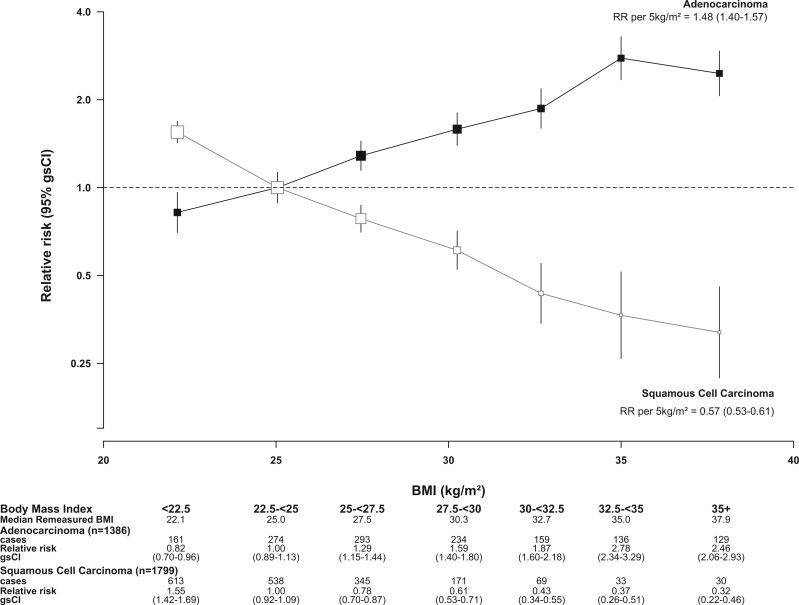
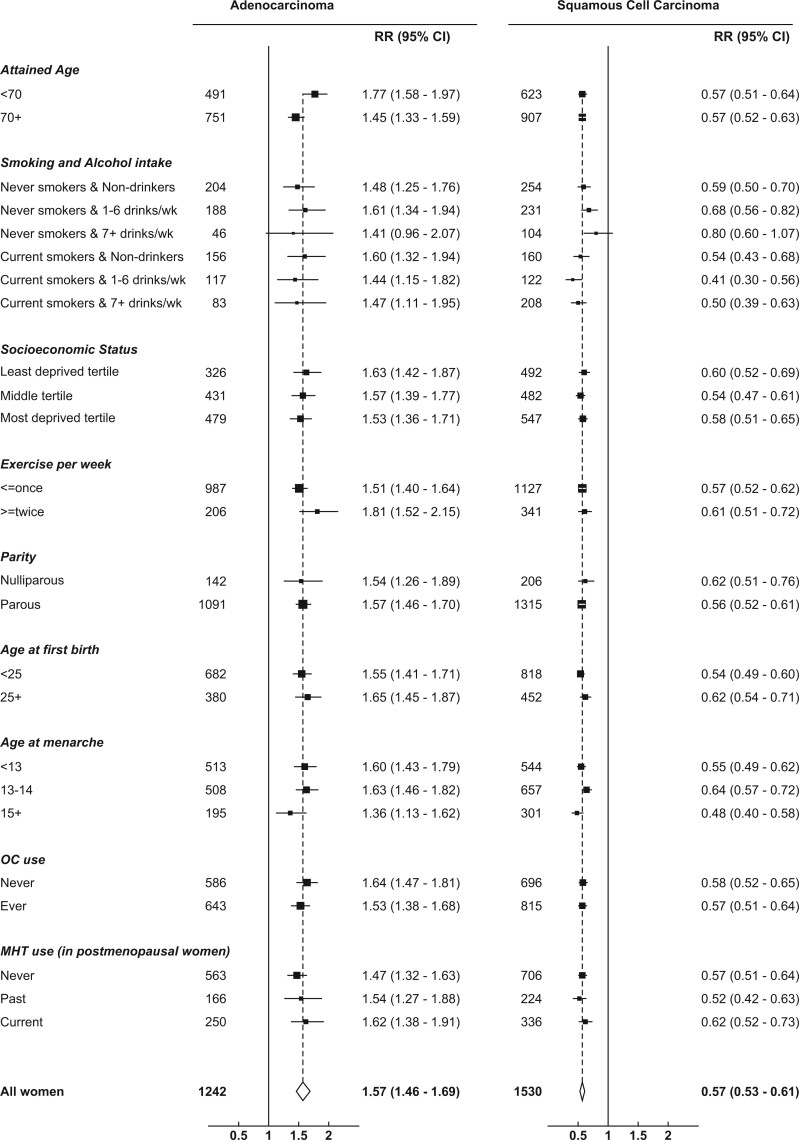
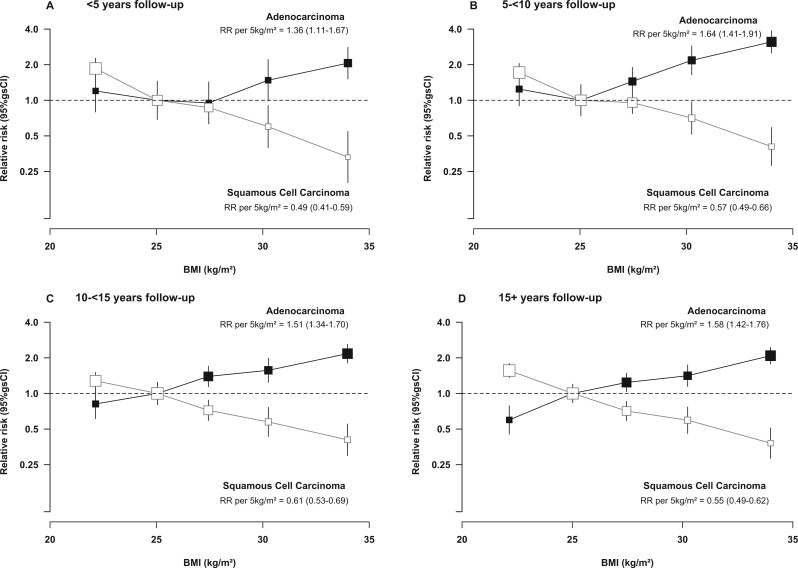
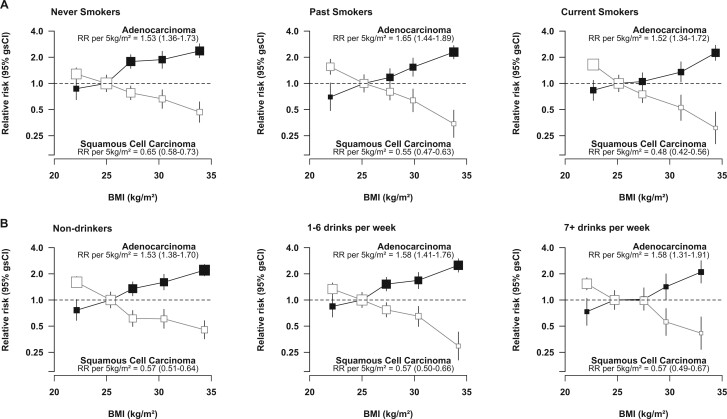
During mean follow-up of 17.7 (SD = 4.9) years, 1386 adenocarcinomas and 1799 squamous cell carcinomas of the oesophagus were registered among 1 255 529 women. Compared with women of BMI 22.5 to <25 kg/m2, those with BMI ≥35 kg/m2 had a 2.5-fold risk of adenocarcinoma (adjusted RR = 2.46, 95% CI = 1.99-3.05) and an almost 70% reduction in risk of squamous cell carcinoma (RR = 0.32, 95% CI = 0.22-0.46). These associations were broadly similar in each 5-year follow-up period, and were evident in both never and ever smokers, although somewhat stronger for squamous cell carcinoma among current and past smokers than in never smokers (Pheterogeneity = 0.007). After controlling for BMI, WC and WHR were associated with risk of squamous cell carcinoma but not adenocarcinoma.
In this population of middle-aged women, there was robust evidence that greater BMI is associated with an increased risk of oesophageal adenocarcinoma and a reduced risk of squamous cell carcinoma.
体重指数(BMI)与食管腺癌风险增加密切相关已得到证实,但与食管鳞癌的关系尚不清楚。关于腹型肥胖与这两种亚型的关系,证据很少。
在英国一项针对中年女性的大型前瞻性队列研究中,平均年龄 56.2 岁(标准差 4.9 岁),我们使用 Cox 回归估计调整后的相对风险(RR)和 95%置信区间(CI),以评估与自我报告的 BMI、腰围(WC)和腰臀比(WHR)相关的食管腺癌和鳞癌风险,同时考虑潜在的反向因果关系偏倚。
在平均 17.7 年(标准差 4.9 年)的随访期间,1255529 名女性中登记了 1386 例腺癌和 1799 例食管鳞癌。与 BMI 为 22.5 至<25 kg/m2 的女性相比,BMI 为≥35 kg/m2 的女性患腺癌的风险增加了 2.5 倍(调整 RR=2.46,95%CI=1.99-3.05),患鳞癌的风险降低了近 70%(RR=0.32,95%CI=0.22-0.46)。这些关联在每个 5 年随访期都基本相似,且在从未吸烟者和曾经吸烟者中均可见,但在当前和过去吸烟者中,这种关联在鳞癌中比在从未吸烟者中更为明显(P 异质性=0.007)。在控制 BMI 后,WC 和 WHR 与鳞癌风险相关,但与腺癌无关。
在该人群中,有强有力的证据表明,BMI 越高,患食管腺癌的风险增加,患食管鳞癌的风险降低。