Doukas Panagiotis, Bassett Cathryn, Krabbe Hanif, Frankort Jelle, Jacobs Michael J, Elfeky Moustafa, Gombert Alexander
Department of Vascular and Endovascular Surgery, University Hospital Aachen, RWTH Aachen University, Aachen, Germany.
Front Cardiovasc Med. 2023 Jun 27;10:1200967. doi: 10.3389/fcvm.2023.1200967. eCollection 2023.
Intestinal ischemia after open thoracoabdominal aortic repairs, is a rare but devastating complication, associated with high mortality. Notoriously challenging to diagnose, visceral malperfusion necessitates immediate surgical attention. Intestinal fatty acid-binding protein (IFABP) has been proposed as a biomarker for the diagnosis of intestinal wall damage. In this prospectively conducted, observational study we evaluated the diagnostic capacity of IFABP levels in patients' serum and their correlation with visceral malperfusion.
23 patients undergoing open thoracoabdominal aortic repairs were included in this study and 8 of them were diagnosed postoperatively with visceral malperfusion-defined as a partial or complete thrombotic occlusion of the superior mesenteric artery and/or the coeliac trunk. IFABP levels and laboratory parameters often associated with intestinal ischemia (leucocytes, CRP, PCT and lactate) were measured at baseline, directly postoperatively, and at 12, 24 and 48 h after surgery. Postoperative visceral malperfusion-as revealed in CT angiography-was assessed and the predictive ability of IFABP levels to detect visceral malperfusion was evaluated with receiver-operator curve analysis.
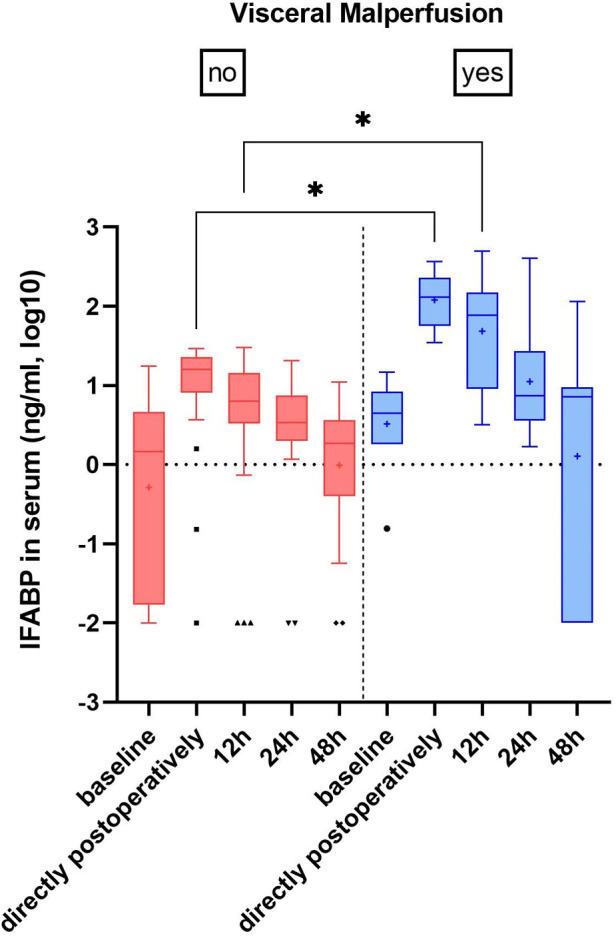
Patients with visceral malperfusion had a relevant risk for a fatal outcome ( = .001). IFABP levels were significantly elevated directly postoperatively and at 12 h after surgery in cases of visceral malperfusion. High IFABP concentrations in serum detected visceral malperfusion accurately during the first 12 h after surgery, with the maximum diagnostic ability achieved immediately after surgery (AUC 1, Sensitivity 100%, Specificity 100%, < .001).
We conclude, that IFABP measurements during the first postoperative hours after open thoracoabdominal aortic surgery can be a valuable tool for reliable and timely detection of visceral malperfusion.
开胸腹部主动脉修复术后发生肠缺血是一种罕见但极具破坏性的并发症,死亡率很高。内脏灌注不良的诊断极具挑战性,需要立即进行手术治疗。肠脂肪酸结合蛋白(IFABP)已被提议作为诊断肠壁损伤的生物标志物。在这项前瞻性观察研究中,我们评估了患者血清中IFABP水平的诊断能力及其与内脏灌注不良的相关性。
本研究纳入了23例行开胸腹部主动脉修复术的患者,其中8例术后被诊断为内脏灌注不良,定义为肠系膜上动脉和/或腹腔干部分或完全血栓性闭塞。在基线、术后即刻以及术后12、24和48小时测量IFABP水平以及通常与肠缺血相关的实验室参数(白细胞、CRP、PCT和乳酸)。评估CT血管造影显示的术后内脏灌注不良情况,并通过受试者操作特征曲线分析评估IFABP水平检测内脏灌注不良的预测能力。
内脏灌注不良的患者有发生致命结局的相关风险(P = 0.001)。在内脏灌注不良的病例中,术后即刻和术后12小时IFABP水平显著升高。血清中高浓度的IFABP在术后最初12小时内准确检测到内脏灌注不良,术后即刻达到最大诊断能力(AUC为1,敏感性为100%,特异性为100%,P < 0.001)。
我们得出结论,在开胸腹部主动脉手术后的最初几个小时内测量IFABP可以成为可靠及时检测内脏灌注不良的有价值工具。