Department of Internal Medicine, College of Medicine, Jouf University, Sakaka, Saudi Arabia.
Department of Pharmacology, Toxicology and Medicine, Medical Faculty, College of Medicine, Al-Mustansiriyah University, P.O. Box 14132, Baghdad, Iraq.
Neurochem Res. 2023 Nov;48(11):3255-3269. doi: 10.1007/s11064-023-03981-1. Epub 2023 Jul 13.
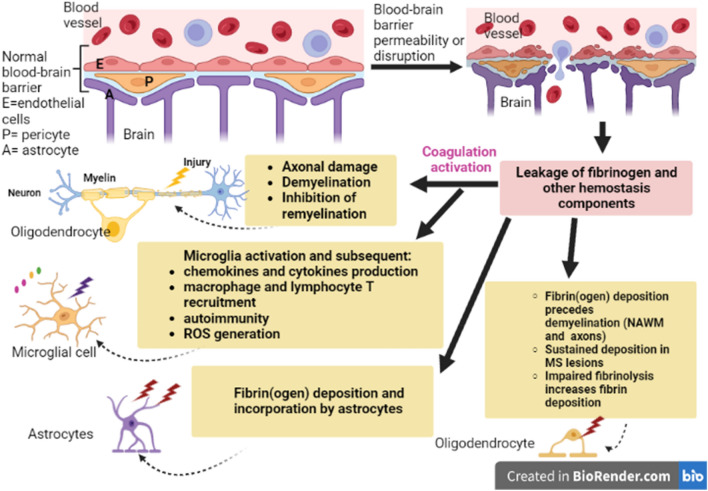
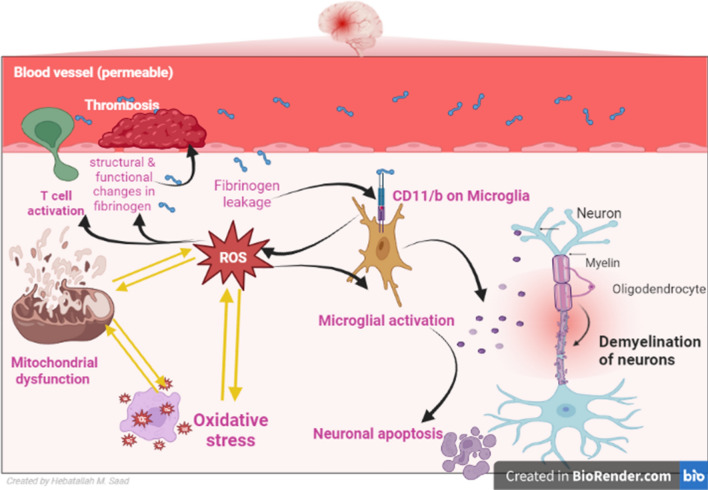
Multiple sclerosis (MS) is an autoimmune demyelinating neurodegenerative disease of the central nervous system (CNS) due to injury of the myelin sheath by immune cells. The clotting factor fibrinogen is involved in the pathogenesis of MS by triggering microglia and the progress of neuroinflammation. Fibrinogen level is correlated with MS severity; consequently, inhibition of the fibrinogen cascade may reduce MS neuropathology. Thus, this review aimed to clarify the potential role of fibrinogen in the pathogenesis of MS and how targeting of fibrinogen affects MS neuropathology. Accumulation of fibrinogen in the CNS may occur independently or due to disruption of blood-brain barrier (BBB) integrity in MS. Fibrinogen acts as transduction and increases microglia activation which induces the progression of inflammation, oxidative stress, and neuronal injury. Besides, brain fibrinogen impairs the remyelination process by inhibiting the differentiation of oligodendrocyte precursor cells. These findings proposed that fibrinogen is associated with MS neuropathology through interruption of BBB integrity, induction of neuroinflammation, and demyelination with inhibition of the remyelination process by suppressing oligodendrocytes. Therefore, targeting of fibrinogen and/or CD11b/CD18 receptors by metformin and statins might decrease MS neuropathology. In conclusion, inhibiting the expression of CD11b/CD18 receptors by metformin and statins may decrease the pro-inflammatory effect of fibrinogen on microglia which is involved in the progression of MS.
多发性硬化症(MS)是一种中枢神经系统(CNS)自身免疫性脱髓鞘神经退行性疾病,由于免疫细胞对髓鞘的损伤所致。凝血因子纤维蛋白原通过触发小胶质细胞和神经炎症的进展而参与 MS 的发病机制。纤维蛋白原水平与 MS 的严重程度相关;因此,抑制纤维蛋白原级联反应可能会减轻 MS 的神经病理学。因此,本综述旨在阐明纤维蛋白原在 MS 发病机制中的潜在作用,以及靶向纤维蛋白原如何影响 MS 的神经病理学。纤维蛋白原在 CNS 中的积累可能独立发生,也可能是由于 MS 中血脑屏障(BBB)完整性的破坏。纤维蛋白原作为转导物并增加小胶质细胞的激活,从而诱导炎症、氧化应激和神经元损伤的进展。此外,脑纤维蛋白原通过抑制少突胶质细胞前体细胞的分化来损害髓鞘再生过程。这些发现表明,纤维蛋白原通过中断 BBB 完整性、诱导神经炎症和脱髓鞘以及通过抑制少突胶质细胞来抑制髓鞘再生过程而与 MS 神经病理学相关。因此,通过二甲双胍和他汀类药物靶向纤维蛋白原和/或 CD11b/CD18 受体可能会降低 MS 神经病理学。总之,二甲双胍和他汀类药物通过抑制 CD11b/CD18 受体的表达可能会降低纤维蛋白原对小胶质细胞的促炎作用,而小胶质细胞参与 MS 的进展。