Department of Physics, College of Sciences, Yasouj University, Yasouj, 75918, Iran.
Smart Photonics Research Laboratory, Sunway University, 47500, Sunway, Selangor, Malaysia.
Sci Rep. 2023 Jul 13;13(1):11325. doi: 10.1038/s41598-023-38475-1.
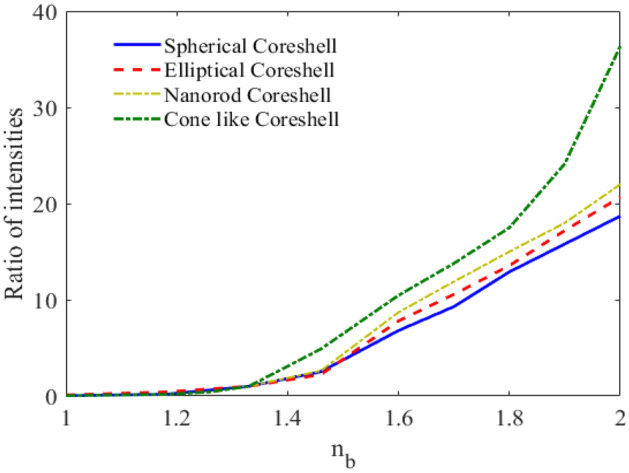
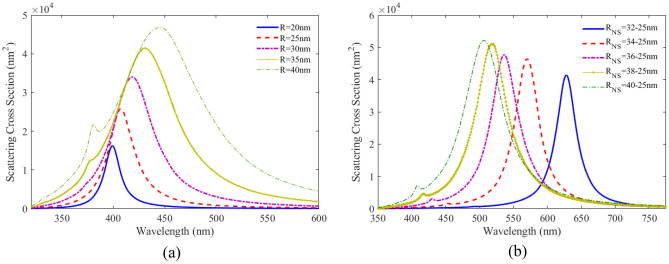
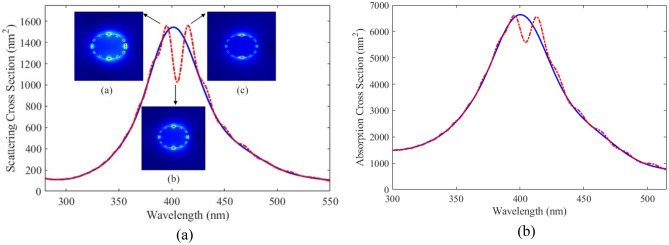
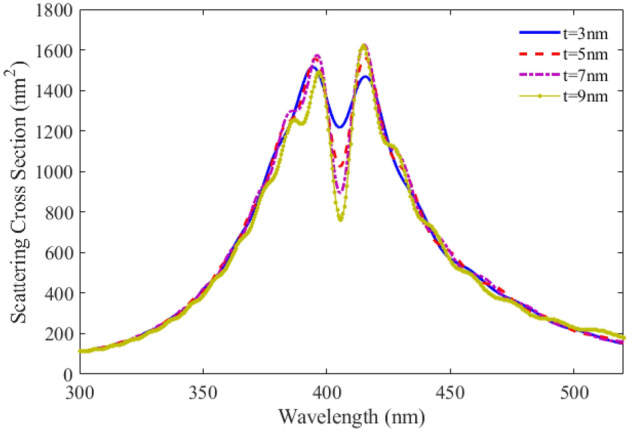
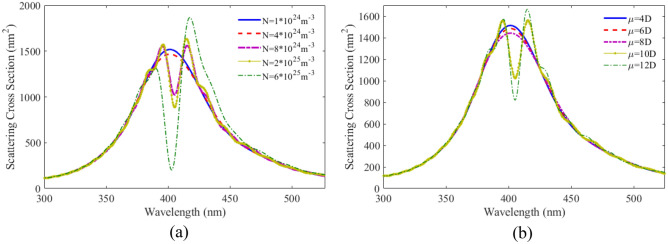
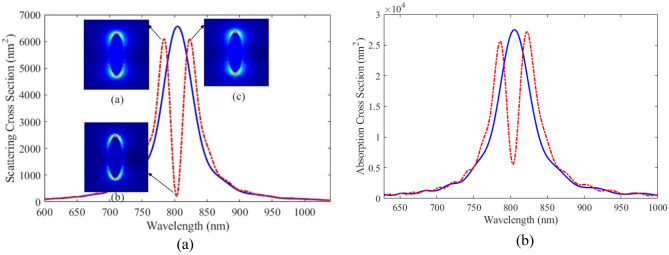
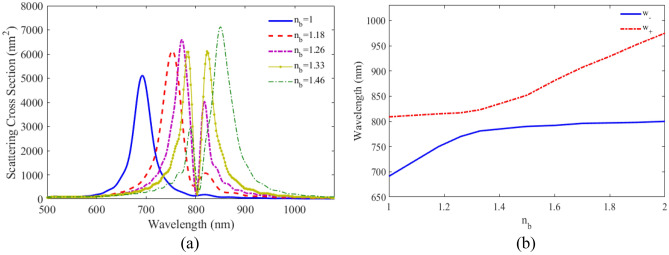
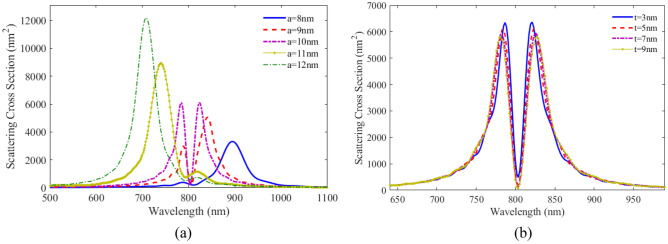
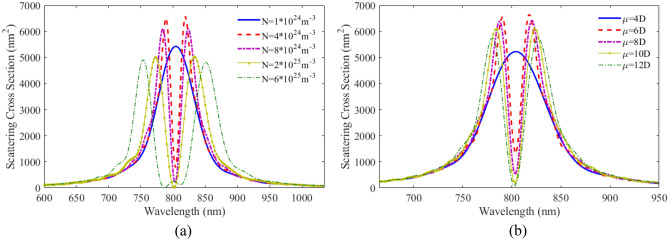
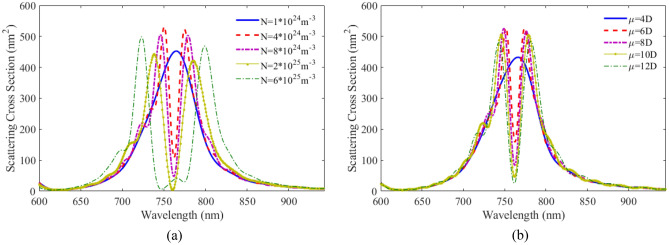
A proposed nanosensor based on hybrid nanoshells consisting of a core of metal nanoparticles and a coating of molecules is simulated by plasmon-exciton coupling in semi classical approach. We study the interaction of electromagnetic radiation with multilevel atoms in a way that takes into account both the spatial and the temporal dependence of the local fields. Our approach has a wide range of applications, from the description of pulse propagation in two-level media to the elaborate simulation of optoelectronic devices, including sensors. We have numerically solved the corresponding system of coupled Maxwell-Liouville equations using finite difference time domain (FDTD) method for different geometries. Plasmon-exciton hybrid nanoshells with different geometries are designed and simulated, which shows more sensitive to environment refractive index (RI) than nanosensor based on localized surface plasmon. The effects of nanoshell geometries, sizes, and quantum emitter parameters on the sensitivity of nanosensors to changes in the RI of the environment were investigated. It was found that the cone-like nanoshell with a silver core and quantum emitter shell had the highest sensitivity. The tapered shape of the cone like nanoshell leads to a higher density of plasmonic excitations at the tapered end of the nanoshell. Under specific conditions, two sharp, deep LSPR peaks were evident in the scattering data. These distinguishing features are valuable as signatures in nanosensors requiring fast, noninvasive response.
一种基于混合纳米壳的纳米传感器被提出,该纳米壳由金属纳米粒子的核和分子涂层组成,通过等离子体-激子耦合在半经典方法中进行模拟。我们以一种既考虑空间又考虑局部场时间依赖性的方式研究了电磁辐射与多能级原子的相互作用。我们的方法有广泛的应用,从两级介质中脉冲传播的描述到光电设备的详细模拟,包括传感器。我们使用有限差分时域(FDTD)方法为不同的几何形状数值求解了相应的耦合麦克斯韦-刘维尔方程。我们设计和模拟了具有不同几何形状的等离子体-激子混合纳米壳,与基于局域表面等离子体的纳米传感器相比,它对环境折射率(RI)的变化更敏感。研究了纳米壳几何形状、尺寸和量子发射器参数对纳米传感器对环境 RI 变化的灵敏度的影响。结果发现,具有银核和量子发射器壳的锥形纳米壳具有最高的灵敏度。锥形纳米壳的锥形形状导致纳米壳末端的等离子体激发密度更高。在特定条件下,在散射数据中可以明显看出两个尖锐、深的 LSPR 峰。这些独特的特征是需要快速、非侵入性响应的纳米传感器的重要特征。