Adnan Aadil, Basu Sandip
Radiation Medicine Centre, Bhabha Atomic Research Centre, Tata Memorial Centre Annexe, JerbaiWadia Road, Parel, Mumbai 400012, India.
Homi Bhabha National Institute, Mumbai 400094, India.
Diagnostics (Basel). 2023 Jun 24;13(13):2154. doi: 10.3390/diagnostics13132154.
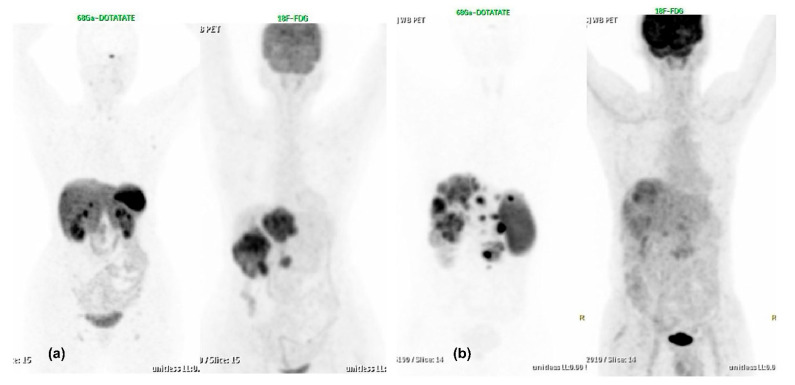
Somatostatin receptor (SSTR) agonist-based Positron Emission Tomography-Computed Tomography (PET-CT) imaging is nowadays the mainstay for the assessment and diagnostic imaging of neuroendocrine neoplasms (NEN), especially in well-differentiated neuroendocrine tumors (NET) (World Health Organization (WHO) grade I and II). Major clinical indications for SSTR imaging are primary staging and metastatic workup, especially (a) before surgery, (b) detection of unknown primary in metastatic NET, (c) patient selection for theranostics and appropriate therapy, especially peptide receptor radionuclide therapy (PRRT), while less major indications include treatment response evaluation on and disease prognostication. Dual tracer PET-CT imaging using SSTR targeted PET tracers, viz. [Ga]Ga-DOTA-Tyr3-Octreotate (DOTA-TATE) and [Ga]Ga-DOTA-NaI3-Octreotide (DOTA-NOC), and fluorodeoxyglucose (FDG), have recently gained widespread acceptance for better assessment of whole-body tumor biology compared to single-site histopathology, in terms of being non-invasive and the ability to assess inter- and intra-tumoral heterogeneity on a global scale. FDG uptake has been identified as independent adverse risk factor in various studies. Recently, somatostatin receptor antagonists have been shown to be more sensitive and specific in detecting the disease. The aim of this review article is to summarize the clinical importance of SSTR-based imaging in the clinical management of neuroendocrine and related tumors.
基于生长抑素受体(SSTR)激动剂的正电子发射断层扫描-计算机断层扫描(PET-CT)成像如今是神经内分泌肿瘤(NEN)评估和诊断成像的主要手段,尤其是在高分化神经内分泌肿瘤(NET)(世界卫生组织(WHO)I级和II级)中。SSTR成像的主要临床适应证是初始分期和转移灶检查,特别是(a)手术前,(b)检测转移性NET中的未知原发灶,(c)选择适合进行治疗诊断和适当治疗的患者,尤其是肽受体放射性核素治疗(PRRT),而次要适应证包括评估治疗反应和疾病预后。使用SSTR靶向PET示踪剂,即[镓]镓-多胺基多羧基-酪氨酰3-奥曲肽(DOTA-TATE)和[镓]镓-多胺基多羧基-碘化钠3-奥曲肽(DOTA-NOC),以及氟脱氧葡萄糖(FDG)的双示踪剂PET-CT成像,与单部位组织病理学相比,最近已被广泛接受,因其具有非侵入性且能够在全球范围内评估肿瘤间和肿瘤内异质性,从而更好地评估全身肿瘤生物学特性。在各种研究中,FDG摄取已被确定为独立的不良风险因素。最近,生长抑素受体拮抗剂已被证明在检测该疾病方面更敏感、更具特异性。这篇综述文章的目的是总结基于SSTR成像在神经内分泌及相关肿瘤临床管理中的临床重要性。