Paudice Michele, Biatta Chiara Maria, Scaglione Giulia, Parodi Alessia, Mammoliti Serafina, Moioli Melita, Centurioni Maria Grazia, Barra Fabio, Ferrero Simone, De Cian Franco, Mazzocco Katia, Vellone Valerio Gaetano
Department of Integrated Diagnostic and Surgical Sciences (DISC), University of Genoa, 16100 Genoa, Italy.
Pathology University Unit, IRCCS Ospedale Policlinico San Martino, 16132 Genoa, Italy.
Diagnostics (Basel). 2023 Jun 26;13(13):2171. doi: 10.3390/diagnostics13132171.
Endometrial cancer is an emerging disease with an increase in prevalence of aggressive histotypes in recent years.
In the present study, potential histopathological and immunohistochemical prognostic markers were investigated. Consecutive cases of high-grade non-endometrioid carcinoma (HG-NEC) of the endometrium were considered.
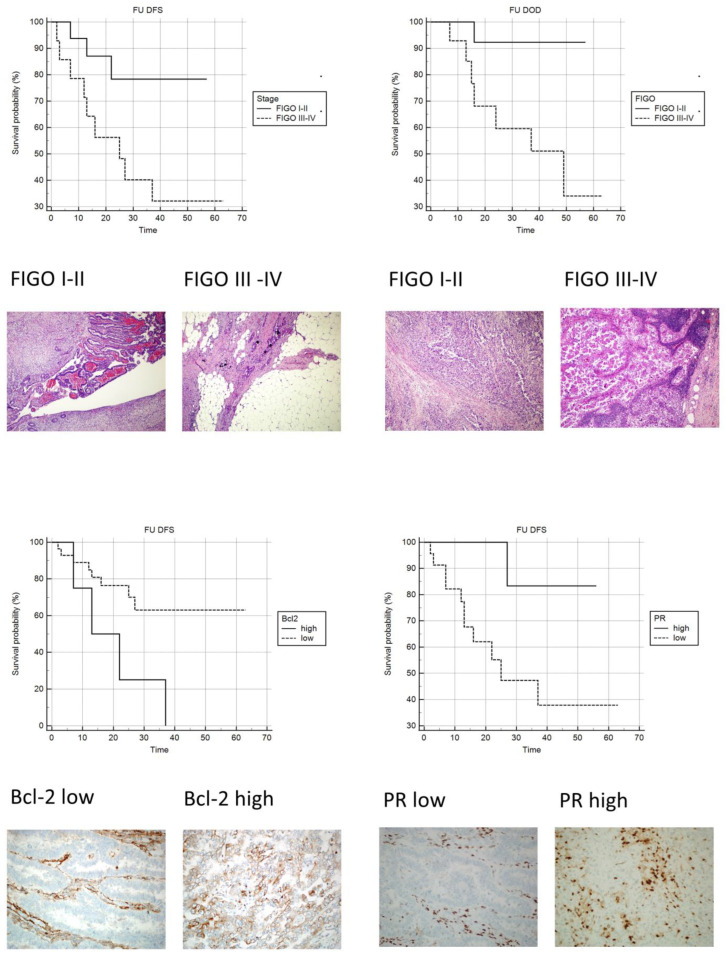
Each surgical specimen was routinely processed; the most significant block was selected for immunohistochemistry and tested for ER, PR, ki67, p53, E-cadherin, β-catenin, Bcl-2 and cyclin D1. For each immunomarker, the percentage of positive tumor cells was evaluated (%) and dichotomized as low and high according to the distribution in the study population. Follow-up was collected for disease-free survival (DFS) and overall survival (OS). Thirty-three cases were eligible: 19 resulted in FIGO I-II; 14 resulted in FIGO III-IV. Twelve patients suffered a recurrent disease (mean follow-up 24.6 months); 8 patients died of the disease (mean follow-up 26.6 months).
Women with recurrent disease demonstrated a significantly higher Bcl2% (35.84 ± 30.96% vs. 8.09 ± 11.56%; = 0.0032) while DOD patients had higher ki67% (75 ± 13.09% vs. 58.6 ± 19.97%; = 0.033) and Bcl2% of border significance (34.37 ± 34.99% vs. 13 ± 17.97%; = 0.078). As expected, FIGO III-IV had a worse DFS (HR = 3.34; 95% CI: 1.1-10.99; = 0.034) and OS (HR = 5.19; 95% CI: 1.27-21.14; = 0.0217). Bcl-2-high patients (Bcl2 > 10%) demonstrated a significantly worse DFS (HR = 9.11; 95% CI: 2.6-32.4; = 0.0006) and OS (HR = 7.63; 95% CI: 1.7-34; = 0.0084); moreover, PR low patients (PR ≤ 10%) had significantly worse DFS (HR = 3.74; 95% CI: 1.2-11.9; = 0.02).
HG-NEC represents a heterogeneous group of endometrial aggressive neoplasms with a worrisome prognosis, often at an advanced stage at presentation. Bcl-2 and PR may represent promising markers to identify a subgroup of patients having an even worse prognosis requiring a careful and close follow-up.
子宫内膜癌是一种近年来侵袭性组织学类型患病率不断上升的新兴疾病。
在本研究中,对潜在的组织病理学和免疫组化预后标志物进行了研究。纳入了子宫内膜高级别非子宫内膜样癌(HG-NEC)的连续病例。
对每个手术标本进行常规处理;选择最具代表性的组织块进行免疫组化检测,检测雌激素受体(ER)、孕激素受体(PR)、Ki67、p53、E-钙黏蛋白、β-连环蛋白、Bcl-2和细胞周期蛋白D1。对于每个免疫标志物,评估阳性肿瘤细胞的百分比(%),并根据研究人群中的分布情况分为低和高两组。收集无病生存期(DFS)和总生存期(OS)的随访数据。33例符合条件:19例为国际妇产科联盟(FIGO)I-II期;14例为FIGO III-IV期。12例患者出现疾病复发(平均随访24.6个月);8例患者死于该疾病(平均随访26.6个月)。
复发患者的Bcl2%显著更高(35.84±30.96%对8.09±11.56%;P=0.0032),而死亡患者的Ki67%更高(75±13.09%对58.6±19.97%;P=0.033),Bcl2%具有临界显著性(34.37±34.99%对13±17.97%;P=0.078)。正如预期的那样,FIGO III-IV期患者的DFS更差(风险比[HR]=3.34;95%置信区间[CI]:1.1-10.99;P=0.034)和OS更差(HR=5.19;95%CI:1.27-21.14;P=0.0217)。Bcl-2高表达患者(Bcl2>10%)的DFS显著更差(HR=9.11;95%CI:2.6-32.4;P=0.0006)和OS更差(HR=7.63;95%CI:1.7-34;P=0.0084);此外,PR低表达患者(PR≤10%)的DFS显著更差(HR=3.74;95%CI:1.2-11.9;P=0.02)。
HG-NEC代表一组异质性的子宫内膜侵袭性肿瘤,预后令人担忧,通常在就诊时处于晚期。Bcl-2和PR可能是有前景的标志物,可用于识别预后更差的患者亚组,这些患者需要仔细密切的随访。