Czech-Załubska Katarzyna, Klich Daniel, Jackowska-Tracz Agnieszka, Didkowska Anna, Bogdan Janusz, Anusz Krzysztof
Department of Food Hygiene and Public Health Protection, Institute of Veterinary Medicine, Warsaw University of Life Sciences (SGGW), Nowoursynowska 166, 02-787 Warsaw, Poland.
Institute of Animal Sciences, University of Life Sciences-SGGW, Ciszewskiego 8, 02-786 Warsaw, Poland.
Foods. 2023 Jul 6;12(13):2610. doi: 10.3390/foods12132610.
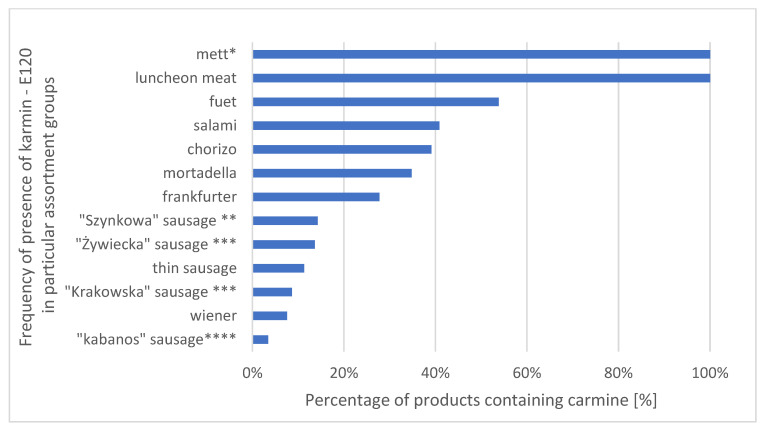
Manufacturers are obliged to label processed meat products with information concerning the additives used and nutritional values. The aim of the study was to identify the dyes most frequently used in processed meat, evaluate their influence on specific food qualities, assess whether their use was correct and review their effect on health. The analysis was based on information on the labels and images of processed meat, and used a generalised linear model with a binary dependent variable. The risks and benefits for human health were defined based on the available literature. Twelve dyes were found to be used in the manufacture of processed meat. Carmine was found in 183 of 273 (67.03%) evaluated assortments containing dyes. The occurrence of water, flavourings and high fat and carbohydrate contents increased the chances that a dye would be present in a particular product. Unauthorised use of food additives was found in 20 products, with smoked meat products demonstrating the highest number of non-compliances. In general, the dyes used with food are considered safe; however, reservations are associated with the use of E150C and E150D caramels due to their potential carcinogenic effect, and carmine and annatto due to their allergic effects.
制造商有义务在加工肉类产品上标注所使用添加剂的信息以及营养价值。本研究的目的是确定加工肉类中最常使用的色素,评估它们对特定食品质量的影响,评估其使用是否正确,并审查它们对健康的影响。该分析基于加工肉类的标签信息和图片,并使用了具有二元因变量的广义线性模型。根据现有文献确定了对人类健康的风险和益处。发现有12种色素用于加工肉类的生产。在273种含有色素的评估产品类别中,有183种(67.03%)含有胭脂红。水分、调味料以及高脂肪和高碳水化合物含量的存在增加了某种色素出现在特定产品中的可能性。在20种产品中发现了未经授权使用食品添加剂的情况,其中烟熏肉类产品的违规情况最多。一般来说,用于食品的色素被认为是安全的;然而,由于E150C和E150D焦糖可能具有致癌作用,以及胭脂红和胭脂树提取物可能具有过敏作用,人们对它们的使用存在保留意见。