Watzling Martin, Klaus Lorenz, Weidemeier Tamara, Horder Hannes, Ebert Regina, Blunk Torsten, Bauer-Kreisel Petra
Department of Trauma, Hand, Plastic and Reconstructive Surgery, University Hospital Würzburg, 97080 Würzburg, Germany.
Department of Musculoskeletal Tissue Regeneration, Julius-Maximilians-Universität Würzburg, 97074 Würzburg, Germany.
Cancers (Basel). 2023 Jul 5;15(13):3501. doi: 10.3390/cancers15133501.
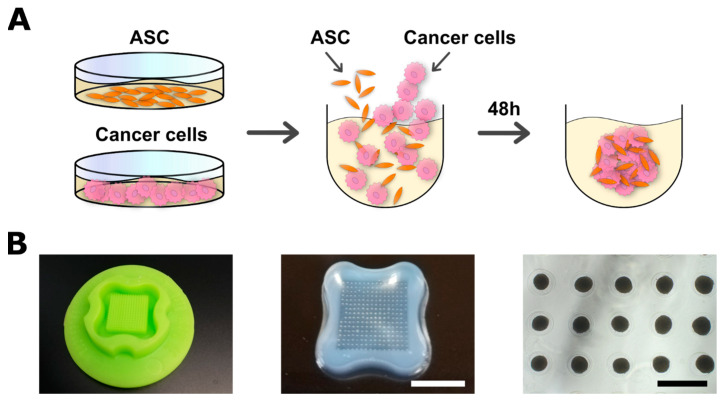
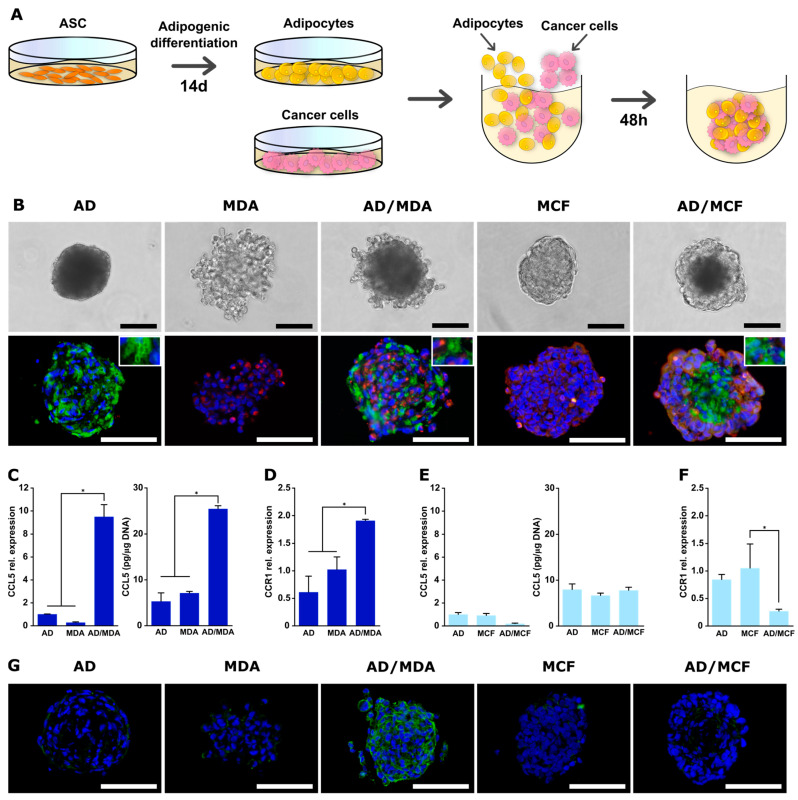
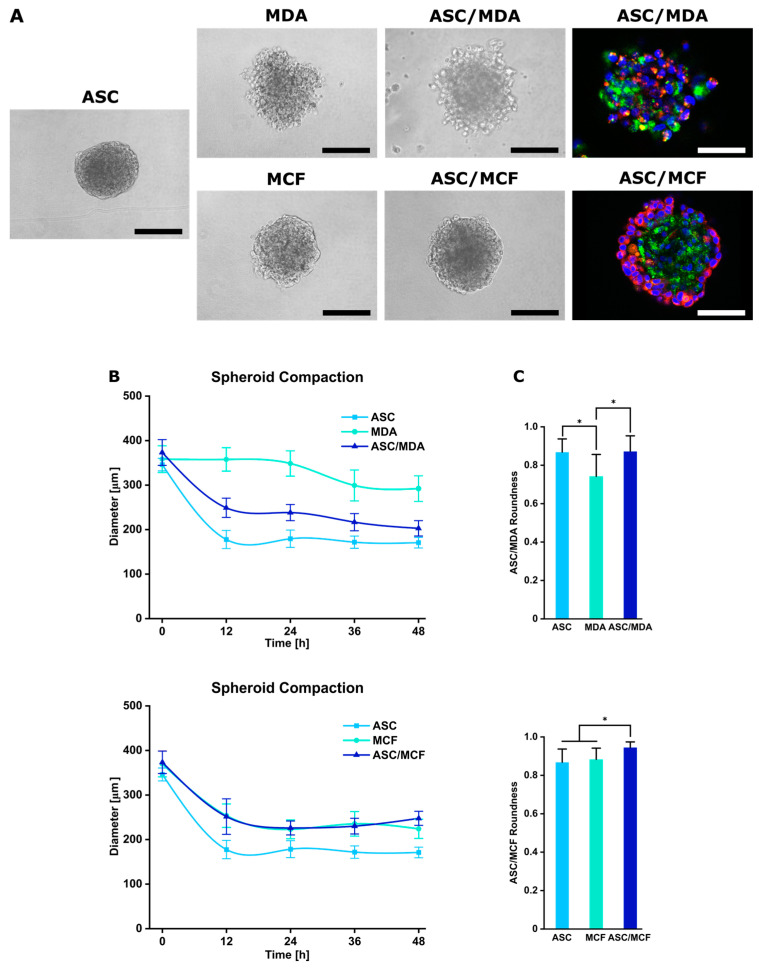
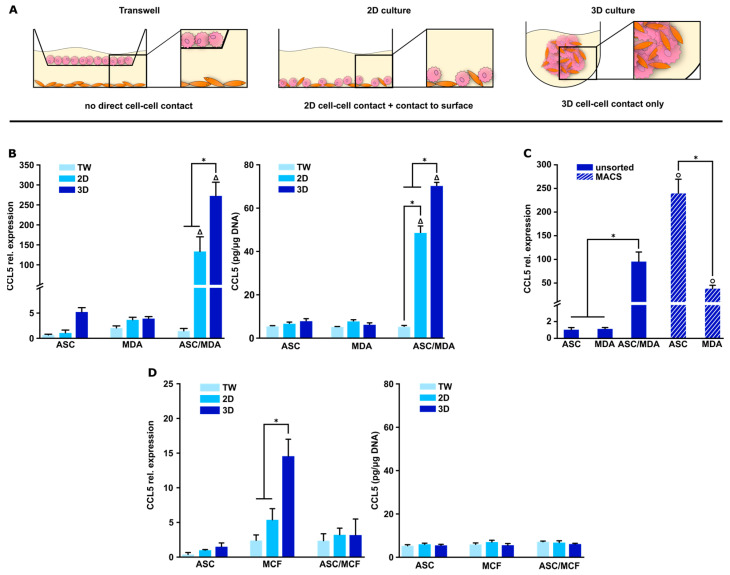
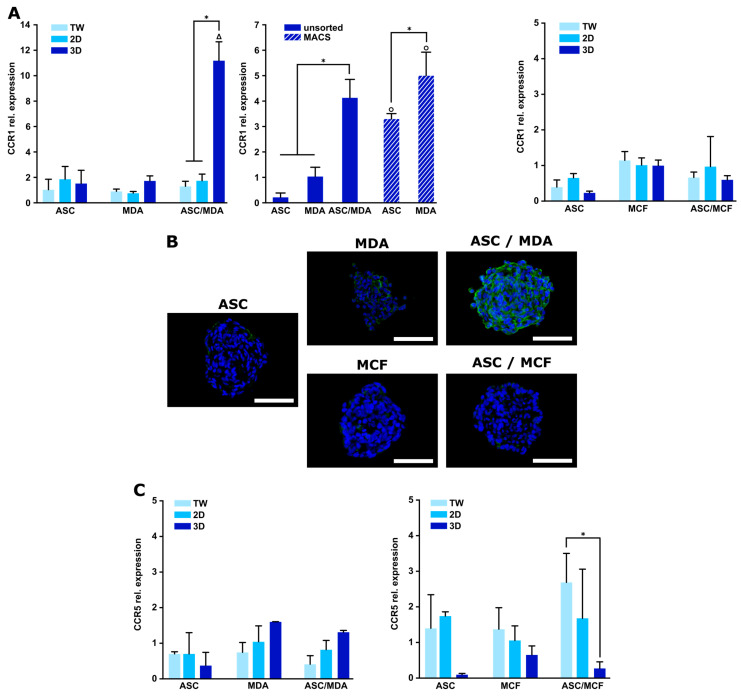
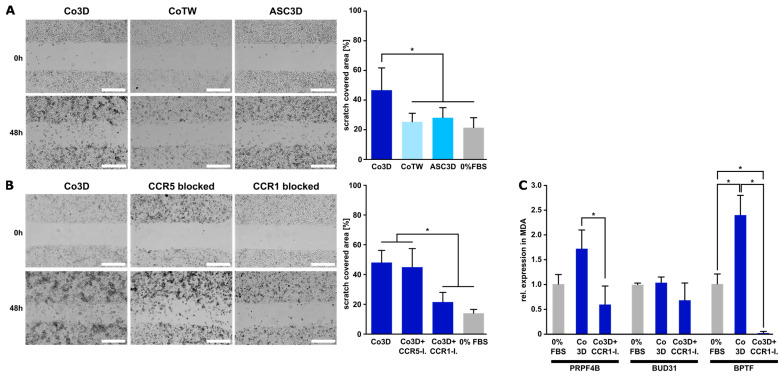
The tumor microenvironment (TME) in breast cancer is determined by the complex crosstalk of cancer cells with adipose tissue-inherent cells such as adipose-derived stromal cells (ASCs) and adipocytes resulting from the local invasion of tumor cells in the mammary fat pad. This leads to heterotypic cellular contacts between these cell types. To adequately mimic the specific cell-to-cell interaction in an in vivo-like 3D environment, we developed a direct co-culture spheroid model using ASCs or differentiated adipocytes in combination with MDA-MB-231 or MCF-7 breast carcinoma cells. Co-spheroids were generated in a well-defined and reproducible manner in a high-throughput process. We compared the expression of the tumor-promoting chemokine CCL5 and its cognate receptors in these co-spheroids to indirect and direct standard 2D co-cultures. A marked up-regulation of CCL5 and in particular the receptor CCR1 with strict dependence on cell-cell contacts and culture dimensionality was evident. Furthermore, the impact of direct contacts between ASCs and tumor cells and the involvement of CCR1 in promoting tumor cell migration were demonstrated. Overall, these results show the importance of direct 3D co-culture models to better represent the complex tumor-stroma interaction in a tissue-like context. The unveiling of tumor-specific markers that are up-regulated upon direct cell-cell contact with neighboring stromal cells, as demonstrated in the 3D co-culture spheroids, may represent a promising strategy to find new targets for the diagnosis and treatment of invasive breast cancer.
乳腺癌中的肿瘤微环境(TME)是由癌细胞与脂肪组织固有细胞(如脂肪来源的基质细胞(ASC)和脂肪细胞)之间复杂的相互作用所决定的,这种相互作用是肿瘤细胞局部侵袭乳腺脂肪垫后产生的。这导致了这些细胞类型之间的异型细胞接触。为了在类似体内的三维环境中充分模拟特定的细胞间相互作用,我们开发了一种直接共培养球体模型,将ASC或分化的脂肪细胞与MDA-MB-231或MCF-7乳腺癌细胞结合使用。共球体以高通量的方式以明确且可重复的方式生成。我们将这些共球体中促肿瘤趋化因子CCL5及其同源受体的表达与间接和直接标准二维共培养进行了比较。CCL5尤其是受体CCR1的显著上调明显依赖于细胞间接触和培养维度。此外,还证明了ASC与肿瘤细胞之间直接接触的影响以及CCR1在促进肿瘤细胞迁移中的作用。总体而言,这些结果表明直接三维共培养模型对于在类似组织的环境中更好地呈现复杂的肿瘤-基质相互作用的重要性。如三维共培养球体所示,揭示与邻近基质细胞直接细胞间接触时上调的肿瘤特异性标志物,可能代表了一种寻找浸润性乳腺癌诊断和治疗新靶点的有前景的策略。