
澳门华人居民的多重疾病与生活方式关联:基于社区需求评估研究的结果
The Multimorbidity and Lifestyle Correlates in Chinese Population Residing in Macau: Findings from a Community-Based Needs Assessment Study.
作者信息
Yang Qingling, Zhang Quanzhi, Ngai Fei Wan, Wang Shaoling, Zhang Dexing, Gao Yang, Hao Chun, Wang Harry Haoxiang, Nogueira Oi Ching Bernice Lam, Liu Ming, Molasiotis Alex, Loke Alice, Xie Yaojie
机构信息
School of Nursing, The Hong Kong Polytechnic University, Hong Kong SAR, China.
School of Nursing, Harbin Medical University, Harbin 150088, China.
出版信息
Healthcare (Basel). 2023 Jun 30;11(13):1906. doi: 10.3390/healthcare11131906.
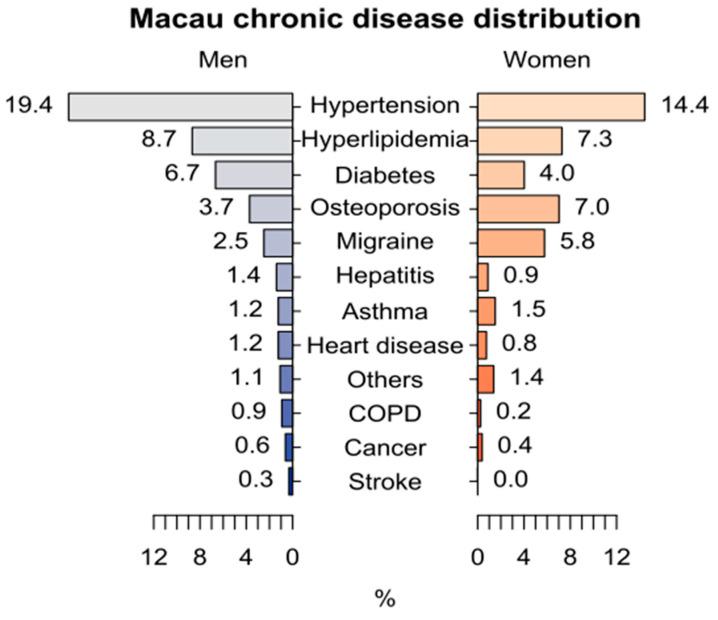
Multimorbidity has become one of the most pressing public health concerns worldwide. The objectives of this study were to understand the prevalence of multimorbidity and its relationship with lifestyle factors among Chinese adults in Macau, and to investigate the combined contribution of common lifestyle factors in predicting multimorbidity. Data were collected through face-to-face interviews using a self-reported questionnaire on common chronic diseases, lifestyle factors and sociodemographics. BMI, physical activity, drinking status, smoking status and sleep quality were assessed, and a composite lifestyle score (0 to 9 points) was calculated, and the higher the score, the healthier the lifestyle. A total of 1443 participants were included in the analysis, of whom 55.2% were female, 51.8% were middle aged or elderly and 30.5% completed tertiary education or higher. The prevalence of multimorbidity was 10.3%. The combination of hypertension and hyperlipidaemia was the most common (22.2%) multimorbidity among the participants with multimorbidity. After the adjustment of the covariates, it was found that the participants who were overweight (OR: 1.95, 95% CI: 1.18-3.20, = 0.009) or obese (OR: 3.76, 95% CI: 2.38-5.96, < 0.001), former drinkers (OR: 2.43, 95% CI: 1.26-4.69, = 0.008), and those who reported poor sleep quality (OR: 2.25, 95% CI: 1.49-3.40, < 0.001) had a high risk of developing multimorbidity. A one-unit increase in the lifestyle score was associated with a 0.33-times reduction in the risk of developing multimorbidity (OR: 0.67; 95% CI: 0.59-0.77, < 0.001). A combination of lifestyle factors can influence a variety of multimorbidity among the Chinese adults in Macau. Thus, comprehensively assessing the combined contribution of several lifestyle factors in predicting multimorbidity is important.
多重疾病共患已成为全球最紧迫的公共卫生问题之一。本研究的目的是了解澳门中国成年人中多重疾病共患的患病率及其与生活方式因素的关系,并调查常见生活方式因素在预测多重疾病共患方面的综合作用。通过面对面访谈收集数据,使用一份关于常见慢性病、生活方式因素和社会人口统计学的自填问卷。评估了体重指数、身体活动、饮酒状况、吸烟状况和睡眠质量,并计算了一个综合生活方式得分(0至9分),得分越高,生活方式越健康。共有1443名参与者纳入分析,其中55.2%为女性,51.8%为中年或老年,30.5%完成了高等教育。多重疾病共患的患病率为10.3%。在患有多重疾病的参与者中,高血压和高脂血症的组合是最常见的(22.2%)多重疾病共患情况。在调整协变量后,发现超重(比值比:1.95,95%置信区间:1.18 - 3.20,P = 0.009)或肥胖(比值比:3.76,95%置信区间:2.38 - 5.96,P < 0.001)的参与者、既往饮酒者(比值比:2.43,95%置信区间:1.26 - 4.69,P = 0.008)以及报告睡眠质量差的参与者(比值比:2.25,95%置信区间:1.49 - 3.40,P < 0.001)发生多重疾病共患的风险较高。生活方式得分每增加一个单位,发生多重疾病共患的风险降低0.33倍(比值比:0.67;95%置信区间:0.59 - 0.77,P < 0.001)。生活方式因素的组合可影响澳门中国成年人中的多种多重疾病共患情况。因此,全面评估多种生活方式因素在预测多重疾病共患方面的综合作用很重要。

 Zotero 插件