Institute of Social Medicine, Occupational Health and Public Health (ISAP), Medical Faculty, University of Leipzig, Philipp-Rosenthal-Str. 55, 04103, Leipzig, Germany.
Global Brain Health Institute (GBHI), Trinity College Dublin, Dublin, Ireland.
Soc Psychiatry Psychiatr Epidemiol. 2022 Oct;57(10):1959-1968. doi: 10.1007/s00127-021-02174-x. Epub 2021 Sep 17.
Social isolation has negative effects on physical and brain health across the lifespan. However, the prevalence of social isolation, specifically with regard to sociodemographic and socioeconomic factors, is not well known.
Database was the Leipzig population-based study of adults (LIFE-Adult Study, n = 10,000). The short form of the Lubben Social Network Scale (LSNS-6) was used to assess social isolation (cutoff < 12 points). Sampling weights were applied to account for differences in sampling fractions.
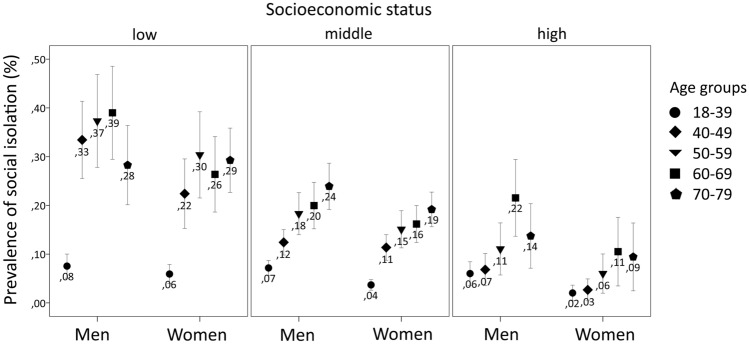
Data were available for 9392 study participants; 51.6% were women, the mean age was 45.2 years (SD = 17.3). The prevalence of social isolation was 12.3% (95% CI 11.6-13.0) across ages 18-79 years. Social isolation was more prevalent in men (13.8%, 95% CI 12.8-14.8) compared to women (10.9%, 95% CI 10.0-11.8; [Formula: see text] (1) = 18.83, p < .001), and it showed an increase with increasing age from 5.4% (95% CI 4.7-6.0) in the youngest age group (18-39 years) to 21.7% (95% CI 19.5-24.0) in the oldest age group (70-79 years; [Formula: see text] (4) = 389.51, p < .001). Prevalence differed largely with regard to socioeconomic status (SES); showing lower prevalence in high SES (7.2%, 95% CI 6.0-8.4) and higher prevalence in low SES (18.6%, 95% CI 16.9-20.3; [Formula: see text] (2) = 115.78; p < .001).
More than one in ten individuals in the adult population reported social isolation, and prevalence varied strongly with regard to sociodemographic and socioeconomic factors. Social isolation was particularly frequent in disadvantaged socioeconomic groups. From a public health perspective, effective prevention of and intervention against social isolation should be a desired target as social isolation leads to poor health. Countermeasures should especially take into account the socioeconomic determinants of social isolation, applying a life-course perspective.
社会隔离会对全生命周期的身心健康产生负面影响。然而,社会隔离的流行程度,特别是与社会人口学和社会经济因素有关的流行程度,尚不清楚。
数据库为莱比锡基于人群的成年人研究(LIFE-Adult Study,n=10000)。采用 Lubben 社会网络量表(LSNS-6)的简短形式来评估社会隔离(截断值<12 分)。应用抽样权重来考虑抽样分数的差异。
研究共纳入 9392 名研究参与者;51.6%为女性,平均年龄为 45.2 岁(SD=17.3)。18-79 岁人群的社会隔离率为 12.3%(95%CI 11.6-13.0)。与女性(10.9%,95%CI 10.0-11.8;[公式:见文本](1)=18.83,p<.001)相比,男性(13.8%,95%CI 12.8-14.8)的社会隔离更为普遍,且随着年龄的增长而增加,从最年轻的年龄组(18-39 岁)的 5.4%(95%CI 4.7-6.0)到最年长的年龄组(70-79 岁)的 21.7%(95%CI 19.5-24.0;[公式:见文本](4)=389.51,p<.001)。社会隔离与社会经济地位(SES)也有很大差异,显示出高 SES(7.2%,95%CI 6.0-8.4)的发生率较低,而低 SES(18.6%,95%CI 16.9-20.3;[公式:见文本](2)=115.78;p<.001)的发生率较高。
成年人群中超过十分之一的人报告存在社会隔离,且其流行程度与社会人口学和社会经济因素密切相关。社会隔离在社会经济劣势群体中尤为普遍。从公共卫生的角度来看,有效预防和干预社会隔离应成为一个理想的目标,因为社会隔离会导致健康状况不佳。对策尤其应考虑到社会隔离的社会经济决定因素,并采用生命历程的观点。