Sgrulletti Mayla, Costagliola Giorgio, Giardino Giuliana, Graziani Simona, Del Duca Elisabetta, Di Cesare Silvia, Di Matteo Gigliola, Consolini Rita, Pignata Claudio, Moschese Viviana
Pediatric Immunopathology and Allergology Unit, Policlinico Tor Vergata, University of Tor Vergata, 00133 Rome, Italy.
Ph.D. Program in Immunology, Molecular Medicine and Applied Biotechnology, University of Rome Tor Vergata, 00133 Rome, Italy.
J Clin Med. 2023 Jun 22;12(13):4206. doi: 10.3390/jcm12134206.
Unclassified primary antibody deficiency (unPAD) is a relatively novel inborn error of immunity (IEI) condition that can vary with time to more defined entities. Since long-term follow-up (FU) studies are scarce, we aimed to provide insight into the evolutionary clinical and immunological scenario of unPAD children to adulthood and identification of biomarkers of primary immune deficiency (PID) persistence.
A total of 23 pediatric unPAD patients underwent clinical and immunological FU for a mean time of 14 years (range 3-32 years, median 16 years).
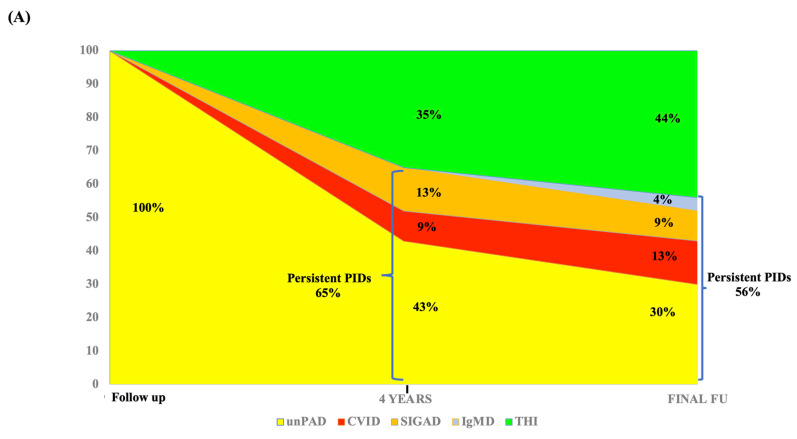
UnPAD diagnosis may change over time. At the last FU, 10/23 (44%) children matched the diagnosis of transient hypogammaglobulinemia of infancy and 13/23 (56%) suffered from a persistent PID. In detail, an unPAD condition was confirmed in 7/23 (30%) patients, whereas 3/23 (13%), 2/23 (9%), and 1/23 (4%) were reclassified as common variable immunodeficiency, selective IgA deficiency, and isolated IgM deficiency, respectively. Low IgA, low specific antibody response to pneumococcus, and lower respiratory tract infections at diagnosis were independently associated with IEI persistence.
Long-term monitoring of unPAD patients is required to define their outcome and possible evolution towards a definitive IEI diagnosis.
未分类的原发性抗体缺陷(unPAD)是一种相对较新的先天性免疫缺陷(IEI)疾病,其病情可能随时间变化发展为更明确的疾病实体。由于长期随访(FU)研究较少,我们旨在深入了解unPAD儿童至成年期的临床和免疫演变情况,并确定原发性免疫缺陷(PID)持续存在的生物标志物。
共有23例儿科unPAD患者接受了平均14年(范围3 - 32年,中位数16年)的临床和免疫随访。
unPAD的诊断可能随时间变化。在最后一次随访时,10/23(44%)的儿童符合婴儿期短暂低丙种球蛋白血症的诊断,13/23(56%)患有持续性PID。具体而言,7/23(30%)的患者确诊为unPAD,而3/23(13%)、2/23(9%)和1/23(4%)分别重新分类为常见可变免疫缺陷、选择性IgA缺乏症和孤立性IgM缺乏症。诊断时低IgA、对肺炎球菌的特异性抗体反应低以及下呼吸道感染与IEI持续存在独立相关。
需要对unPAD患者进行长期监测,以确定其预后以及向明确的IEI诊断发展的可能演变情况。