Feil Katharina, Riedl David, Böttcher Bettina, Fuchs Martin, Kapelari Klaus, Gräßer Sofie, Toth Bettina, Lampe Astrid
Department of Gynecological Endocrinology and Reproductive Medicine, Medical University of Innsbruck, 6020 Innsbruck, Austria.
University Hospital of Psychiatry II, Department of Psychiatry, Psychotherapy, Psychosomatics and Medical Psychology, Medical University of Innsbruck, 6020 Innsbruck, Austria.
J Clin Med. 2023 Jul 5;12(13):4501. doi: 10.3390/jcm12134501.
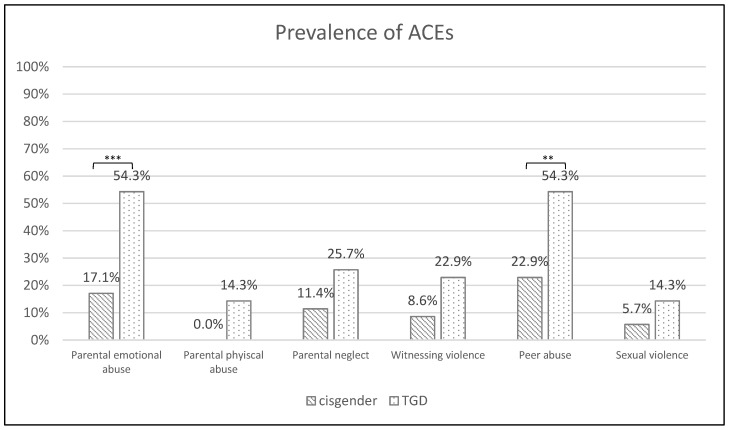
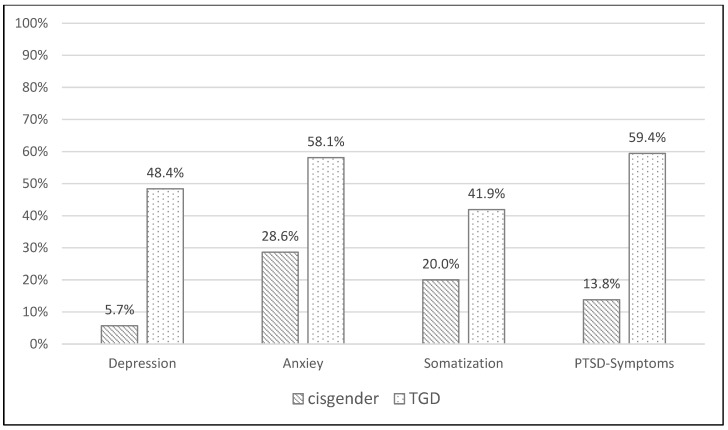
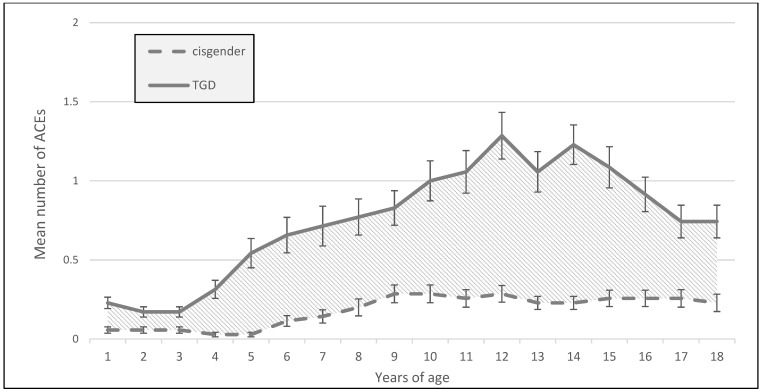
Adverse childhood experiences (ACE) have been shown to have a tremendous negative impact on health outcomes later in life. This study presents data on the prevalence of ACEs, psychological distress, and trauma-related symptoms in transgender and gender-diverse (TGD) people compared to cisgender people. TGD adults ( = 35) and a matched sample of nonpsychiatric hospital patients ( = 35) were surveyed between September 2018 and March 2019. Participants completed the Maltreatment and Abuse Chronology of Exposure Scale to assess ACEs, as well as the Brief Symptom Inventory and the Essener Trauma Inventory to assess psychological distress and trauma-related symptoms. TGD patients reported a higher number of ACEs than cisgender patients (0.7 vs. 2.4; < 0.001; d = 0.94). A total of 28.6% of TGD vs. 5.7% cisgender patients reported four or more ACEs ( < 0.001). The most common forms of ACEs were parental abuse (54.3%) and peer abuse (54.3%). No significantly increased prevalence of sexual abuse was found ( > 0.05). TGD patients also reported a higher prevalence of depression (48.4% vs. 5.7%, < 0.001), posttraumatic stress disorder symptoms (59.4% vs. 13.8%, < 0.001), and anxiety (58.1% vs. 28.6%, = 0.016). Health care providers should be aware of and assess ACEs, especially in vulnerable groups such as TGD people, and create a safe place through open-minded, affirming care.
童年不良经历(ACE)已被证明会对日后的健康状况产生巨大的负面影响。本研究呈现了与顺性别者相比,跨性别和性别多样化(TGD)人群中ACEs、心理困扰及创伤相关症状的患病率数据。在2018年9月至2019年3月期间,对35名TGD成年人和35名非精神科医院患者的匹配样本进行了调查。参与者完成了暴露于虐待和忽视的年代表量表以评估ACEs,以及简明症状量表和埃森纳创伤量表以评估心理困扰和创伤相关症状。TGD患者报告的ACEs数量高于顺性别患者(0.7对2.4;P<0.001;d=0.94)。共有28.6%的TGD患者与5.7%的顺性别患者报告有四种或更多的ACEs(P<0.001)。ACEs最常见的形式是父母虐待(54.3%)和同伴虐待(54.3%)。未发现性虐待的患病率有显著增加(P>0.05)。TGD患者还报告了更高的抑郁症患病率(48.4%对5.7%,P<0.001)、创伤后应激障碍症状患病率(59.4%对13.8%,P<0.001)和焦虑患病率(58.1%对28.6%,P=0.016)。医疗保健提供者应意识到并评估ACEs,尤其是在TGD人群等弱势群体中,并通过思想开放、肯定性的护理创造一个安全的环境。