CIRI-Centre International de Recherche en Infectiologie, Team GIMAP, Université Claude Bernard Lyon 1, Inserm, U1111, CNRS, UMR530, CIC 1408 Vaccinology, 42023 Saint-Etienne, France.
Service de Psychiatrie Transversale, Centre Hospitalo-Universitaire de Saint Etienne, Hôpital Nord, 42055 Saint-Etienne, France.
Int J Mol Sci. 2023 Jun 24;24(13):10568. doi: 10.3390/ijms241310568.
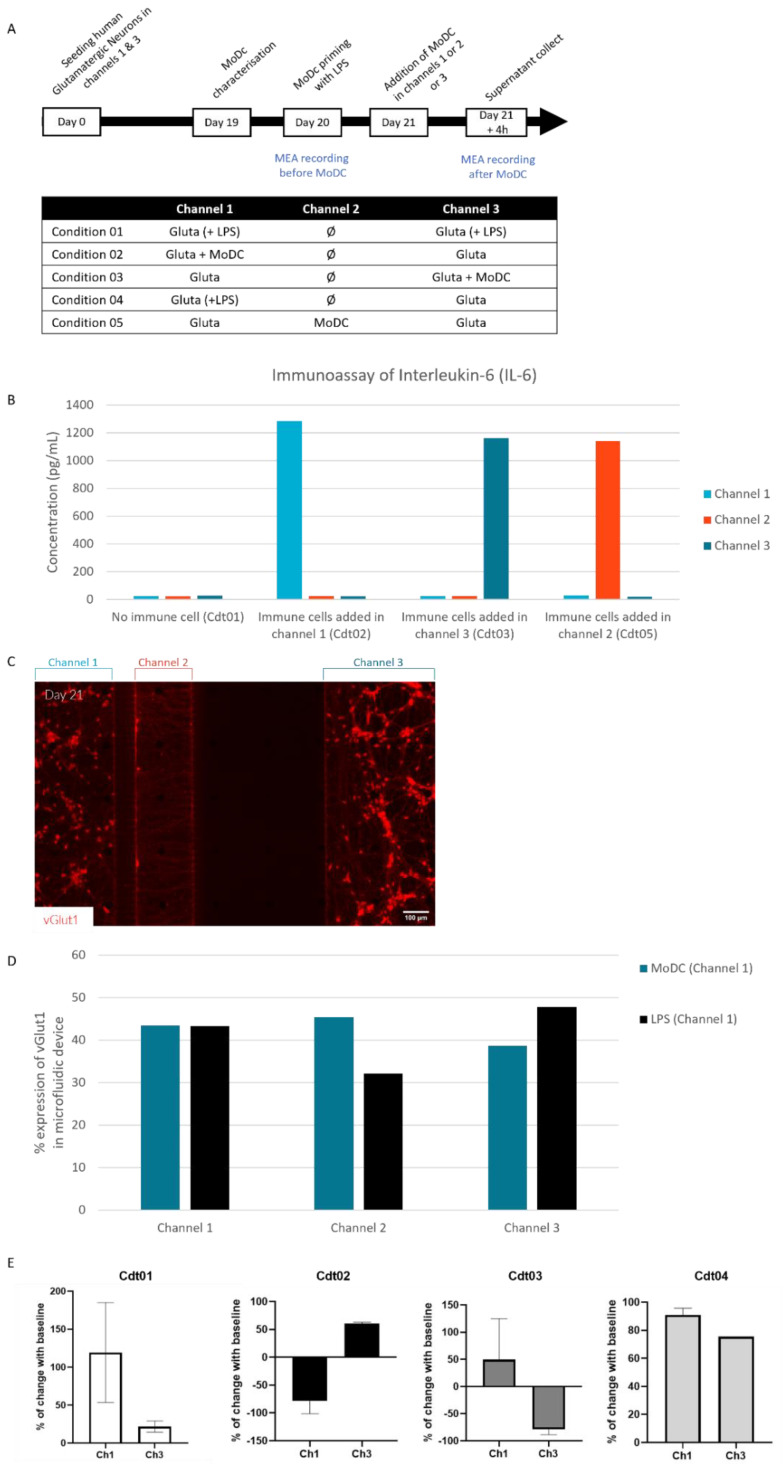
Inflammatory bowel diseases (IBD) are complex chronic inflammatory disorders of the gastrointestinal (GI) tract. Recent evidence suggests that the gut-brain axis may be pivotal in gastrointestinal and neurological diseases, especially IBD. Here, we present the first proof of concept for a microfluidic technology to model bilateral neuro-immunological communication. We designed a device composed of three compartments with an asymmetric channel that allows the isolation of soma and neurites thanks to microchannels and creates an in vitro synaptic compartment. Human-induced pluripotent stem cell-derived cortical glutamatergic neurons were maintained in soma compartments for up to 21 days. We performed a localized addition of dendritic cells (MoDCs) to either the soma or synaptic compartment. The microfluidic device was coupled with microelectrode arrays (MEAs) to assess the impact on the electrophysiological activity of neurons while adding dendritic cells. Our data highlight that an electrophysiologic signal is transmitted between two compartments of glutamatergic neurons linked by synapses in a bottom-up way when soma is exposed to primed dendritic cells. In conclusion, our study authenticates communication between dendritic cells and neurons in inflammatory conditions such as IBD. This platform opens the way to complexification with gut components to reach a device for pharmacological compound screening by blocking the gut-brain axis at a mucosal level and may help patients.
炎症性肠病(IBD)是一种复杂的慢性胃肠道(GI)炎症性疾病。最近的证据表明,肠道-大脑轴可能在胃肠道和神经疾病中起关键作用,尤其是 IBD。在这里,我们首次提出了一种用于模拟双侧神经免疫通讯的微流控技术的概念验证。我们设计了一种由三个隔室组成的装置,其中有一个不对称的通道,通过微通道可以隔离神经元体和神经突,并创建一个体外突触隔室。人类诱导多能干细胞衍生的皮质谷氨酸能神经元在神经元体隔室中培养长达 21 天。我们将树突状细胞(MoDC)局部添加到神经元体或突触隔室中。该微流控装置与微电极阵列(MEA)耦合,以评估向神经元添加树突状细胞对其电生理活性的影响。我们的数据表明,当神经元体暴露于成熟的树突状细胞时,通过突触以自下而上的方式在两个谷氨酸能神经元隔室之间传递电生理信号。总之,我们的研究证实了炎症条件下(如 IBD)树突状细胞和神经元之间的通讯。该平台为与肠道成分的复杂化开辟了道路,以达到通过在黏膜水平阻断肠道-大脑轴进行药物化合物筛选的设备,并可能帮助患者。