Department of Pharmacology and Toxicology, College of Pharmacy, Jazan University, Jazan 45142, Saudi Arabia.
Inflammation Pharmacology and Drug Discovery Unit, Medical Research Center (MRC), Jazan University, Jazan 45142, Saudi Arabia.
Int J Mol Sci. 2023 Jun 25;24(13):10621. doi: 10.3390/ijms241310621.
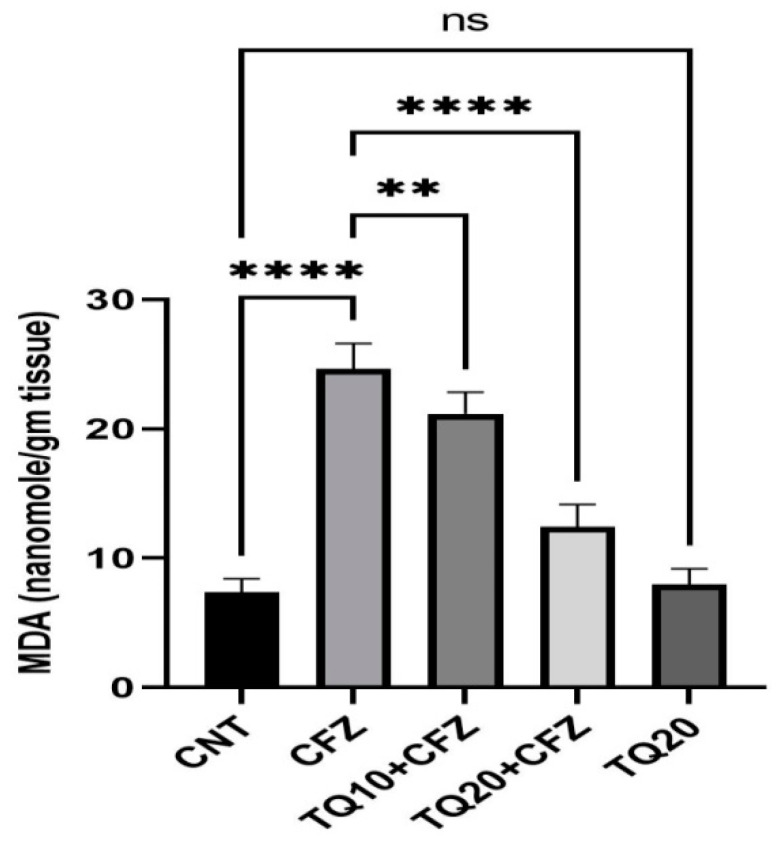
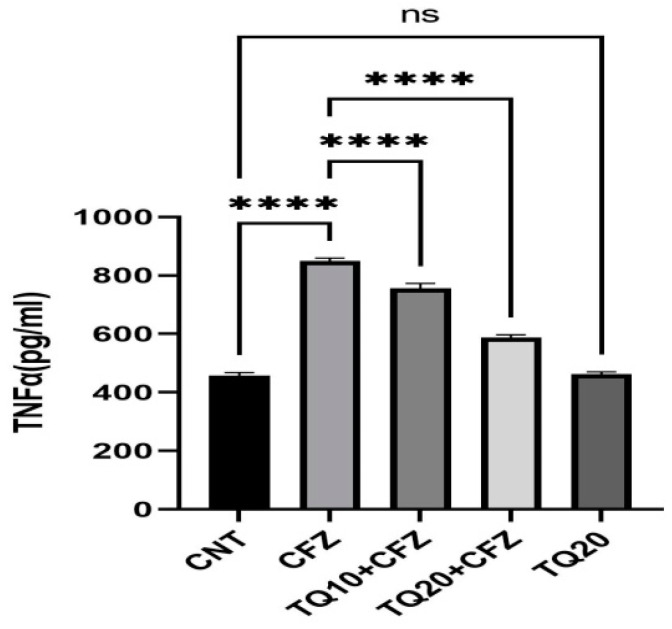
Chemotherapy-induced kidney damage is an emerging problem that restricts cancer treatment effectiveness. The proteasome inhibitor carfilzomib (CFZ) is primarily used to treat multiple myeloma and has been associated with severe renal injury in humans. CFZ-induced nephrotoxicity remains an unmet medical need, and there is an urgent need to find and develop a nephroprotective and antioxidant therapy for this condition. Thymoquinone (TQ) is a bioactive compound that has been isolated from Nigella sativa seeds. It has a wide range of pharmacological properties. Therefore, this experimental design aimed to study the effectiveness of TQ against CFZ-induced renal toxicity in rats. The first group of rats was a normal control (CNT); the second group received CFZ (4 mg/kg b.w.); the third and fourth groups received TQ (10 and 20 mg/kg b.w.) 2 h before receiving CFZ; the fifth group received only TQ (20 mg/kg b.w.). This experiment was conducted for 16 days, and at the end of the experiment, blood samples and kidney tissue were collected for biochemical assays. The results indicated that administration of CFZ significantly enhanced serum marker levels such as BUN, creatinine, and uric acid in the CFZ group. Similarly, it was also noticed that CFZ administration induced oxidative stress by reducing antioxidants (GSH) and antioxidant enzymes (CAT and SOD) and increasing lipid peroxidation. CFZ treatment also enhanced the expression of IL-1β, IL-6, and TNF-α production. Moreover, CFZ increased caspase-3 concentrations and reduced Nrf2 expression in the CFZ-administered group. However, treatment with 10 and 20 mg/kg TQ significantly decreased serum markers and increased antioxidant enzymes. TQ treatment considerably reduced IL-1β, IL-6, TNF-α, and caspase-3 concentrations. Overall, this biochemical estimation was also supported by histopathological outcomes. This study revealed that TQ administration significantly mitigated the negative effects of CFZ treatment on Nrf2 expression. Thus, it indicates that TQ may have utility as a potential drug to prevent CFZ-induced nephrotoxicity in the future.
化疗引起的肾损伤是一个新出现的问题,限制了癌症治疗的效果。蛋白酶体抑制剂卡非佐米(CFZ)主要用于治疗多发性骨髓瘤,并已被证实与人类的严重肾损伤有关。CFZ 诱导的肾毒性仍然是一个未满足的医疗需求,迫切需要为这种情况找到和开发一种肾保护和抗氧化治疗方法。姜黄素(TQ)是一种从黑种草种子中分离出来的生物活性化合物。它具有广泛的药理作用。因此,本实验设计旨在研究 TQ 对 CFZ 诱导的大鼠肾毒性的作用。第一组大鼠为正常对照组(CNT);第二组给予 CFZ(4mg/kg b.w.);第三组和第四组在给予 CFZ 前 2 小时给予 TQ(10 和 20mg/kg b.w.);第五组仅给予 TQ(20mg/kg b.w.)。本实验进行了 16 天,实验结束时采集血样和肾组织进行生化分析。结果表明,CFZ 给药显著提高了 CFZ 组血清标志物水平,如 BUN、肌酐和尿酸。同样,也注意到 CFZ 给药通过降低抗氧化剂(GSH)和抗氧化酶(CAT 和 SOD)和增加脂质过氧化来诱导氧化应激。CFZ 处理还增加了 IL-1β、IL-6 和 TNF-α的产生。此外,CFZ 增加了 caspase-3 浓度并降低了 CFZ 给药组的 Nrf2 表达。然而,10 和 20mg/kg TQ 的治疗显著降低了血清标志物并增加了抗氧化酶。TQ 治疗显著降低了 IL-1β、IL-6、TNF-α和 caspase-3 浓度。总体而言,这项生化评估也得到了组织病理学结果的支持。这项研究表明,TQ 给药显著减轻了 CFZ 处理对 Nrf2 表达的负面影响。因此,它表明 TQ 可能具有作为预防 CFZ 诱导的肾毒性的潜在药物的用途。