Cancer Gene Therapy Group, Latvian Biomedical Research and Study Centre, Ratsupites Str. 1, k.1, LV-1067 Riga, Latvia.
Int J Mol Sci. 2023 Jun 28;24(13):10763. doi: 10.3390/ijms241310763.
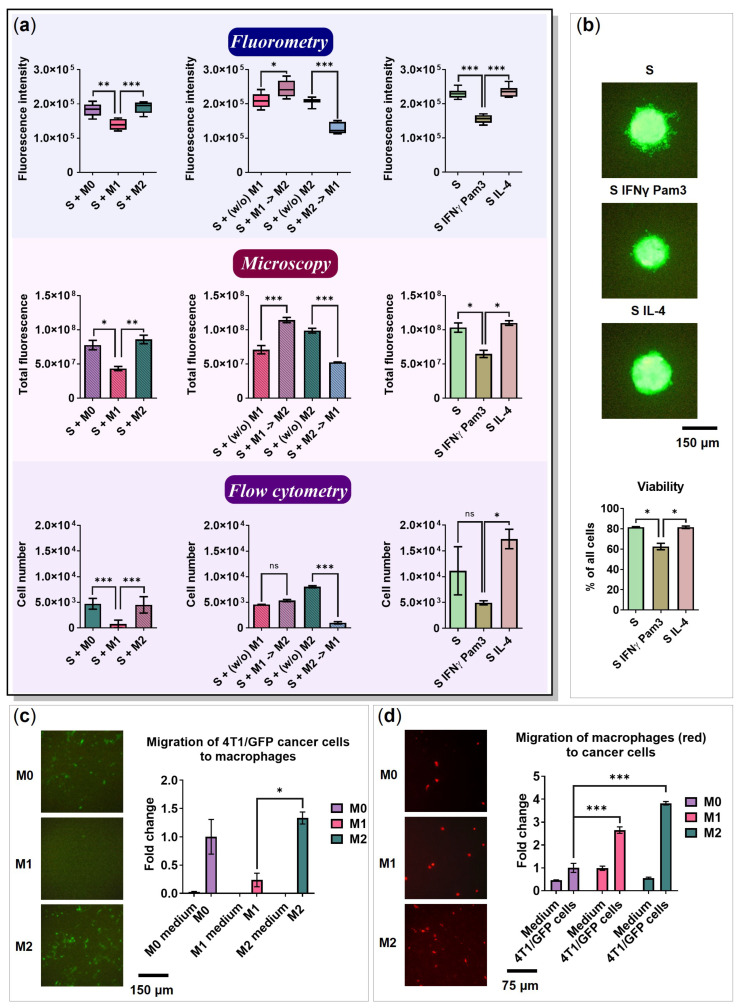
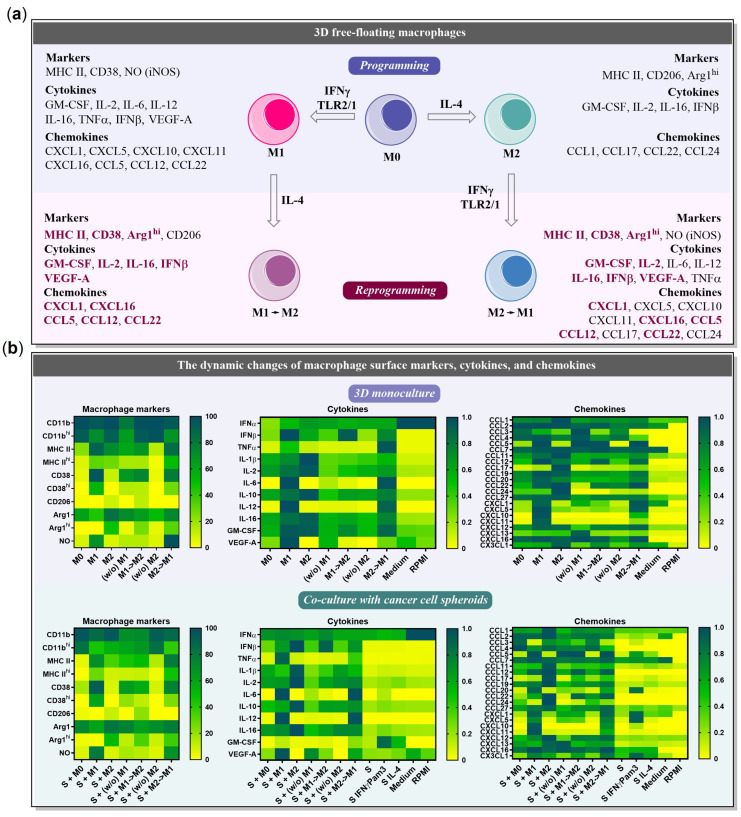
Reprogramming of tumor-associated macrophages (TAMs) is a promising strategy for cancer immunotherapy. Several studies have shown that cancer cells induce/support the formation of immunosuppressive TAMs phenotypes. However, the specific factors that orchestrate this immunosuppressive process are unknown or poorly studied. In vivo studies are expensive, complex, and ethically constrained. Therefore, 3D cell interaction models could become a unique framework for the identification of important TAMs programming factors. In this study, we have established and characterized a new in vitro 3D model for macrophage programming in the presence of cancer cell spheroids. First, it was demonstrated that the profile of cytokines, chemokines, and surface markers of 3D-cultured macrophages did not differ conceptually from monolayer-cultured M1 and M2-programmed macrophages. Second, the possibility of reprogramming macrophages in 3D conditions was investigated. In total, the dynamic changes in 6 surface markers, 11 cytokines, and 22 chemokines were analyzed upon macrophage programming (M1 and M2) and reprogramming (M1→M2 and M2→M1). According to the findings, the reprogramming resulted in a mixed macrophage phenotype that expressed both immunosuppressive and anti-cancer immunostimulatory features. Third, cancer cell spheroids were shown to stimulate the production of immunosuppressive M2 markers as well as pro-tumor cytokines and chemokines. In summary, the newly developed 3D model of cancer cell spheroid/macrophage co-culture under free-floating conditions can be used for studies on macrophage plasticity and for the development of targeted cancer immunotherapy.
重编程肿瘤相关巨噬细胞(TAMs)是癌症免疫治疗的一种有前途的策略。几项研究表明,癌细胞诱导/支持形成免疫抑制性 TAMs 表型。然而,协调这种免疫抑制过程的具体因素尚不清楚或研究甚少。体内研究昂贵、复杂且受到伦理限制。因此,3D 细胞相互作用模型可能成为鉴定重要 TAMs 编程因子的独特框架。在这项研究中,我们建立并表征了一种新的体外 3D 模型,用于在存在癌细胞球体的情况下对巨噬细胞进行编程。首先,证明了 3D 培养的巨噬细胞的细胞因子、趋化因子和表面标志物谱与单层培养的 M1 和 M2 编程巨噬细胞在概念上没有区别。其次,研究了在 3D 条件下重编程巨噬细胞的可能性。总共分析了 6 个表面标志物、11 个细胞因子和 22 个趋化因子在巨噬细胞编程(M1 和 M2)和重编程(M1→M2 和 M2→M1)过程中的动态变化。根据研究结果,重编程导致表达免疫抑制和抗肿瘤免疫刺激特征的混合巨噬细胞表型。第三,癌细胞球体被证明可刺激产生免疫抑制性 M2 标志物以及促肿瘤细胞因子和趋化因子。总之,新开发的癌细胞球体/巨噬细胞共培养的 3D 模型在自由浮动条件下可用于研究巨噬细胞的可塑性和开发靶向癌症免疫治疗。