Department of Chemistry, University of Missouri, 601 S. College Avenue, Columbia, MO 65211, USA.
Molecules. 2023 Jun 27;28(13):5011. doi: 10.3390/molecules28135011.
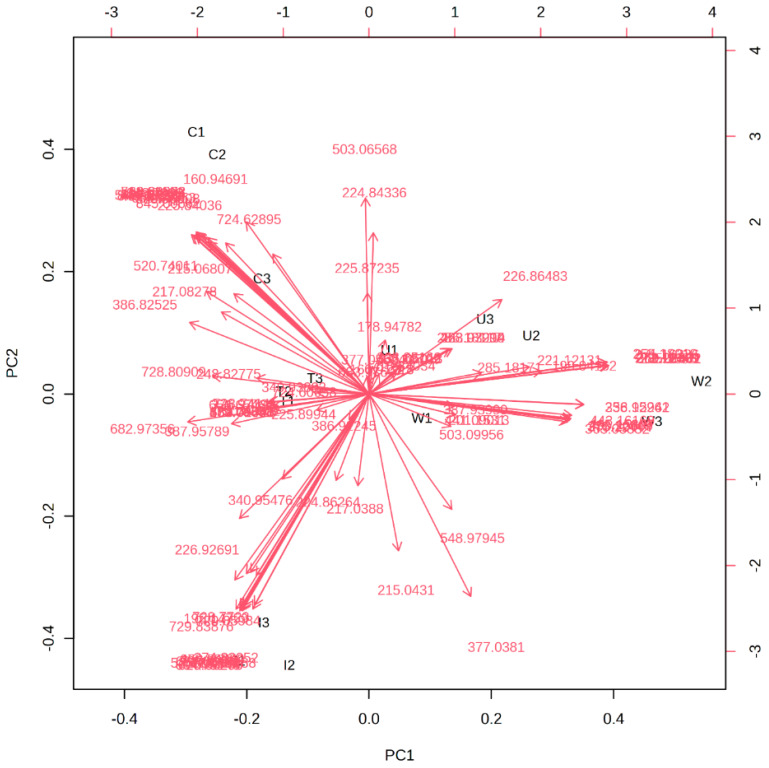
The presence of phenolic compounds in honey can serve as potential authenticity markers for honey's botanical or geographical origins. The composition and properties of honey can vary greatly depending on the floral and geographical origins. This study focuses on identifying the specific markers that can distinguish honey based on their geographical areas in the United States. The main approach presented in this study to identify the geographic origins of honey involves chemometric methods combined with phenolic compound fingerprinting. Sample clean-up and phenolic compound extraction was carried out using solid phase extraction (SPE). Reversed phase liquid chromatography in combination with tandem mass spectrometry were utilized for the separation of the compounds. The honey physicochemical qualities were predominantly determined via spectrophotometric methods. Multivariate statistical tools such as principal component analysis (PCA), analysis of variance (ANOVA), and partial-least squares discriminant analysis (PLS-DA) were employed as both classification and feature selection tools. Overall, the present study was able to identify the presence of 12 potential markers to differentiate the honey's geographical origins. The total phenolic content ranged from 81.6 to 105.7 mg GAE/100 g corresponding to honey from Colorado and Washington, respectively (GAE: gallic acid equivalents). The regression analysis shows a tendency for the total phenolic content of honey to increase as the color of honey increases. The most important result obtained in this study is the demonstration that the geographical origin of honey plays a critical role in predicting the physical properties and phenolic composition of honey.
蜂蜜中酚类化合物的存在可以作为蜂蜜植物学或地理起源的潜在真实性标志物。蜂蜜的组成和性质会因花卉和地理来源的不同而有很大差异。本研究专注于确定可以根据美国地理区域来区分蜂蜜的特定标志物。本研究中确定蜂蜜地理起源的主要方法涉及化学计量学方法与酚类化合物指纹图谱相结合。使用固相萃取(SPE)进行样品净化和酚类化合物提取。采用反相液相色谱与串联质谱联用对化合物进行分离。蜂蜜的物理化学性质主要通过分光光度法确定。主成分分析(PCA)、方差分析(ANOVA)和偏最小二乘判别分析(PLS-DA)等多元统计工具被用作分类和特征选择工具。总的来说,本研究能够识别出 12 种潜在标志物,以区分蜂蜜的地理起源。总酚含量范围为 81.6 至 105.7 mg GAE/100 g,分别对应于科罗拉多州和华盛顿州的蜂蜜(GAE:没食子酸当量)。回归分析表明,蜂蜜的总酚含量随着蜂蜜颜色的加深而有增加的趋势。本研究最重要的结果是证明了蜂蜜的地理起源在预测蜂蜜的物理性质和酚类组成方面起着关键作用。