Henan Key Laboratory of Bimolecular Reorganization and Sensing, Henan Engineering Center of New Energy Battery Materials, School of Chemistry and Chemical Engineering, Shangqiu Normal University, Shangqiu 476000, China.
School of Petrochemical Engineering, Liaoning Petrochemical University, Fushun 113001, China.
Molecules. 2023 Jul 5;28(13):5212. doi: 10.3390/molecules28135212.
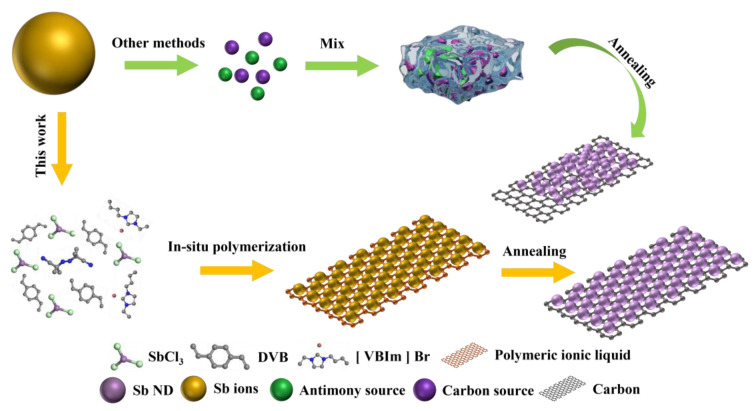
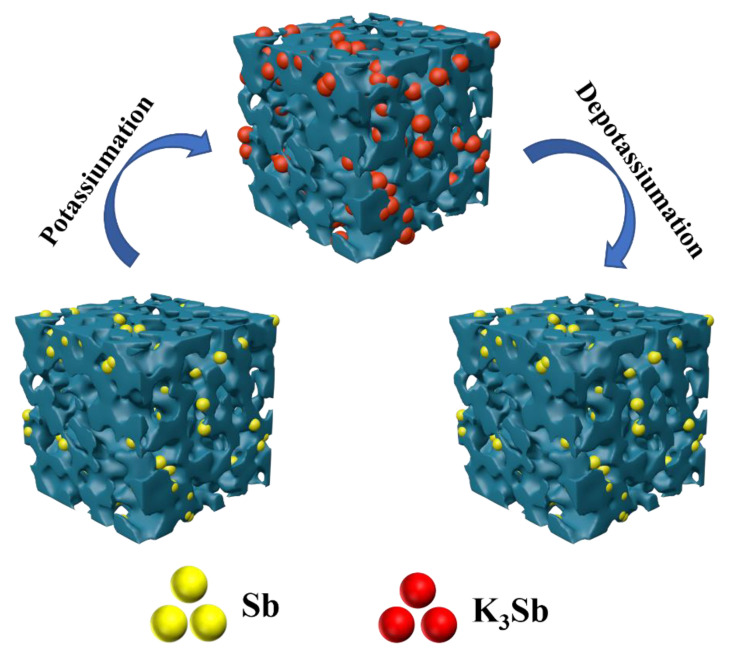
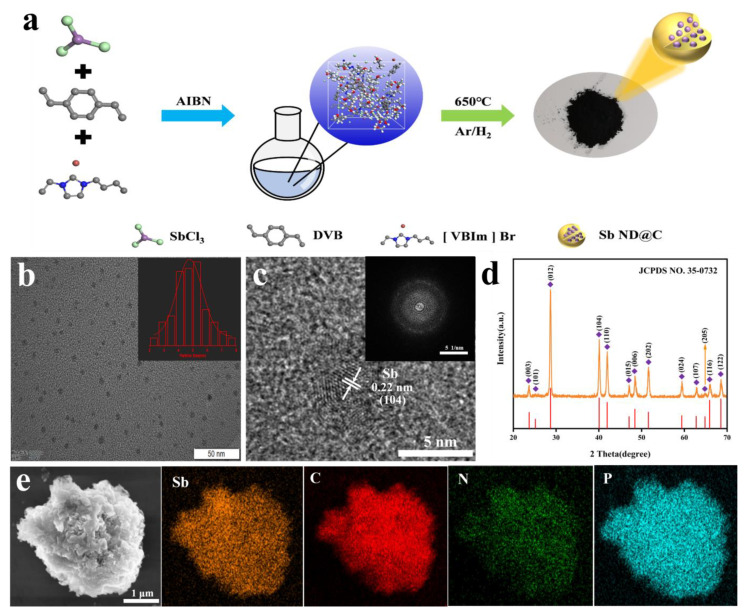
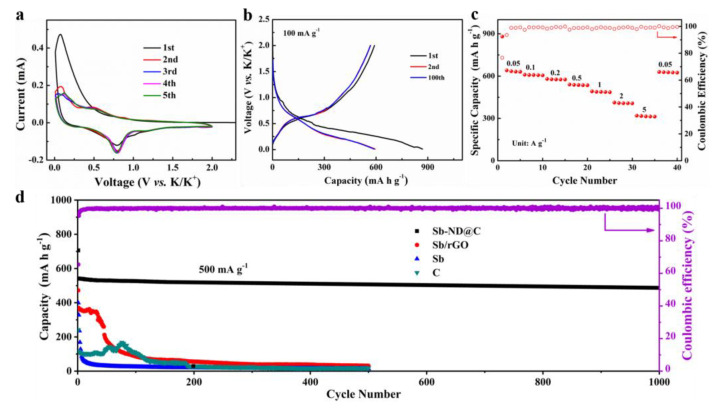
Antimony (Sb) is a potential candidate anode for potassium-ion batteries (PIBs) owing to its high theoretical capacity. However; in the process of potassium alloying reaction; the huge volume expansion (about 407%) leads to pulverization of active substance as well as loss of electrical contact resulting in rapidly declining capacity. Herein; uniformly dispersed Sb-Nanodot in carbon frameworks (Sb-ND@C) were constructed by in situ confined polymerization of ionic liquids. Attributed to the uniformly dispersed Sb-ND and confinement effect of carbon frameworks; as anode for PIBs; Sb-ND@C delivered a superior rate capability (320.1 mA h g at 5 A g) and an outstanding cycling stability (486 mA h g after 1000 cycles; achieving 89.8% capacity retention). This work offers a facile route to prepare highly dispersed metal-Nanodot via the in situ polymerization of ionic liquid for high-performance metal-ion batteries.
锑 (Sb) 因其高理论容量而成为钾离子电池 (PIB) 的潜在候选阳极。然而;在钾合金化反应过程中;巨大的体积膨胀(约 407%)导致活性物质粉碎以及电接触损失,从而导致容量迅速下降。在此;通过离子液体的原位受限聚合,构建了均匀分散在碳框架中的 Sb-Nanodot(Sb-ND@C)。由于 Sb-ND 的均匀分散和碳框架的限制作用,作为 PIB 的阳极,Sb-ND@C 表现出优异的倍率性能(在 5 A g 时为 320.1 mA h g)和出色的循环稳定性(在 1000 次循环后为 486 mA h g,容量保持率为 89.8%)。这项工作提供了一种通过离子液体的原位聚合制备高度分散的金属-Nanodot 的简便途径,可用于高性能金属离子电池。