Lamport Derek T A
School of Life Sciences, University of Sussex, Brighton BN1 9QG, UK.
Plants (Basel). 2023 Jul 3;12(13):2531. doi: 10.3390/plants12132531.
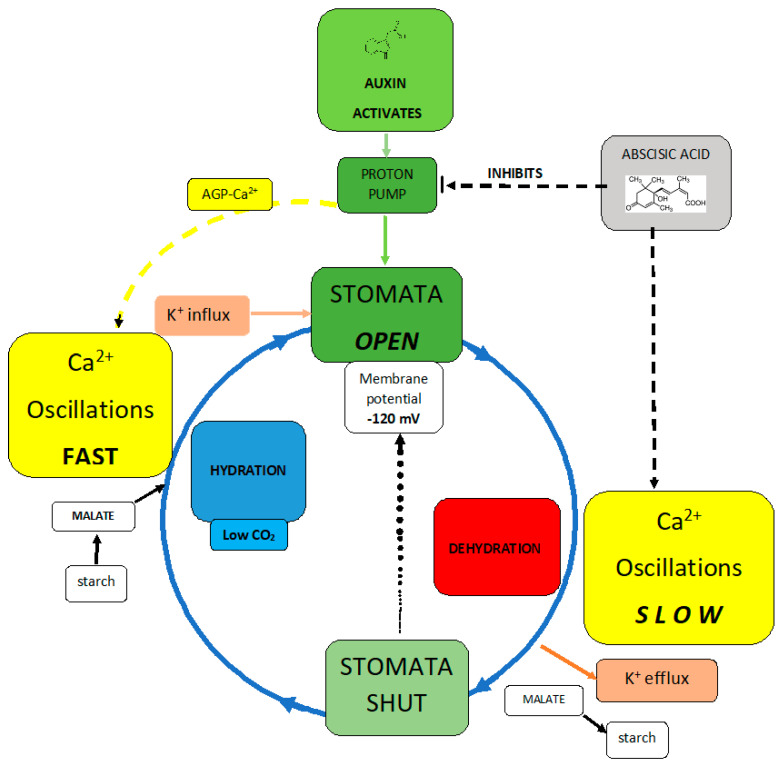
Since Darwin's "Power of Movement in Plants" the precise mechanism of oscillatory plant growth remains elusive. Hence the search continues for the hypothetical growth oscillator that regulates a huge range of growth phenomena ranging from circumnutation to pollen tube tip growth and stomatal movements. Oscillators are essentially simple devices with few components. A universal growth oscillator with only four major components became apparent recently with the discovery of a missing component, notably arabinogalactan glycoproteins (AGPs) that store dynamic Ca at the cell surface. Demonstrably, auxin-activated proton pumps, AGPs, Ca channels, and auxin efflux "PIN" proteins, embedded in the plasma membrane, combine to generate cytosolic Ca oscillations that ultimately regulate oscillatory growth: Hechtian adhesion of the plasma membrane to the cell wall and auxin-activated proton pumps trigger the release of dynamic Ca stored in periplasmic AGP monolayers. These four major components represent a molecular PINball machine a strong visual metaphor that also recognises auxin efflux "PIN" proteins as an essential component. Proton "pinballs" dissociate Ca ions bound by paired glucuronic acid residues of AGP glycomodules, hence reassessing the role of proton pumps. It shifts the prevalent paradigm away from the recalcitrant "acid growth" theory that proposes direct action on cell wall properties, with an alternative explanation that connects proton pumps to Ca signalling with dynamic Ca storage by AGPs, auxin transport by auxin-efflux PIN proteins and Ca channels. The extensive Ca signalling literature of plants ignores arabinogalactan proteins (AGPs). Such scepticism leads us to reconsider the validity of the universal growth oscillator proposed here with some exceptions that involve marine plants and perhaps the most complex stress test, stomatal regulation.
自达尔文的《植物的运动力》以来,植物振荡生长的确切机制仍然难以捉摸。因此,人们继续寻找一种假设的生长振荡器,它能调节从植物旋转运动到花粉管顶端生长和气孔运动等一系列广泛的生长现象。振荡器本质上是由少数组件构成的简单装置。最近,随着一个缺失组件的发现,一种仅由四个主要组件构成的通用生长振荡器变得清晰起来,这个组件就是在细胞表面储存动态钙的阿拉伯半乳聚糖糖蛋白(AGP)。显然,嵌入质膜的生长素激活质子泵、AGP、钙通道和生长素外排“PIN”蛋白共同作用,产生胞质钙振荡,最终调节振荡生长:质膜与细胞壁的赫希安黏附以及生长素激活质子泵触发了储存于周质AGP单分子层中的动态钙的释放。这四个主要组件构成了一个分子弹球机,这是一个很形象的比喻,同时也将生长素外排“PIN”蛋白视为一个关键组件。质子“弹球”使与AGP糖模块的成对葡萄糖醛酸残基结合的钙离子解离,从而重新评估了质子泵的作用。它将普遍流行的范式从顽固的“酸生长”理论中转移出来,“酸生长”理论认为质子直接作用于细胞壁特性,而现在有一种替代解释将质子泵与钙信号传导联系起来,即通过AGP进行动态钙储存、通过生长素外排PIN蛋白进行生长素运输以及通过钙通道进行钙运输。植物界大量关于钙信号传导的文献都忽略了阿拉伯半乳聚糖蛋白(AGP)。这种怀疑促使我们重新考虑这里提出的通用生长振荡器的有效性,不过存在一些例外情况,涉及海洋植物,也许还有最复杂的应激测试——气孔调节。