Department of Internal Medicine III, University of Giessen, Klinikstr. 33, 35392 Giessen, Germany.
Nutrients. 2023 Jul 3;15(13):3021. doi: 10.3390/nu15133021.
Obesity and related diseases are among the main public health issues in the western world. They are thought to be caused by a state of chronic, low-grade inflammation. Cathelicidin antimicrobial peptide (CAMP) was recently discovered to be expressed and secreted by adipocytes. Representing a novel immunomodulatory adipokine, CAMP might play an important role in the complex interaction between metabolism and inflammation.
In a cohort of 80 volunteers, serum samples were collected prior to, and 2 h, 4 h, and 6 h after, oral lipid ingestion. CAMP, fatty acid binding proteins 2 and 4 (FABP-2/-4), and dipeptidylpeptidase-4 (DPP-4) serum concentrations were measured via ELISA. Human Simpson-Golabi-Behmel syndrome (SGBS) adipocytes were treated with free fatty acids, and gene expression levels of , , and were quantified by RT-PCR.
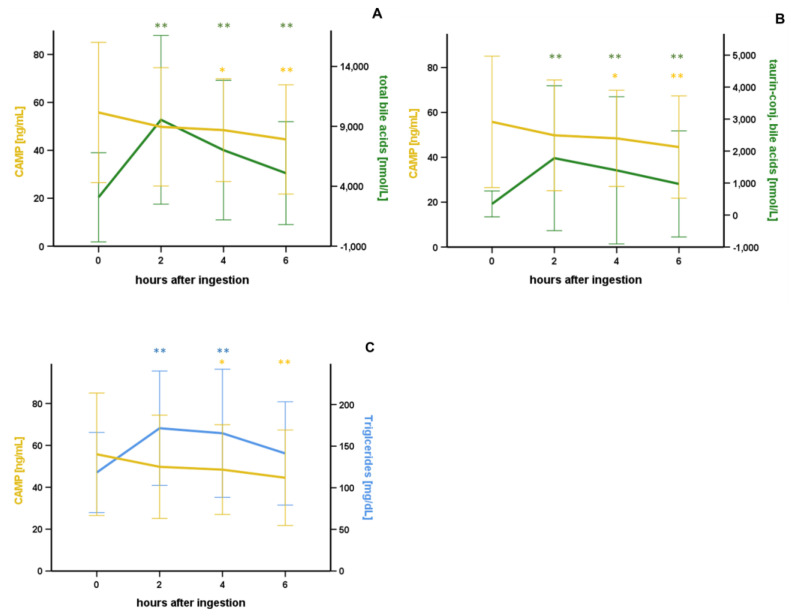
The mean base-line CAMP serum concentration was 55.78 ± 29.26 ng/mL, with a range of 10.77-146.24 ng/mL. Interestingly, CAMP serum levels were positively correlated with LDL cholesterol, but negatively correlated with HDL cholesterol and adiponectin. Men exhibited higher CAMP serum concentrations than women, an effect apparently linked to oral contraception in the majority of female participants. In both genders, CAMP serum concentrations significantly decreased in a stepwise manner 4 h and 6 h after oral lipid ingestion. This decline was paralleled by a rise of serum bile acid and triglyceride levels upon lipid ingestion. In human SGBS adipocytes, treatment with free fatty acids did not affect gene expression, but increased gene expression.
In conclusion, systemic levels of the antimicrobial peptide and novel adipokine CAMP are significantly decreased upon oral lipid ingestion. While this decline might be linked to the simultaneous increase in bile acids, the underlying mechanisms remain to be elucidated. Furthermore, CAMP might indicate a putative novel cardiovascular biomarker of both inflammatory and metabolic relevance in metaflammation and adipose inflammation.
肥胖症和相关疾病是西方国家主要的公共卫生问题之一。人们认为,这些问题是由慢性低度炎症引起的。抗菌肽(CAMP)最近被发现由脂肪细胞表达和分泌。作为一种新型的免疫调节脂肪因子,CAMP 可能在代谢和炎症的复杂相互作用中发挥重要作用。
在 80 名志愿者的队列中,在口服脂质摄入前、摄入后 2 小时、4 小时和 6 小时采集血清样本。通过 ELISA 测量 CAMP、脂肪酸结合蛋白 2 和 4(FABP-2/-4)和二肽基肽酶-4(DPP-4)的血清浓度。用人 Simpson-Golabi-Behmel 综合征(SGBS)脂肪细胞用游离脂肪酸处理,并通过 RT-PCR 定量测定 、 和 的基因表达水平。
平均基础 CAMP 血清浓度为 55.78±29.26ng/mL,范围为 10.77-146.24ng/mL。有趣的是,CAMP 血清水平与 LDL 胆固醇呈正相关,但与 HDL 胆固醇和脂联素呈负相关。男性的 CAMP 血清浓度高于女性,这种效应显然与大多数女性参与者口服避孕药有关。在两性中,口服脂质后 CAMP 血清浓度呈阶梯式显著降低,4 小时和 6 小时后。这种下降伴随着脂质摄入后血清胆汁酸和甘油三酯水平的升高。在人 SGBS 脂肪细胞中,游离脂肪酸处理不会影响 基因表达,但会增加 基因表达。
总之,口服脂质后,系统水平的抗菌肽和新型脂肪因子 CAMP 显著降低。虽然这种下降可能与同时增加的胆汁酸有关,但潜在机制仍有待阐明。此外,CAMP 可能表明在炎症和代谢相关的脂肪炎症中,有一个潜在的新型心血管炎症和代谢标志物。