Department of Biomedical Engineering, I-Shou University, Kaohsiung 84001, Taiwan.
Department of Computer Science and Information Engineering, Chaoyang University of Technology, Taichung 413310, Taiwan.
Sensors (Basel). 2023 Jun 22;23(13):5818. doi: 10.3390/s23135818.
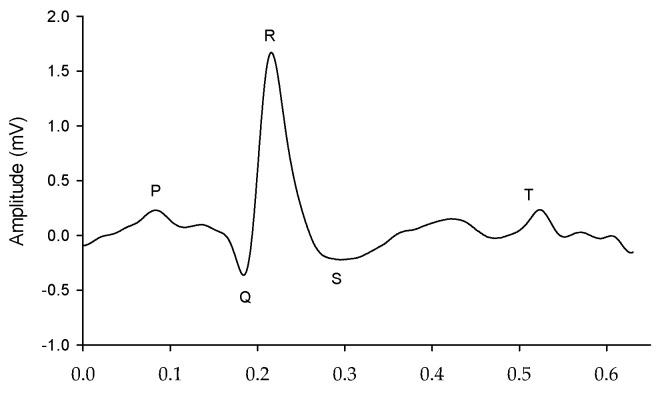
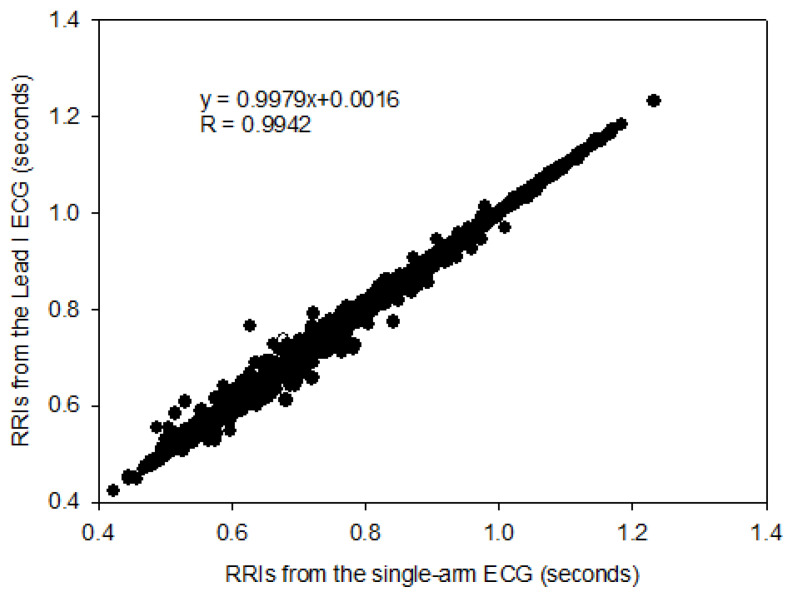
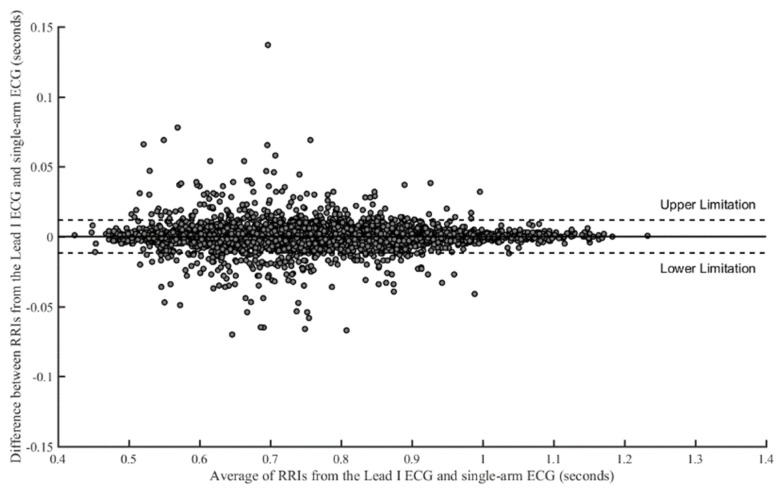
The number of people experiencing mental stress or emotional dysfunction has increased since the onset of the COVID-19 pandemic, as many individuals have had to adapt their daily lives. Numerous studies have demonstrated that mental health disorders can pose a risk for certain diseases, and they are also closely associated with the problem of mental workload. Now, wearable devices and mobile health applications are being utilized to monitor and assess individuals' mental health conditions on a daily basis using heart rate variability (HRV), typically measured by the R-to-R wave interval (RRI) of an electrocardiogram (ECG). However, portable or wearable ECG devices generally require two electrodes to perform bipolar limb leads, such as the Einthoven triangle. This study aims to develop a single-arm ECG measurement method, with lead I ECG serving as the gold standard. We conducted static and dynamic experiments to analyze the morphological performance and signal-to-noise ratio (SNR) of the single-arm ECG. Three morphological features were defined, RRI, the duration of the QRS complex wave, and the amplitude of the R wave. Thirty subjects participated in this study. The results indicated that RRI exhibited the highest cross-correlation (R = 0.9942) between the single-arm ECG and lead I ECG, while the duration of the QRS complex wave showed the weakest cross-correlation (R = 0.2201). The best SNR obtained was 26.1 ± 5.9 dB during the resting experiment, whereas the worst SNR was 12.5 ± 5.1 dB during the raising and lowering of the arm along the z-axis. This single-arm ECG measurement method offers easier operation compared to traditional ECG measurement techniques, making it applicable for HRV measurement and the detection of an irregular RRI.
自 COVID-19 大流行以来,经历心理压力或情绪功能障碍的人数有所增加,因为许多人不得不调整日常生活。许多研究表明,心理健康障碍可能会增加某些疾病的风险,而且它们与心理工作量问题密切相关。现在,可穿戴设备和移动健康应用程序正被用于通过心率变异性(HRV)来监测和评估个体的日常心理健康状况,通常通过心电图(ECG)的 R 波到 R 波间隔(RRI)来测量。然而,便携式或可穿戴 ECG 设备通常需要两个电极来执行双极肢体导联,例如埃因托芬三角。本研究旨在开发一种单臂 ECG 测量方法,以导联 I ECG 作为金标准。我们进行了静态和动态实验,以分析单臂 ECG 的形态表现和信噪比(SNR)。定义了三个形态特征,即 RRI、QRS 复合波的持续时间和 R 波的幅度。30 名受试者参与了这项研究。结果表明,在单臂 ECG 和导联 I ECG 之间,RRI 的相关性最高(R=0.9942),而 QRS 复合波的持续时间相关性最低(R=0.2201)。在静息实验中获得的最佳 SNR 为 26.1±5.9dB,而在沿 z 轴抬起和放下手臂时最差 SNR 为 12.5±5.1dB。与传统的 ECG 测量技术相比,这种单臂 ECG 测量方法操作更加简单,适用于 HRV 测量和不规则 RRI 的检测。