Department of Plant Sciences, University of California, Davis, CA 95616, USA.
Division of Agriculture and Natural Resources, University of California, Davis, CA 95618, USA.
Sensors (Basel). 2023 Jul 7;23(13):6218. doi: 10.3390/s23136218.
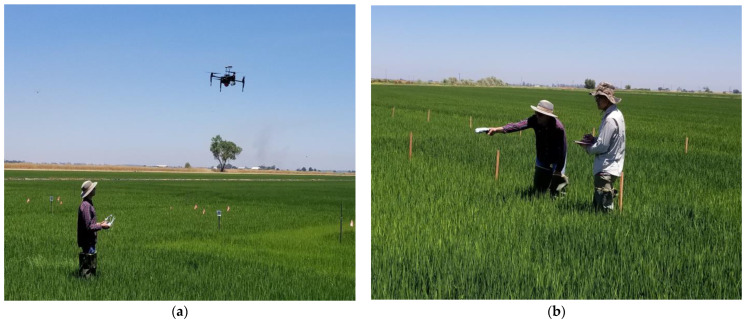
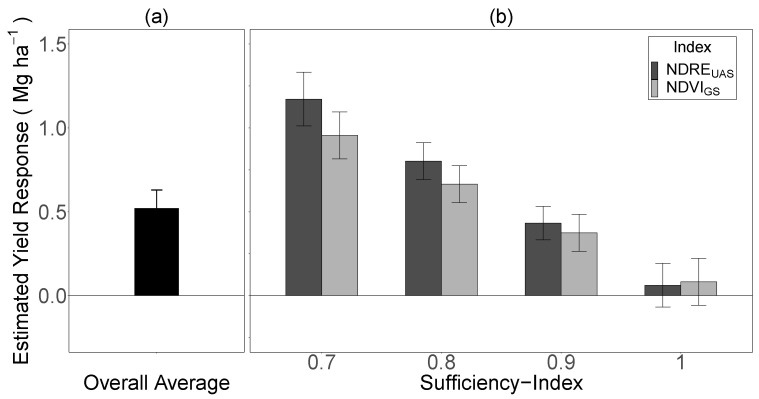
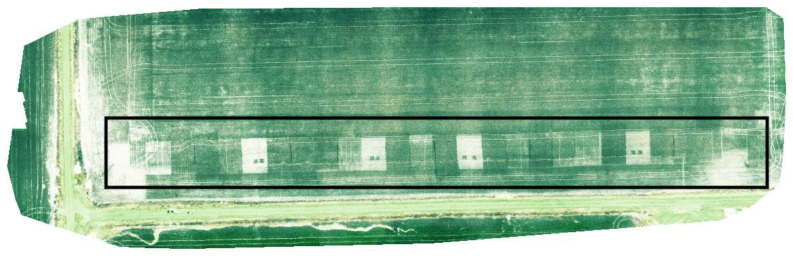
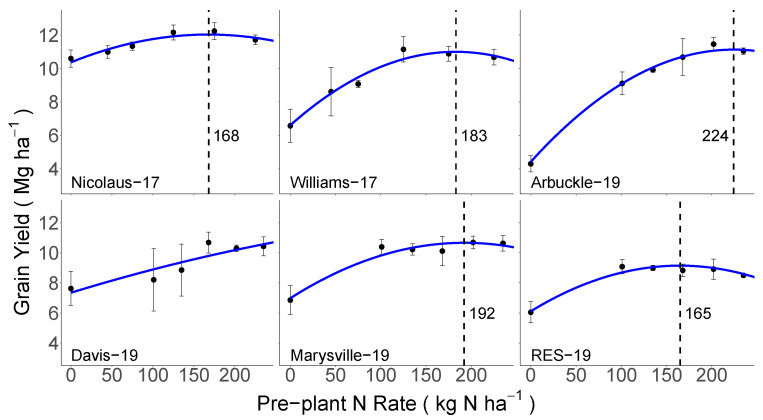
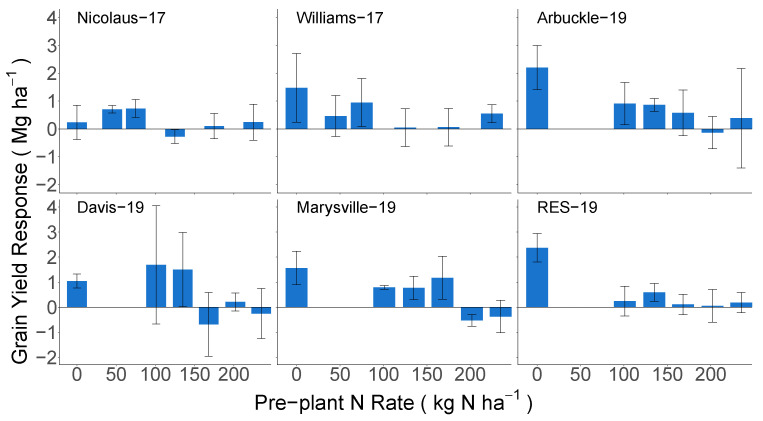
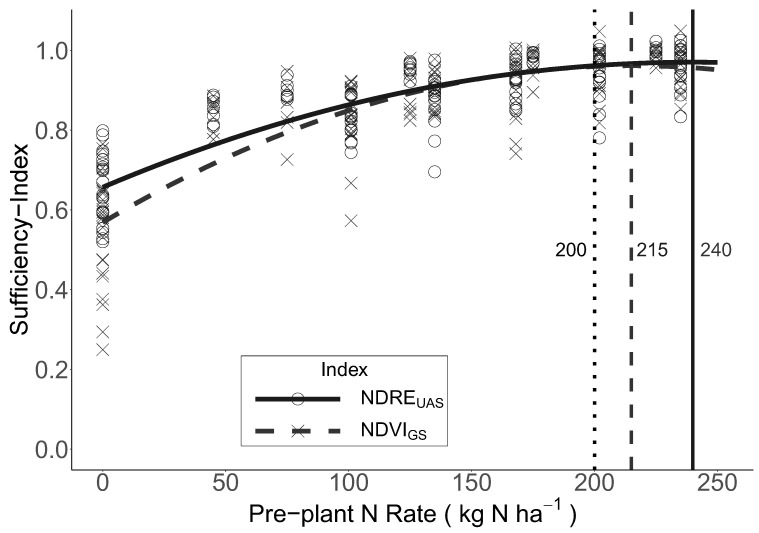
Accurately detecting nitrogen (N) deficiency and determining the need for additional N fertilizer is a key challenge to achieving precise N management in many crops, including rice ( L.). Many remotely sensed vegetation indices (VIs) have shown promise in this regard; however, it is not well-known if VIs measured from different sensors can be used interchangeably. The objective of this study was to quantitatively test and compare the ability of VIs measured from an aerial and proximal sensor to predict the crop yield response to top-dress N fertilizer in rice. Nitrogen fertilizer response trials were established across two years (six site-years) throughout the Sacramento Valley rice-growing region of California. At panicle initiation (PI), unmanned aircraft system (UAS) Normalized Difference Red-Edge Index (NDRE) and GreenSeeker (GS) Normalized Difference Vegetation Index (NDVI) were measured and expressed as a sufficiency index (SI) (VI of N treatment divided by VI of adjacent N-enriched area). Following reflectance measurements, each plot was split into subplots with and without top-dress N fertilizer. All metrics evaluated in this study indicated that both NDRE and NDVI performed similarly with respect to predicting the rice yield response to top-dress N at PI. Utilizing SI measurements prior to top-dress N fertilizer application resulted in a 113% and 69% increase (for NDRE and NDVI, respectively) in the precision of the rice yield response differentiation compared to the effect of applying top-dress N without SI information considered. When the SI measured via NDRE and NDVI at PI was ≤0.97 and 0.96, top-dress N applications resulted in a significant ( < 0.05) increase in crop yield of 0.19 and 0.21 Mg ha, respectively. These results indicate that both aerial NDRE and proximal NDVI have the potential to accurately predict the rice yield response to PI top-dress N fertilizer in this system and could serve as the basis for developing a decision support tool for farmers that could potentially inform better N management and improve N use efficiency.
准确检测氮(N)缺乏并确定是否需要额外的 N 肥是实现许多作物(包括水稻)精确 N 管理的关键挑战。许多遥感植被指数(VIs)在这方面显示出了前景;然而,目前尚不清楚是否可以互换使用来自不同传感器的 VIs。本研究的目的是定量测试和比较从航空和近地传感器测量的 VIs 预测水稻穗期 N 肥追肥对作物产量响应的能力。在加利福尼亚州萨克拉门托河谷水稻种植区的两年(六个站点年)中建立了氮肥响应试验。在颖花启动(PI)时,测量了无人飞行器系统(UAS)归一化差异红边指数(NDRE)和 GreenSeeker(GS)归一化差异植被指数(NDVI),并表示为充足指数(SI)(N 处理的 VI 除以相邻 N 富集区的 VI)。在进行反射率测量后,每个小区分为施追肥 N 和不施追肥 N 的小区。本研究评估的所有指标均表明,NDRE 和 NDVI 在预测 PI 期追肥 N 对水稻产量的响应方面表现相似。在施用追肥 N 之前利用 SI 测量值,与不考虑 SI 信息而施用追肥 N 相比,可使水稻产量响应差异的精度分别提高 113%和 69%。当 PI 处的 NDRE 和 NDVI 的 SI 测量值≤0.97 和 0.96 时,追肥 N 的施用分别使作物产量显著增加(<0.05),分别为 0.19 和 0.21 Mg ha。这些结果表明,航空 NDRE 和近地 NDVI 都有可能准确预测该系统中 PI 期追肥 N 对水稻产量的响应,可为开发农民决策支持工具提供依据,从而有可能实现更好的 N 管理并提高 N 利用效率。