Khalofah Ahlam, Khan Muhammad Ifnan, Arif Muhammad, Hussain Ansar, Ullah Rehmat, Irfan Muhammad, Mahpara Shahzadi, Shah Rahmat Ullah, Ansari Mohammad Javed, Kintl Antonin, Brtnicky Martin, Danish Subhan, Datta Rahul
Faculty of Science, Department of Biology, King Khalid University, Abha, Saudi Arabia.
Research Center for Advanced Materials Science (RCAMS), King Khalid University, Abha, Kingdom of Saudi Arabia.
PLoS One. 2021 Feb 25;16(2):e0247529. doi: 10.1371/journal.pone.0247529. eCollection 2021.
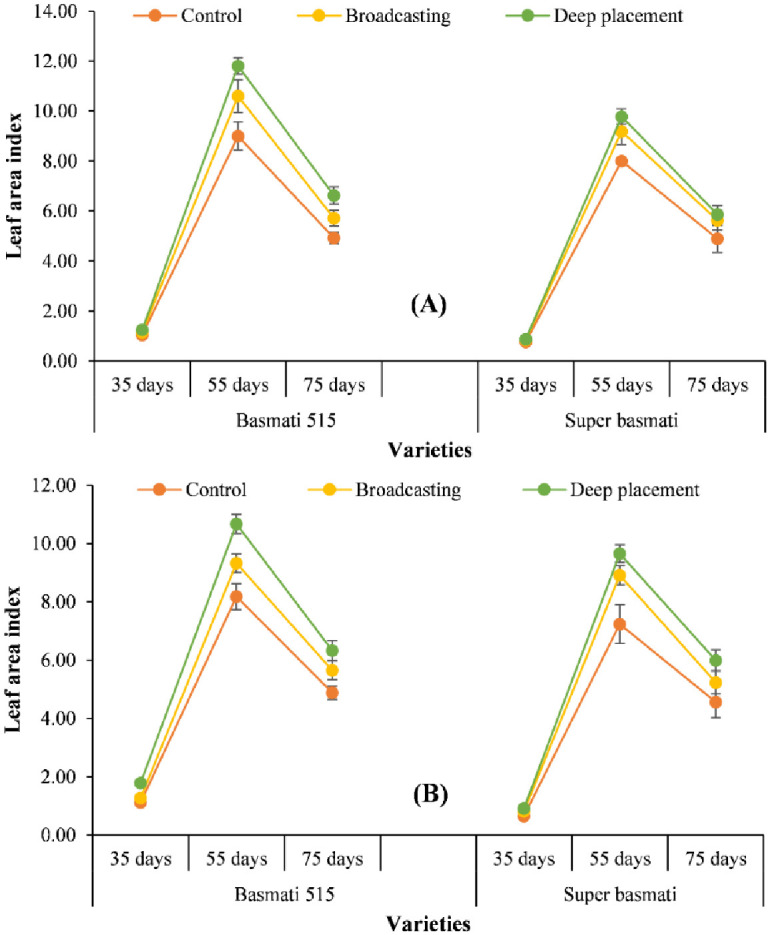
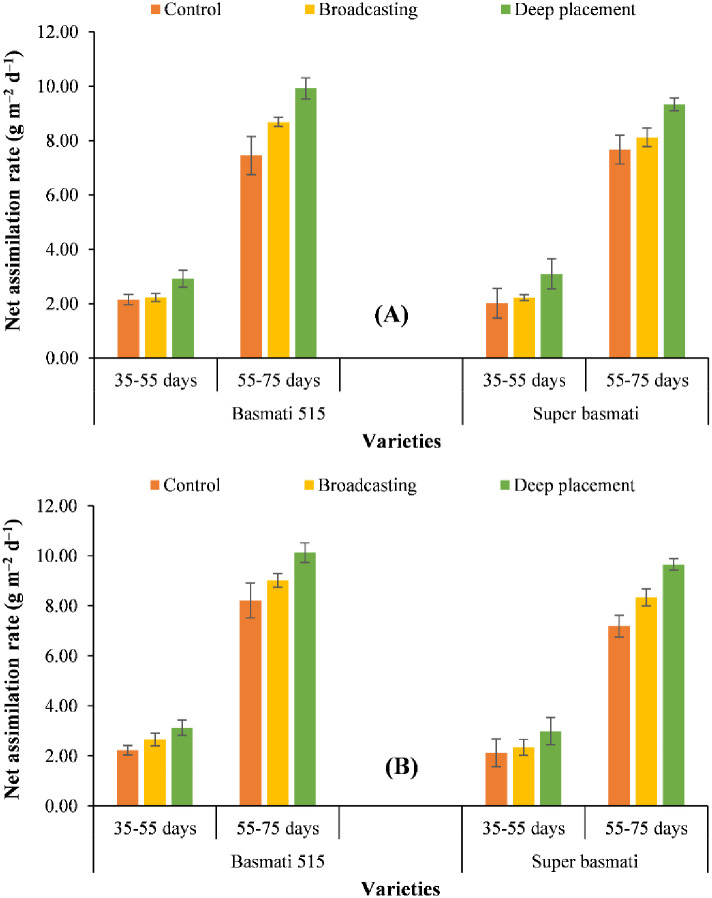
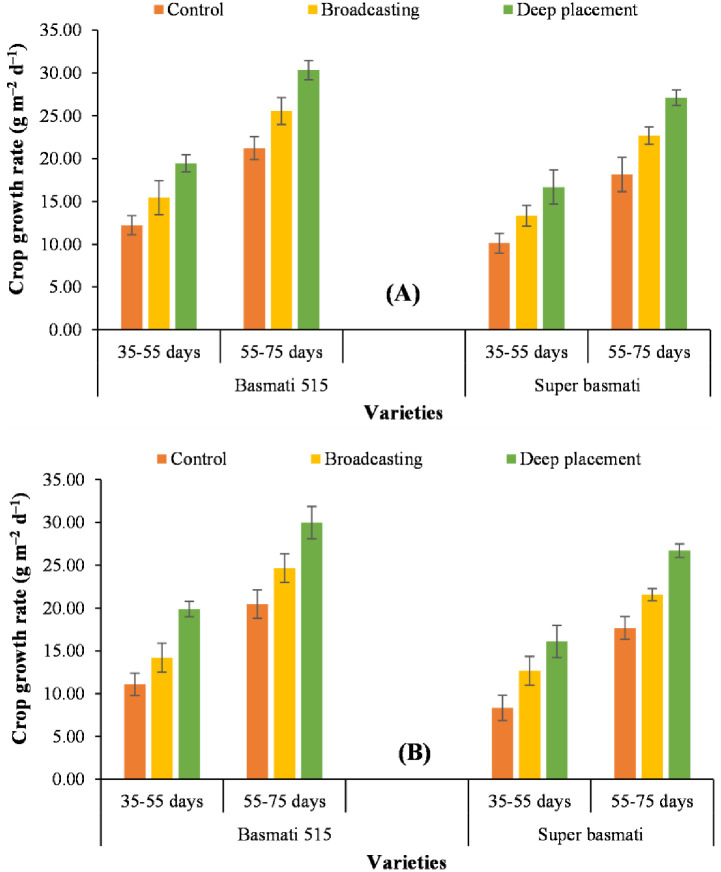
Rice (Oryza sativa L.) feeds to two-third of the global population by serving as staple food. It is the main export commodity of several countries; thus, contributes towards foreign exchange earnings. Unfortunately, average global rice yield is far below than its genetic potential. Low nitrogen (N) use efficiency (NUE) is among the major reasons for low average yield. Current study evaluated the impact of nitrogen fertilizer application methods (conventional and deep placement) on growth, yield-related traits, chlorophyll contents, photosynthesis rate, agronomic N-use efficiency (ANUE), partial factors productivity of applied N (PFP) and economic returns of two different transplanted rice varieties (Basmati-515 and Super-Basmati). Fertilizer application methods significantly affected allometry, yield-related traits, chlorophyll contents, photosynthesis rate, ANUE, PFP and economic returns. Deep placement of N-fertilizer (DPNF) observed better allometric traits, high chlorophyll contents, photosynthesis rate, ANUE, PFP, yield attributes and economic returns compared to conventional application of N-fertilizer (CANF). Similarly, Basmati-515 had better allometric and yield-related traits, chlorophyll contents, photosynthesis rate, ANUE, PFP and economic returns than Super-Basmati. Regarding interactions among N-fertilizer application methods and rice varieties, Basmati-515 with DPNF resulted in higher chlorophyll contents, photosynthesis rate, ANUE, PFP, allometric and yield related traits and economic returns than CANF. The lowest values of these traits were observed for Super-Basmati with no application of N-fertilizer. Both varieties had better yield and economic returns with DPNF compared to CANF. It is concluded that DPNF improved yield, ANUE and economic returns; therefore, should be opted to improve productivity of transplanted fine rice. Nonetheless, lower nitrogen doses need to be tested for DPNF to infer whether it could lower N use in rice crop.
水稻(Oryza sativa L.)作为主食养活了全球三分之二的人口。它是几个国家的主要出口商品,因此有助于赚取外汇。不幸的是,全球水稻平均产量远低于其遗传潜力。低氮(N)利用效率(NUE)是平均产量低的主要原因之一。本研究评估了氮肥施用方法(常规施肥和深施)对两种不同移栽水稻品种(Basmati - 515和超级巴斯马蒂)的生长、产量相关性状、叶绿素含量、光合速率、农学氮利用效率(ANUE)、施氮部分因素生产力(PFP)和经济收益的影响。施肥方法显著影响了异速生长、产量相关性状、叶绿素含量、光合速率、ANUE、PFP和经济收益。与常规施用氮肥(CANF)相比,深施氮肥(DPNF)表现出更好的异速生长性状、高叶绿素含量、光合速率、ANUE、PFP、产量属性和经济收益。同样,Basmati - 515比超级巴斯马蒂具有更好的异速生长和产量相关性状、叶绿素含量、光合速率、ANUE、PFP和经济收益。关于氮肥施用方法和水稻品种之间的相互作用,采用DPNF的Basmati - 515比CANF具有更高的叶绿素含量、光合速率、ANUE、PFP、异速生长和产量相关性状以及经济收益。未施氮肥的超级巴斯马蒂这些性状的值最低。与CANF相比,两个品种采用DPNF时都具有更好的产量和经济收益。研究得出结论,DPNF提高了产量、ANUE和经济收益;因此,应选择DPNF来提高移栽优质水稻的生产力。尽管如此,需要对DPNF测试更低的氮肥用量,以推断其是否能降低水稻作物的氮用量。