Faculty of Life and Environmental Sciences, University of Tsukuba, 1-1-1 Tennodai, Tsukuba 305-8572, Japan.
Sensors (Basel). 2023 Jul 7;23(13):6229. doi: 10.3390/s23136229.
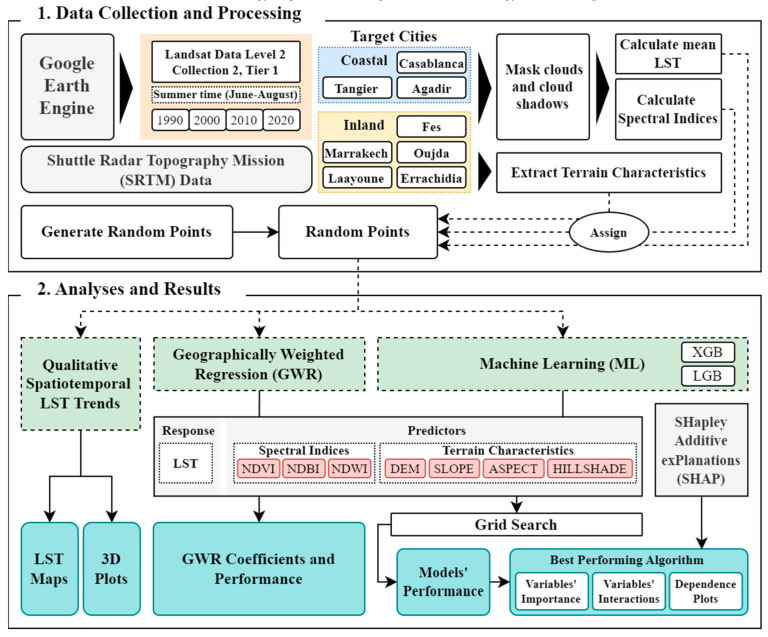
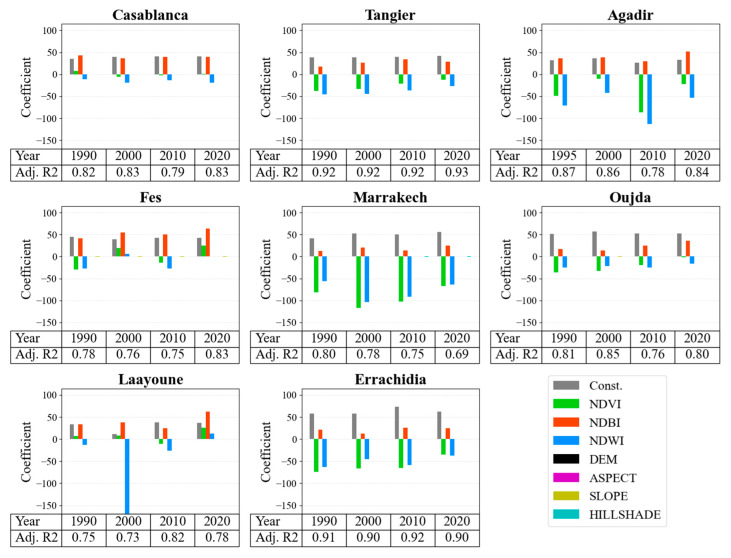
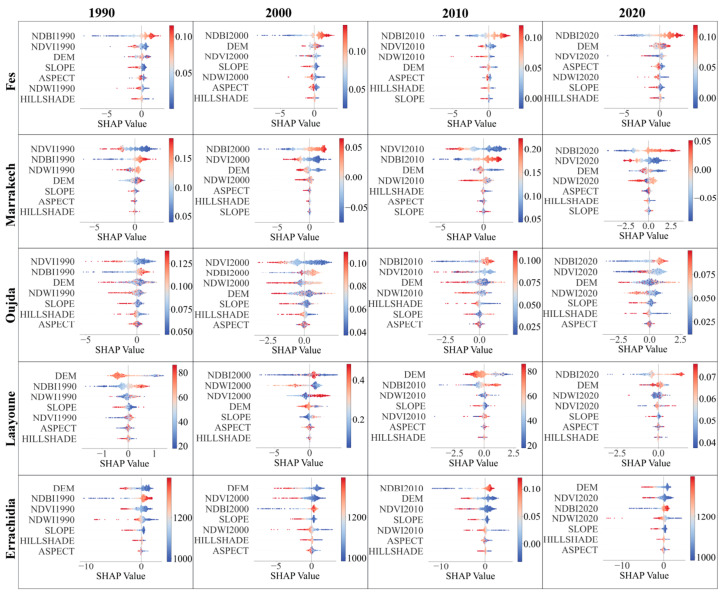
This study examines the Land Surface Temperature (LST) trends in eight key Moroccan cities from 1990 to 2020, emphasizing the influential factors and disparities between coastal and inland areas. Geographically weighted regression (GWR), machine learning (ML) algorithms, namely XGBoost and LightGBM, and SHapley Additive exPlanations (SHAP) methods are utilized. The study observes that urban areas are often cooler due to the presence of urban heat sinks (UHSs), more noticeably in coastal cities. However, LST is seen to increase across all cities due to urbanization and the degradation of vegetation cover. The increase in LST is more pronounced in inland cities surrounded by barren landscapes. Interestingly, XGBoost frequently outperforms LightGBM in the analyses. ML models and SHAP demonstrate efficacy in deciphering urban heat dynamics despite data quality and model tuning challenges. The study's results highlight the crucial role of ongoing urbanization, topography, and the existence of water bodies and vegetation in driving LST dynamics. These findings underscore the importance of sustainable urban planning and vegetation cover in mitigating urban heat, thus having significant policy implications. Despite its contributions, this study acknowledges certain limitations, primarily the use of data from only four discrete years, thereby overlooking inter-annual, seasonal, and diurnal variations in LST dynamics.
本研究考察了 1990 年至 2020 年期间摩洛哥八个主要城市的地表温度(LST)趋势,重点研究了沿海和内陆地区之间的影响因素和差异。本研究采用了地理加权回归(GWR)、机器学习(ML)算法,包括 XGBoost 和 LightGBM,以及 SHapley Additive exPlanations(SHAP)方法。研究发现,由于城市热汇(UHS)的存在,城市地区通常较凉爽,这种情况在沿海城市更为明显。然而,由于城市化和植被覆盖退化,所有城市的 LST 都在增加。在被贫瘠景观环绕的内陆城市,LST 的增加更为显著。有趣的是,XGBoost 在分析中经常优于 LightGBM。尽管存在数据质量和模型调整挑战,ML 模型和 SHAP 仍能有效地解析城市热动态。研究结果强调了城市化进程、地形以及水体和植被的存在对驱动 LST 动态的关键作用。这些发现突出了可持续城市规划和植被覆盖在缓解城市热岛效应方面的重要性,因此具有重要的政策意义。尽管本研究做出了贡献,但它也承认存在一些局限性,主要是仅使用了四年的数据,因此忽略了 LST 动态的年际、季节性和昼夜变化。