Kassa Belayneh Dessie, Yigzaw Aklog Almaw, Kassie Yoseph Gebremedhin, Kedimu Mulugeta Wondimu, Mekuanint Yihun Fenta, Moges Natnael
Department of Emergency and Critical Care Medicine, Debre Tabor University, Debre Tabor, Ethiopia.
Department of Internal Medicine, Debre Tabor University, Debre Tabor, Ethiopia.
Toxicol Rep. 2023 Jun 20;11:36-39. doi: 10.1016/j.toxrep.2023.06.009. eCollection 2023 Dec.
One emergency that occurs frequently and has high morbidity is carbon monoxide poisoning. After a time of lucidity, some victims who recover from the incident of acute carbon monoxide exposure may later suffer delayed neuropsychiatric sequelae (DNS), which can include cognitive impairments, a wide range of neurological abnormalities, and affective disorders. Below, we report the first documented incident of DNS after carbon monoxide poisoning in Ethiopia.
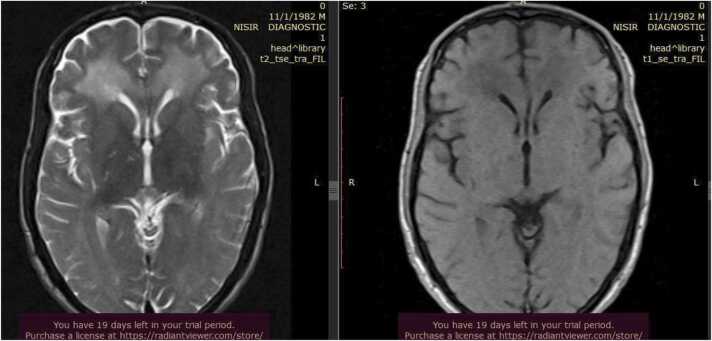
A 40-year-old male patient who developed a coma after he was exposed to burning charcoal in a closed room was admitted to Debre Tabor Comprehensive Specialized Hospital in the northwest region of Ethiopia. He stayed for 12 days during his first admission and was discharged with improvement. One month after discharge, he developed delayed neuropsychiatric sequelae, which manifested as bizarre behavior, being unable to walk unsupported, loss of concentration, and failure to control urine and feces. Brain MRI showed bilateral periventricular and frontoparietal deep white matter subcortical abnormal T1 and T2 prolongation with no restriction of diffusivity, possibly due to demyelinating disorders. He was managed with fluid therapy, benzhexol, risperidone, and rehabilitation therapy. He stayed for two weeks in our hospital and was discharged with improvement.
Despite the paucity of delayed neuropsychiatric sequelae from carbon monoxide poisoning, physicians should be highly suspicious in the right situations. The precise mechanisms of delayed toxic effects, prevention measures, and treatment modalities have not yet been determined; therefore, more research and attention are required.
一氧化碳中毒是一种频繁发生且发病率较高的急症。在经历一段清醒期后,一些从急性一氧化碳中毒事件中恢复的受害者可能会随后出现迟发性神经精神后遗症(DNS),其中包括认知障碍、多种神经异常及情感障碍。以下,我们报告埃塞俄比亚首例有记录的一氧化碳中毒后迟发性神经精神后遗症事件。
一名40岁男性患者,在封闭房间内接触燃烧的木炭后昏迷,被收治于埃塞俄比亚西北部的德布雷塔博尔综合专科医院。他首次住院12天,出院时病情有所改善。出院后一个月,他出现迟发性神经精神后遗症,表现为行为怪异、无法独立行走、注意力不集中以及大小便失禁。脑部磁共振成像显示双侧脑室周围及额顶叶深部白质皮质下T1和T2异常延长,弥散不受限,可能是由于脱髓鞘疾病所致。对其进行了液体疗法、苯海索、利培酮及康复治疗。他在我院住院两周,出院时病情改善。
尽管一氧化碳中毒导致的迟发性神经精神后遗症较少见,但在适当情况下医生应高度怀疑。迟发性毒性作用的确切机制、预防措施及治疗方式尚未确定;因此,需要更多的研究和关注。