Liang Fangguo, Yang Yusheng, Chen Yuyong, Xie Jiajun, Liu Shencai, Tan Zilin, Tian Liangjie, Yu Zhiqiang, Shi Zhanjun, Xie Peigen, Ding Hong, Yang Qinfeng
Department of Plastic and Cosmetic Surgery, Nanfang Hospital, Southern Medical University, Guangzhou, Guangdong Province, 510515, China.
Division of Orthopaedics and Traumatology, Department of Orthopaedics, Nanfang Hospital, Southern Medical University, Guangzhou, Guangdong Province, 510515, China.
Mater Today Bio. 2023 Jun 23;21:100712. doi: 10.1016/j.mtbio.2023.100712. eCollection 2023 Aug.
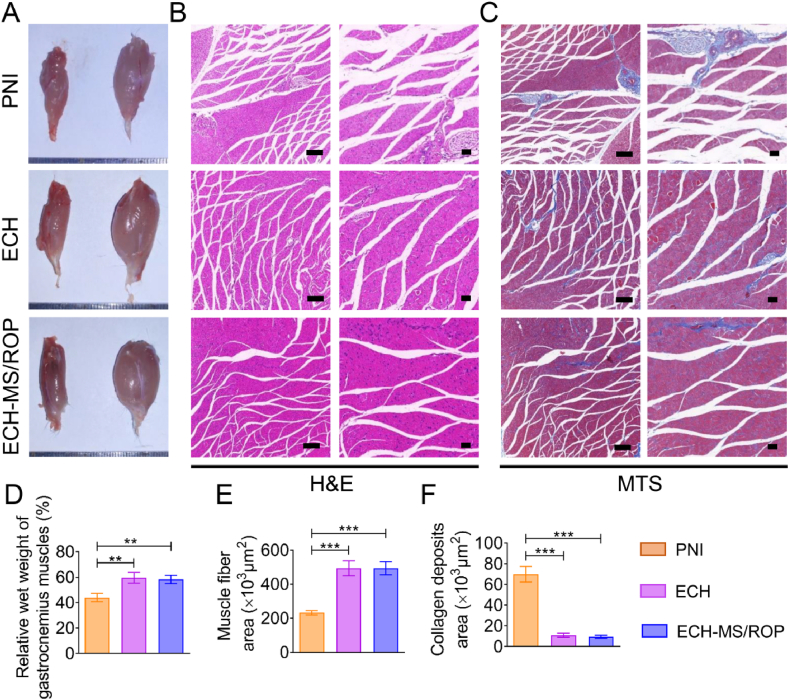
In recent years, electroconductive hydrogels (ECHs) have shown great potential in promoting nerve regeneration and motor function recovery following diabetic peripheral nerve injury (PNI), attributed to their similar electrical and mechanical characteristics to innate nervous tissue. It is well-established that PNI causes motor deficits and pain, especially in diabetics. Current evidence suggests that ropivacaine (ROP) encapsulated in poly lactic-co-glycolic acid (PLGA) microspheres (MSs) yield a sustained analgesic effect. In this study, an ECH electroconductive network loaded with MS/ROP (ECH-MS/ROP) was designed as a promising therapeutic approach for diabetic PNI to exert lasting analgesia and functional recovery. This dual delivery system allowed ROP's slow and sequential release, achieving sustained analgesia as demonstrated by our experiments. Meanwhile, this system was designed like a lamellar dressing, with desirable adhesive and self-curling properties, convenient for treating injured nerve tissues via automatically wrapping tube-like structures, facilitating the process of implantation. Our assays verified that ECH-MS/ROP was able to enhance the adhesion and motility of Schwann cells. Besides, both and studies substantiated that ECH-MS/ROP stimulated myelinated axon regeneration through the MEK/ERK signaling pathway, thereby improving muscular denervation atrophy and facilitating functional recovery. Therefore, this study suggests that the ECH-MS/ROP dressing provides a promising strategy for treating diabetic PNI to facilitate nerve regeneration, functional recovery and pain relief.
近年来,导电水凝胶(ECHs)在促进糖尿病性周围神经损伤(PNI)后的神经再生和运动功能恢复方面显示出巨大潜力,这归因于其与天然神经组织相似的电学和力学特性。众所周知,PNI会导致运动功能障碍和疼痛,尤其是在糖尿病患者中。目前的证据表明,包裹在聚乳酸-乙醇酸共聚物(PLGA)微球(MSs)中的罗哌卡因(ROP)具有持续的镇痛效果。在本研究中,设计了一种负载MS/ROP的ECH导电网络(ECH-MS/ROP),作为治疗糖尿病性PNI的一种有前景的方法,以实现持久的镇痛和功能恢复。这种双重递送系统使ROP能够缓慢且顺序释放,正如我们的实验所证明的,实现了持续镇痛。同时,该系统设计成层状敷料,具有理想的粘附和自卷曲特性,便于通过自动包裹管状结构来治疗受损神经组织,促进植入过程。我们的实验证实ECH-MS/ROP能够增强雪旺细胞的粘附和活力。此外,体内和体外研究均证实ECH-MS/ROP通过MEK/ERK信号通路刺激有髓轴突再生,从而改善肌肉失神经萎缩并促进功能恢复。因此,本研究表明ECH-MS/ROP敷料为治疗糖尿病性PNI以促进神经再生、功能恢复和缓解疼痛提供了一种有前景的策略。