Center for Orthopaedics, Trauma Surgery and Rehabilitation Medicine, University of Greifswald, Greifswald, Germany.
ARCUS Sportklinik, Pforzheim, Germany.
Am J Sports Med. 2023 Aug;51(10):2679-2687. doi: 10.1177/03635465231181633. Epub 2023 Jul 14.
Minced cartilage implantation (MCI) has seen a renaissance in recent years. In this evolved technique, human articular cartilage is harvested with an arthroscopic shaver, augmented with platelet-rich plasma (PRP), and implanted with autologous thrombin. This modified technique combines the possibility of cell-based surgical cartilage repair with a minimally invasive autologous 1-step procedure. However, evidence on cell survival and preserved function after shaver-based mincing and PRP supplementation is limited.
To evaluate the effects of arthroscopic shaver mincing and augmentation with PRP on human cartilage tissue.
Controlled laboratory study.
Standardized samples were taken from 12 donors during autologous MCI. A comparison of cell outgrowth, cell viability, proliferation capacity, and ability to produce extracellular matrix-specific proteoglycans after chondrogenic redifferentiation was made between cartilage taken by curettage from the border of the cartilage defect, cartilage tissue minced by an arthroscopic shaver, and cartilage tissue minced by an arthroscopic shaver that was additionally augmented with autologous PRP.
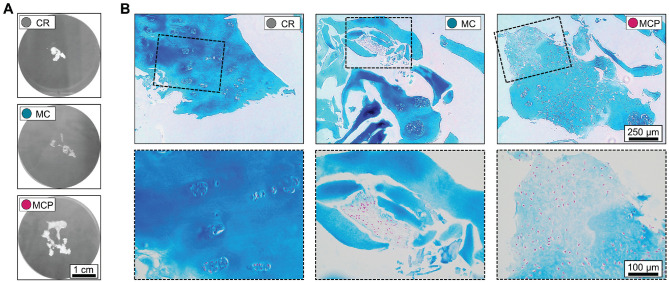
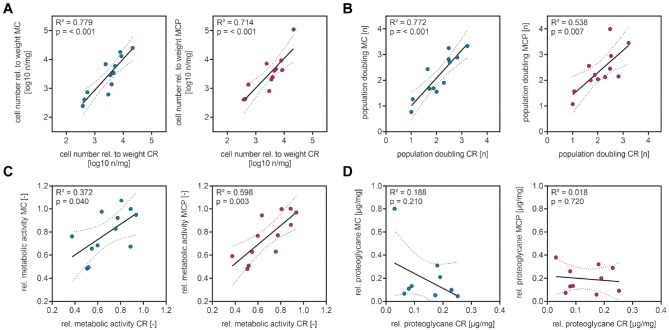
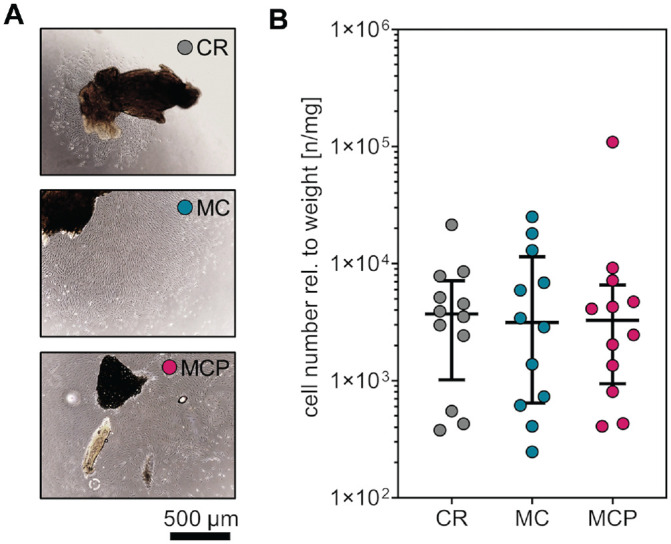
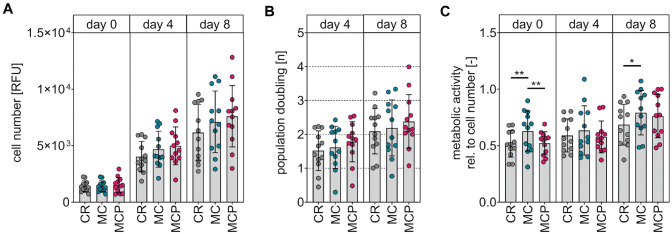
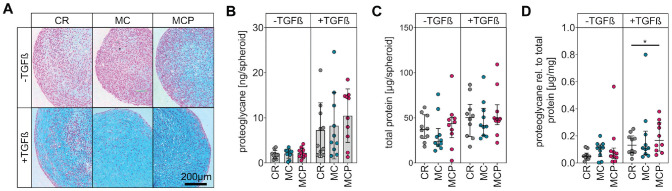
There was no difference between all 3 groups in terms of cell outgrowth or proliferation capacity. Metabolic activity relative to the cell number of chondrocytes isolated from shaver-minced cartilage was higher compared with chondrocytes isolated from cartilage that was derived by curettage or shaver-minced cartilage that was augmented with PRP. After chondrogenic stimulation, the normalized proteoglycan content was higher in spheroids of cells derived from shaver-minced cartilage augmented with PRP than in spheroids of cells derived from curettage. A high correlation of cell outgrowth, proliferation capacity, and viability between isolated cells from all 3 groups taken from an individual donor was observed.
Chondrocytes isolated from human cartilage tissue that was harvested and minced with an arthroscopic shaver remained viable and proliferative. The augmentation of shaver-minced cartilage with PRP led to the enhanced proteoglycan production of chondrogenic spheroids in vitro, pointing toward the development of a cartilage-specific extracellular matrix. This in vitro study yields promising results regarding the use of an arthroscopic shaver and augmentation with PRP in the context of MCI.
Knowledge that shaver mincing and augmentation with PRP are feasible for processing articular cartilage during MCI is highly relevant for surgical cartilage repair.
近年来,碎软骨植入术(MCI)重新兴起。在这种改良技术中,采用关节镜刨削器采集人关节软骨,用富含血小板的血浆(PRP)进行增强,并与自体凝血酶一起植入。这种改良技术将基于细胞的外科软骨修复的可能性与微创性自体 1 步手术相结合。然而,关于基于刨削的切碎和 PRP 补充后细胞存活和保留功能的证据有限。
评估关节镜刨削和 PRP 增强对人软骨组织的影响。
对照实验室研究。
在自体 MCI 过程中,从 12 名供体中采集标准化样本。通过对软骨缺损边缘刮除获得的软骨、关节镜刨削切碎的软骨和关节镜刨削切碎后额外用自体 PRP 增强的软骨进行细胞外生长、细胞活力、增殖能力以及软骨形成后产生细胞外基质特异性蛋白聚糖的能力比较,来评估这 3 种方法的效果。
在细胞外生长或增殖能力方面,3 组之间没有差异。与从刮除或 PRP 增强的刨削软骨中分离的软骨细胞相比,从刨削切碎的软骨中分离的软骨细胞的代谢活性与细胞数量的比值更高。在软骨形成刺激后,PRP 增强的刨削切碎软骨衍生的细胞球体中的标准化蛋白聚糖含量高于从刮除获得的软骨中分离的细胞球体。从每位供体的所有 3 组中分离的细胞的细胞外生长、增殖能力和活力之间存在高度相关性。
从关节镜采集和切碎的软骨组织中分离出来的软骨细胞仍然具有活力和增殖能力。PRP 增强刨削切碎的软骨导致体外软骨形成球体的蛋白聚糖产生增强,表明软骨特异性细胞外基质的发展。这项体外研究为 MCI 背景下使用关节镜刨削和 PRP 增强提供了有希望的结果。
了解关节镜刨削和 PRP 增强在 MCI 过程中用于处理关节软骨是手术软骨修复的关键。