Fraunhofer Institute for Silicate Research ISC, Neunerplatz 2, 97082, Würzburg, Germany.
Department of Tissue Engineering and Regenerative Medicine TERM, University Hospital Würzburg, Röntgenring 11, 97070, Würzburg, Germany.
Sci Rep. 2023 Jul 15;13(1):11440. doi: 10.1038/s41598-023-38535-6.
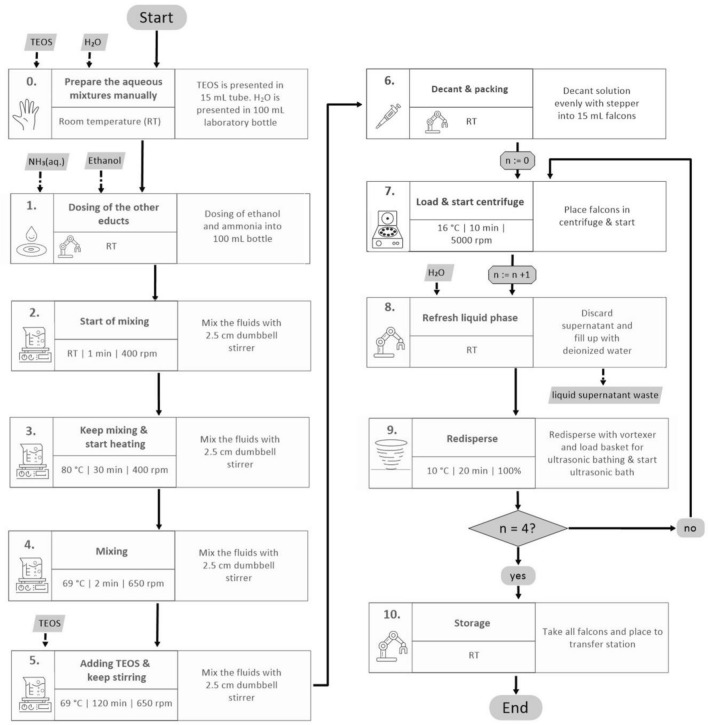
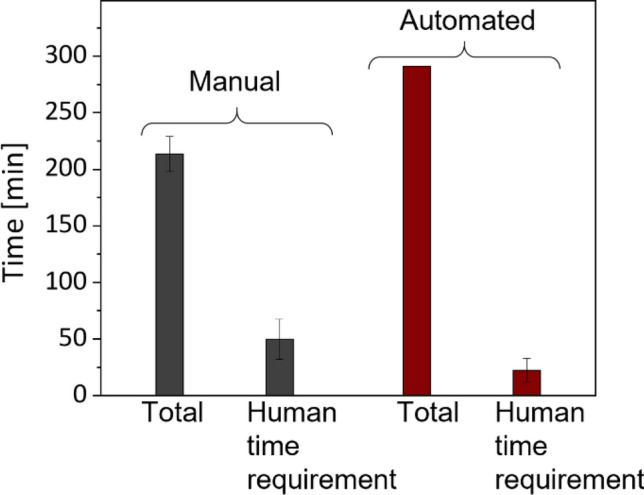
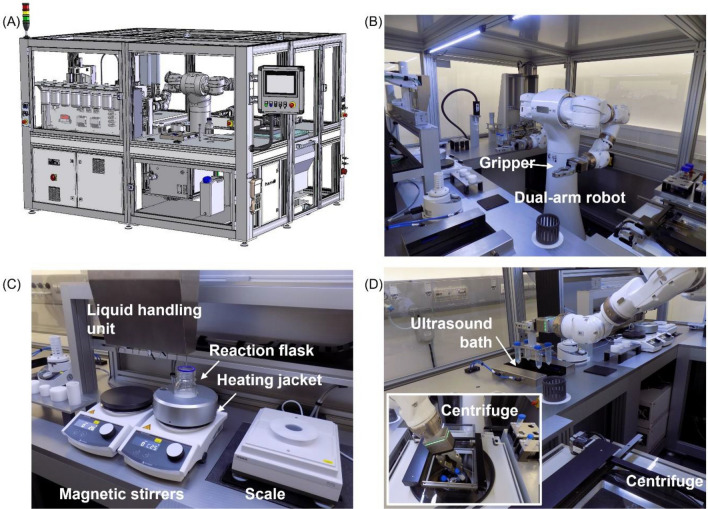
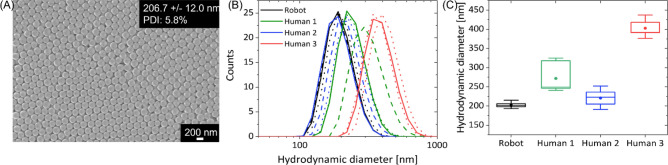
Robotic systems facilitate relatively simple human-robot interaction for non-robot experts, providing the flexibility to implement different processes. In this context, shorter process times, as well as an increased product and process quality could be achieved. Robots short time-consuming processes, take over ergonomically unfavorable tasks and work efficiently all the time. In addition, flexible production is possible while maintaining or even increasing safety. This study describes the successful development of a dual-arm robot-based modular infrastructure and the establishment of an automated process for the reproducible production of nanoparticles. As proof of concept, a manual synthesis protocol for silica nanoparticle preparation with a diameter of about 200 nm as building blocks for photonic crystals was translated into a fully automated process. All devices and components of the automated system were optimized and adapted according to the synthesis requirements. To demonstrate the benefit of the automated nanoparticle production, manual (synthesis done by lab technicians) and automated syntheses were benchmarked. To this end, different processing parameters (time of synthesis procedure, accuracy of dosage etc.) and the properties of the produced nanoparticles were compared. We demonstrate that the use of the robot not only increased the synthesis accuracy and reproducibility but reduced the personnel time and costs up to 75%.
机器人系统为非机器人专家提供了相对简单的人机交互,具有实现不同流程的灵活性。在这种情况下,可以实现更短的流程时间以及更高的产品和流程质量。机器人可以缩短耗时的流程,接管不符合人体工程学的任务,并始终高效地工作。此外,在保持甚至提高安全性的同时,可以实现灵活的生产。本研究描述了基于双臂机器人的模块化基础设施的成功开发,并建立了用于可重复生产纳米粒子的自动化工艺。作为概念验证,将用于制备约 200nm 直径的二氧化硅纳米粒子的手动合成方案(作为光子晶体的构建块)转化为全自动工艺。根据合成要求,对自动化系统的所有设备和组件进行了优化和调整。为了证明自动化纳米颗粒生产的好处,对手动(由实验室技术人员进行的合成)和自动化合成进行了基准测试。为此,比较了不同的加工参数(合成过程的时间、剂量的准确性等)和所生产的纳米颗粒的性质。我们证明,使用机器人不仅提高了合成的准确性和重现性,而且将人员时间和成本降低了 75%。