Department of Anesthesiology, Hunan Cancer Hospital, School of Xiangya Medicine, Central South University, Hunan, China.
Department of Anesthesiology, Women's Hospital, School of Medicine Zhejiang University, Zhejiang, China.
Nicotine Tob Res. 2023 Nov 22;25(12):1856-1864. doi: 10.1093/ntr/ntad118.
The kappa-opioid receptor (KOR) has been implicated in mediating the behavioral and biochemical effects associated with nicotine reward and withdrawal; however, its underlying mechanisms remain to be further explored.
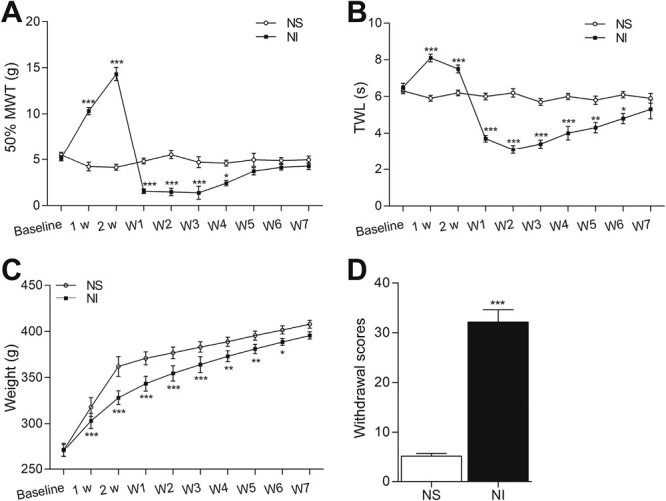
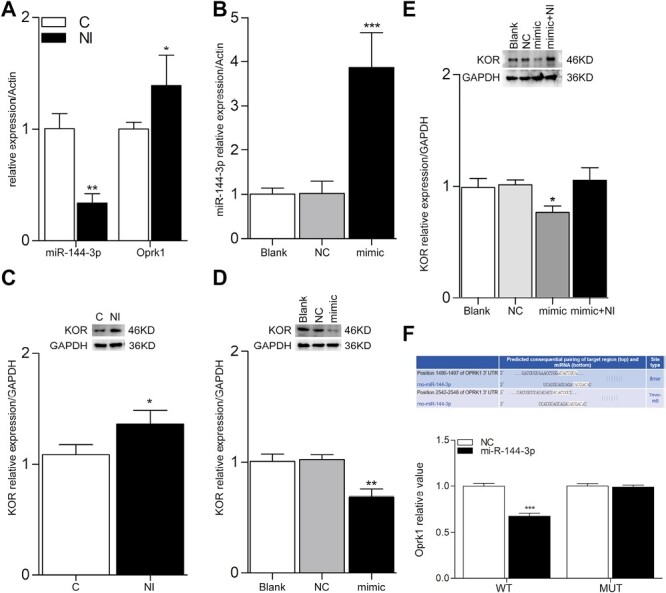
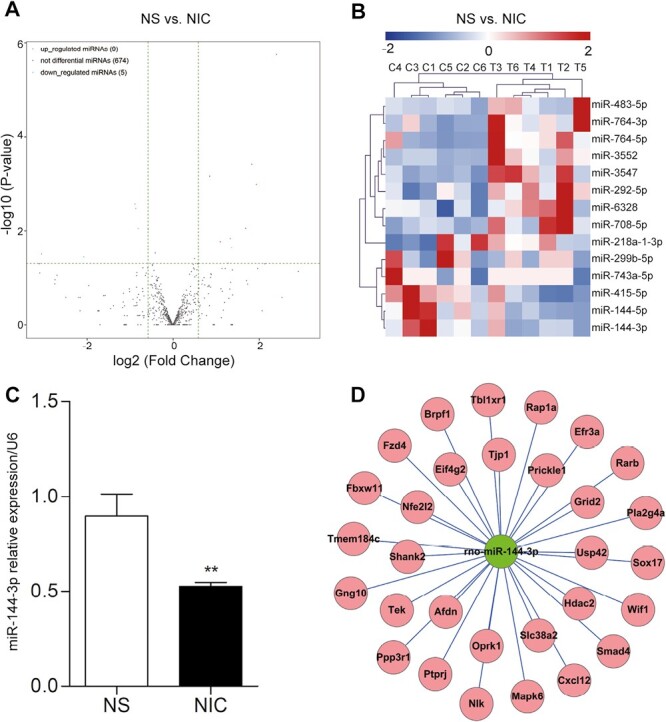
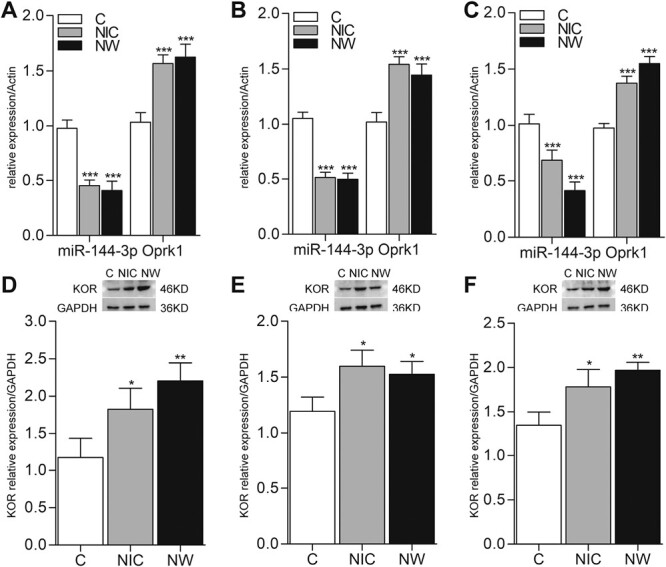
Adult male Sprague-Dawley rats were used to establish a nicotine dependence and withdrawal model by injecting nicotine (3 mg/kg/day, s.c.) or vehicle for 14 days, followed by the termination of nicotine for 7 days. Body weight gain, pain behaviors, and withdrawal scores were assessed in succession. MicroRNA (miRNA) sequencing was performed, and quantitative real-time PCR was used to detect the expression of candidate miRNAs and Oprk1. Western blotting was performed to examine KOR protein expression of KOR. Luciferase assay was conducted to validate the relationship of certain miRNAs/Oprk1.
The behavioral results showed that nicotine dependence and withdrawal induced behavioral changes. Biochemical analyses demonstrated that miR-144-3p expression decreased and Oprk1/KOR expression increased in the prefrontal cortex, nucleus accumben, and hippocampus. Further investigation suggested that miR-144-3p exerted an inhibitory effect on Oprk1 expression in PC12 cells.
This study revealed that miR-144-3p/Oprk1/KOR might be a potential pathway underlying the adverse effects induced by nicotine dependence and withdrawal, and might provide a novel therapeutic target for smoking cessation.
This study demonstrates an impact of nicotine dependence and nicotine withdrawal on behavioral outcomes and the expressions of miR-144-3p/Oprk1/KOR in male rats. These findings have important translational implications given the continued use of nicotine and the difficulty in smoking cessation worldwide, which can be applied to alleviated the adverse effects induced by nicotine dependence and withdrawal, thus assist smokers to quit smoking.
κ 阿片受体(KOR)参与介导与尼古丁奖赏和戒断相关的行为和生化效应;然而,其潜在机制仍有待进一步探索。
使用成年雄性 Sprague-Dawley 大鼠通过注射尼古丁(3mg/kg/天,皮下)或载体建立尼古丁依赖和戒断模型 14 天,然后终止尼古丁 7 天。依次评估体重增加、疼痛行为和戒断评分。进行 microRNA(miRNA)测序,并用定量实时 PCR 检测候选 miRNA 和 Oprk1 的表达。进行 Western blot 以检查 KOR 蛋白表达的 KOR。进行荧光素酶测定以验证某些 miRNA/Oprk1 的关系。
行为结果表明,尼古丁依赖和戒断引起行为变化。生化分析表明,miR-144-3p 表达减少,Oprk1/KOR 表达增加在前额叶皮质、伏隔核和海马体。进一步的研究表明,miR-144-3p 对 PC12 细胞中 Oprk1 表达具有抑制作用。
本研究表明,miR-144-3p/Oprk1/KOR 可能是尼古丁依赖和戒断引起的不良反应的潜在途径,并可能为戒烟提供新的治疗靶点。
本研究表明,尼古丁依赖和尼古丁戒断对雄性大鼠的行为结果和 miR-144-3p/Oprk1/KOR 的表达有影响。鉴于尼古丁的持续使用和全球戒烟的困难,这些发现具有重要的转化意义,可以应用于减轻尼古丁依赖和戒断引起的不良反应,从而帮助吸烟者戒烟。