Brandone Amanda C, Stout Wyntre
Department of Psychology, Lehigh University.
J Cogn Dev. 2023;24(3):375-396. doi: 10.1080/15248372.2022.2146117. Epub 2022 Nov 25.
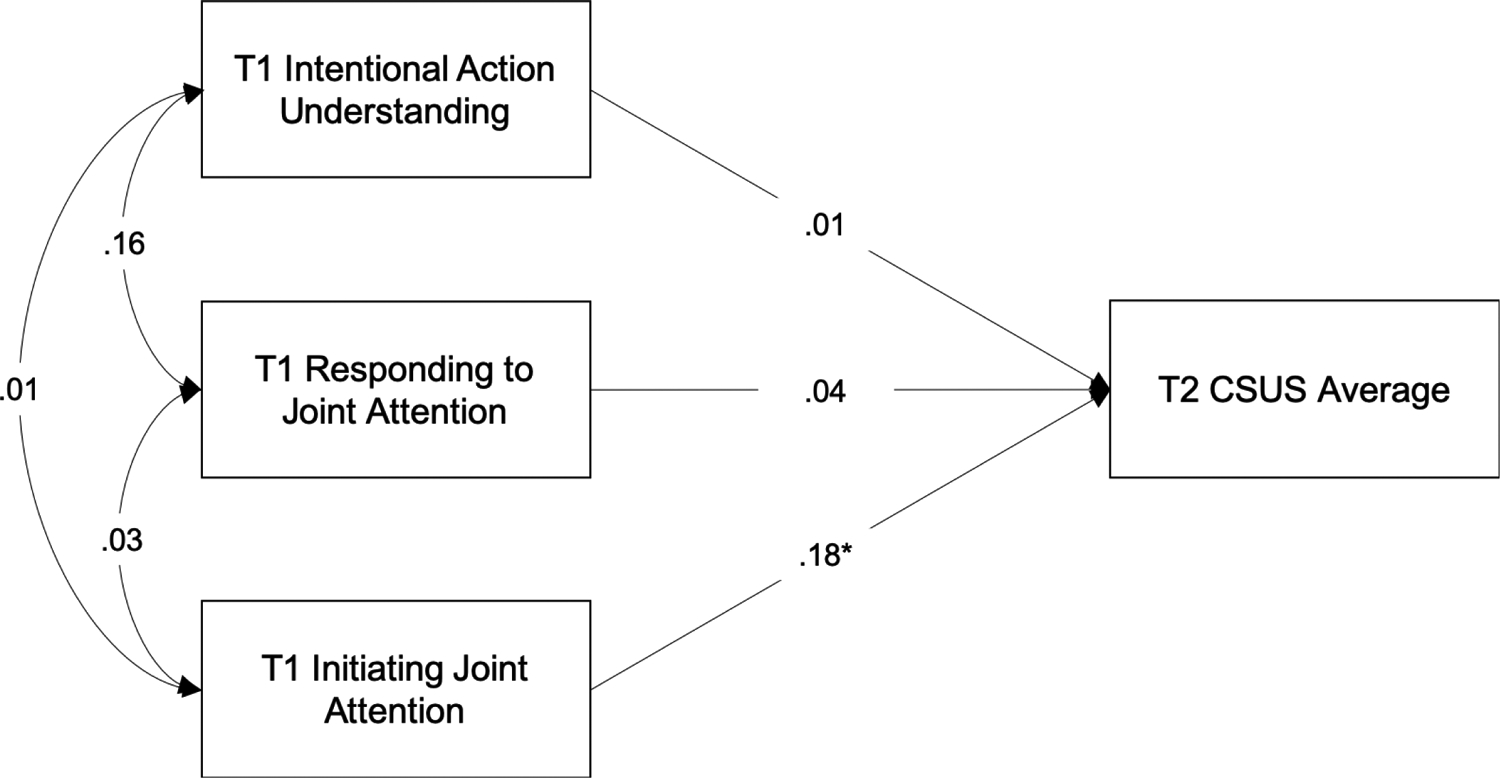
A growing body of literature has established longitudinal associations between key social cognitive capacities emerging in infancy and children's subsequent theory of mind. However, existing work is limited by modest sample sizes, narrow infant measures, and theory of mind assessments with restricted variability and generalizability. The current study aimed to extend this literature by (a) recruiting a large sample of participants ( = 116; 53 boys; 63 girls; all U.S. residents; 88 White, 8 Hispanic or Latino, 2 Black or African American, 14 two or more races/ethnicities, 4 unknown; median family income: $74-122,000), (b) examining multiple measures of infant social cognition (intentional action understanding, responding to joint attention, initiating joint attention) at Time 1 (8-12 months), and (c) using an ecologically valid theory of mind assessment designed to capture individual differences in preschoolers' mental state understanding (the Children's Social Understanding Scale; Tahiroglu et al., 2014) at Time 2 (37-45 months). Measured variable path analysis revealed a significant longitudinal association between infants' initiating joint attention and later theory of mind: infants who engaged in more attempts to initiate joint attention with experimenters through gaze alternation or gestures went on to show better parent-reported mental state understanding as preschoolers. Notably, the paths from infants' responding to joint attention and intentional action understanding to later theory of mind did not emerge as significant. These findings bolster and clarify existing claims about how mental state reasoning is rooted in foundational social-cognitive capacities emerging in infancy.
越来越多的文献已经确立了婴儿期出现的关键社会认知能力与儿童后续心理理论之间的纵向关联。然而,现有研究存在样本量较小、婴儿测量方法有限以及心理理论评估的变异性和普遍性受限等问题。本研究旨在通过以下方式扩展这一文献:(a)招募大量参与者样本(n = 116;53名男孩;63名女孩;均为美国居民;88名白人,8名西班牙裔或拉丁裔,2名黑人或非裔美国人,14名两个或更多种族/族裔,4名未知;家庭收入中位数:74,000 - 122,000美元),(b)在时间1(8 - 12个月)检查婴儿社会认知的多种测量指标(对有意动作的理解、对联合注意的回应、发起联合注意),以及(c)在时间2(37 - 45个月)使用一种生态效度高的心理理论评估方法,旨在捕捉学龄前儿童心理状态理解方面的个体差异(儿童社会理解量表;Tahiroglu等人,2014年)。测量变量路径分析揭示了婴儿发起联合注意与后期心理理论之间存在显著的纵向关联:那些通过目光交替或手势与实验者进行更多发起联合注意尝试的婴儿,在学龄前阶段,其父母报告的心理状态理解表现更好。值得注意的是,婴儿对联合注意的回应和对有意动作的理解与后期心理理论之间的路径并不显著。这些发现支持并澄清了关于心理状态推理如何植根于婴儿期出现的基础社会认知能力的现有观点。