Eur Stroke J. 2023 Sep;8(3):722-730. doi: 10.1177/23969873231183211. Epub 2023 Jul 17.
Ischaemic stroke patients with atrial fibrillation (AF) are at high risk of stroke recurrence despite oral anticoagulation therapy. Patients with cardiovascular comorbidities may take both antiplatelet and oral anticoagulation therapy (OAC/AP). Our study aims to evaluate the safety and efficacy of OAC/AP therapy as secondary prevention in people with AF and ischaemic stroke.
We performed a post-hoc analysis of pooled individual data from multicenter prospective cohort studies and compared outcomes in the OAC/AP cohort and patients on DOAC/VKA anticoagulation alone (OAC cohort). Primary outcome was a composite of ischaemic stroke, systemic embolism, intracranial bleeding, and major extracranial bleeding, while secondary outcomes were ischaemic and haemorrhagic events considered separately. A multivariable logistic regression analysis was performed to identify independent predictors for outcome events. To compare the risk of outcome events between the two cohorts, the relation between the survival function and the set of explanatory variables were calculated by Cox proportional hazard models and the results were reported as adjusted hazard ratios (HR). Finally another analysis was performed to compare the overall risk of outcome events in both OAC/AP and OAC cohorts after propensity score matching (PSM).
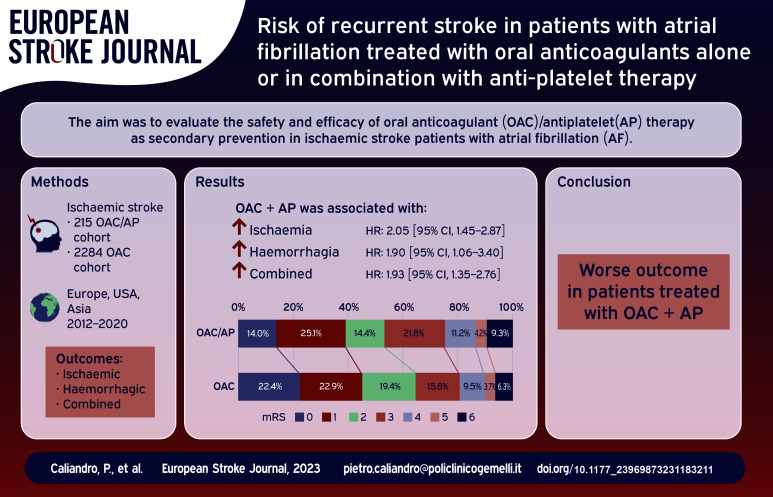
During a mean follow-up time of 7.5 ± 9.1 months (median follow-up time 3.5 months, interquartile range ±3), 2284 stroke patients were on oral anticoagulants and 215 were on combined therapy. The multivariable model demonstrated that the composite outcome is associated with age (OR: 1.03, 95% CI: 1.01-1.04 for each year increase) and concomitant antiplatelet therapy (OR: 2.2, 95% CI: 1.48-3.27), the ischaemic outcome with congestive heart failure (OR: 1.55, 95% CI: 1.02-2.36) and concomitant antiplatelet therapy (OR: 1.93, 95% CI: 1.19-3.13) and the haemorrhagic outcome with age (OR: 1.03, 95% CI: 1.01-1.06 for each year increase), alcoholism (OR: 2.15, 95% CI: 1.06-4.39) and concomitant antiplatelet therapy (OR: 2.22, 95% CI: 1.23-4.02). Cox regression demonstrated a higher rate of the composite outcome (hazard ratio of 1.93 [95% CI, 1.35-2.76]), ischaemic events (HR: 2.05 [95% CI: 1.45-2.87]) and bleeding outcomes (HR: 1.90 [95% CI, 1.06-3.40]) in OAC/AP cohort. After PSM analysis, the composite outcome remained more frequent in people treated with OAC + AP (RR: 1.70 [95% CI, 1.05-2.74]).
Secondary prevention with combination of oral anticoagulant and antiplatelet therapy after ischaemic stroke was associated with worse outcomes in our cohort.
Further research is needed to improve secondary prevention by investigating the mechanisms of recurrent ischaemic stroke in patients with atrial fibrillation.
尽管接受了口服抗凝治疗,患有心房颤动 (AF) 的缺血性中风患者仍存在中风复发的高风险。患有心血管合并症的患者可能同时接受抗血小板和口服抗凝治疗 (OAC/AP)。我们的研究旨在评估 AF 和缺血性中风患者中 OAC/AP 治疗作为二级预防的安全性和有效性。
我们对来自多中心前瞻性队列研究的汇总个体数据进行了事后分析,并比较了 OAC/AP 组和仅接受 DOAC/VKA 抗凝治疗的患者 (OAC 组) 的结局。主要结局是缺血性中风、全身性栓塞、颅内出血和主要颅外出血的复合结局,而次要结局是分别考虑缺血性和出血性事件。进行多变量逻辑回归分析以确定结局事件的独立预测因素。为了比较两个队列的结局事件风险,使用 Cox 比例风险模型计算生存函数与解释变量集之间的关系,并报告调整后的风险比 (HR)。最后,进行了另一种分析,以比较 OAC/AP 和 OAC 队列在倾向评分匹配 (PSM) 后的总体结局事件风险。
在平均 7.5±9.1 个月(中位数随访时间 3.5 个月,四分位距 ±3)的随访期间,2284 名中风患者接受了口服抗凝治疗,215 名患者接受了联合治疗。多变量模型表明,复合结局与年龄(每增加 1 岁,OR:1.03,95%CI:1.01-1.04)和同时使用抗血小板治疗(OR:2.2,95%CI:1.48-3.27)相关,缺血性结局与充血性心力衰竭(OR:1.55,95%CI:1.02-2.36)和同时使用抗血小板治疗(OR:1.93,95%CI:1.19-3.13)相关,出血性结局与年龄(OR:1.03,95%CI:1.01-1.06,每年增加)、酗酒(OR:2.15,95%CI:1.06-4.39)和同时使用抗血小板治疗(OR:2.22,95%CI:1.23-4.02)相关。Cox 回归表明 OAC/AP 组复合结局(风险比 1.93 [95%CI,1.35-2.76])、缺血性事件(HR:2.05 [95%CI,1.45-2.87])和出血结局(HR:1.90 [95%CI,1.06-3.40])的发生率更高。在 PSM 分析后,OAC+AP 治疗的人复合结局仍然更频繁(RR:1.70 [95%CI,1.05-2.74])。
我们的队列研究表明,缺血性中风后联合使用口服抗凝剂和抗血小板治疗的二级预防与更差的结局相关。
需要进一步研究通过研究心房颤动患者复发性缺血性中风的机制来改善二级预防。
