Purrucker Jan C, Hölscher Kyra, Kollmer Jennifer, Ringleb Peter A
Department of Neurology, Heidelberg University Hospital, 69120 Heidelberg, Germany.
Department of Neuroradiology, Heidelberg University Hospital, 69120 Heidelberg, Germany.
J Clin Med. 2020 Sep 11;9(9):2938. doi: 10.3390/jcm9092938.
Reducing the number of ischemic strokes in patients with atrial fibrillation despite oral anticoagulation remains an important, yet largely unsolved challenge. Therefore, we assessed the etiology of ischemic strokes despite anticoagulation with vitamin K antagonists (VKA) or non-VKA oral anticoagulants (NOACs).
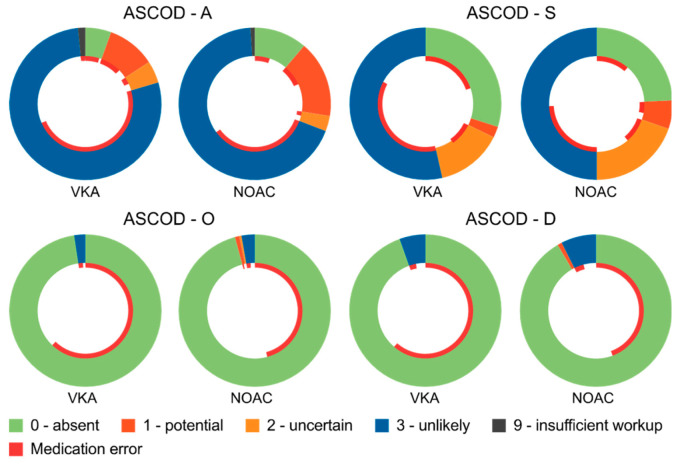
Patients with known atrial fibrillation (AF), treatment with VKA or NOAC, and acute ischemic stroke admitted between 2015 and 2018 (1st half) were identified from the hospital database. Brain imaging data were independently reviewed. An integrated etiologic classification according to the ASCOD system was made. Medication errors (admission INR <2.0 in the VKA- or NOAC-specific concentration <10 ng/mL) or dosage/dosing errors were also analyzed.
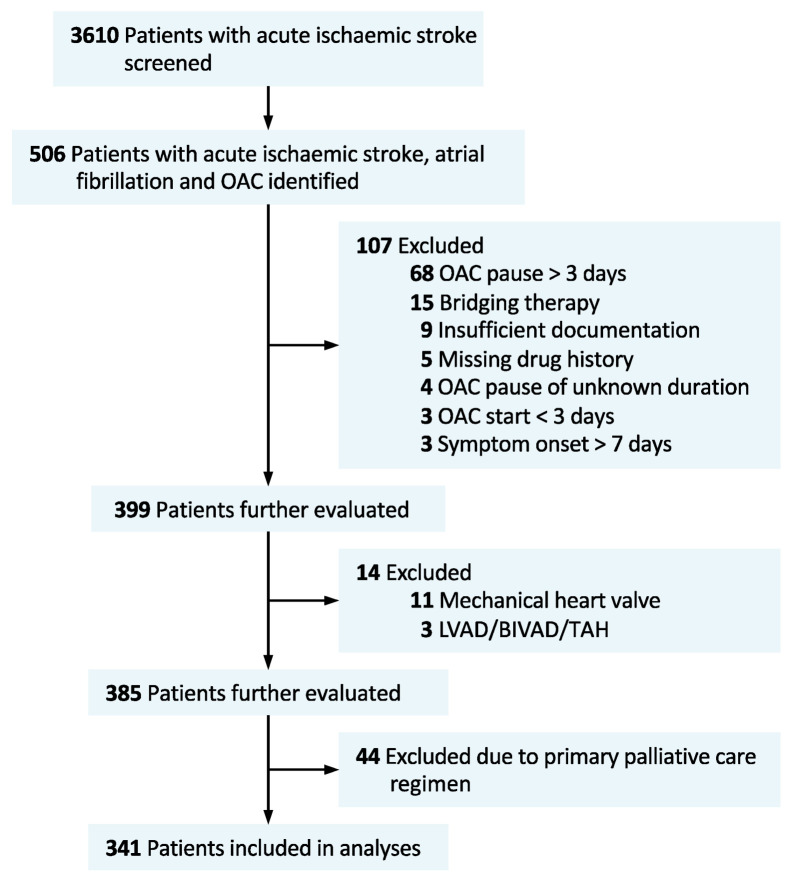
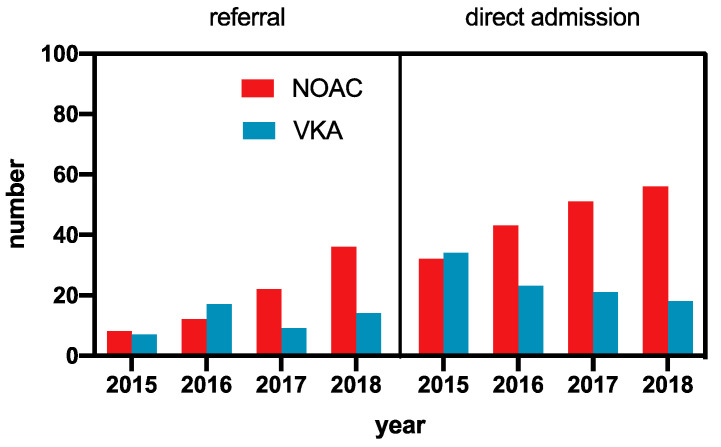
Of 3610 patients screened, = 341 were included (VKA, = 127; NOAC, = 214). An overall increasing rate of OAC-associated stroke per year was observed. In 95.3% of patients with adequate diagnostic work-up ( = 321/337), at least one additional potential, uncertain, or unlikely non-cardiac cause of stroke was identified. More patients in the VKA than in the NOAC group had a medication error (81/127, 63.8% vs. 102/205, 49.8%; = 0.013).
Stroke risk factors despite atrial fibrillation were highly prevalent. Although less common with NOACs than VKAs, medication errors are still frequent.
尽管使用了口服抗凝药,但减少心房颤动患者的缺血性卒中数量仍然是一项重要但尚未得到充分解决的挑战。因此,我们评估了在使用维生素K拮抗剂(VKA)或非VKA口服抗凝剂(NOAC)进行抗凝治疗的情况下缺血性卒中的病因。
从医院数据库中识别出2015年至2018年(上半年)期间已知患有心房颤动(AF)、接受VKA或NOAC治疗且发生急性缺血性卒中的患者。对脑成像数据进行独立审查。根据ASCOD系统进行综合病因分类。还分析了用药错误(VKA组入院时国际标准化比值<2.0或NOAC组特定浓度<10 ng/mL)或剂量/给药错误。
在筛查的3610例患者中,纳入了341例(VKA组127例;NOAC组214例)。观察到每年OAC相关卒中的总体发生率呈上升趋势。在95.3%进行了充分诊断检查的患者(321/337)中,至少发现了一种其他潜在、不确定或不太可能的非心脏性卒中病因。VKA组用药错误的患者比NOAC组多(81/127,63.8%对102/205,49.8%;P = 0.013)。
尽管存在心房颤动,但卒中危险因素仍然非常普遍。虽然与VKA相比,NOAC导致的用药错误较少见,但仍然很频繁。