Grupo de Investigación en Diversidad Biológica, Departamento de Ciencias Biológicas, Facultad de Ciencias Agropecuarias, Universidad Nacional de Colombia-Sede Palmira, Carrera, 32 No. 12-00, 763536, Palmira, Valle del Cauca, Colombia.
Int Microbiol. 2024 Apr;27(2):377-391. doi: 10.1007/s10123-023-00392-8. Epub 2023 Jul 17.
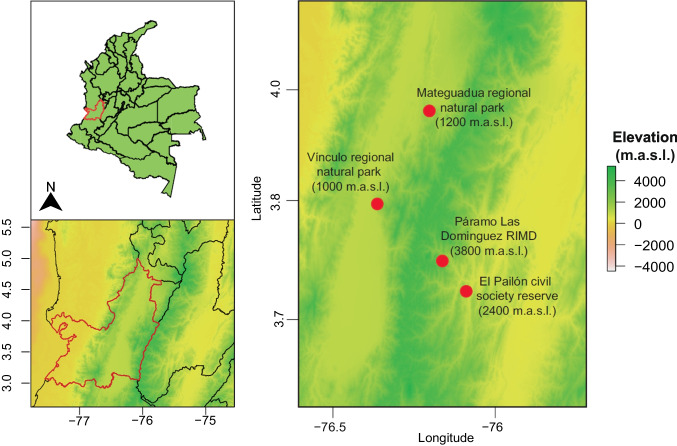
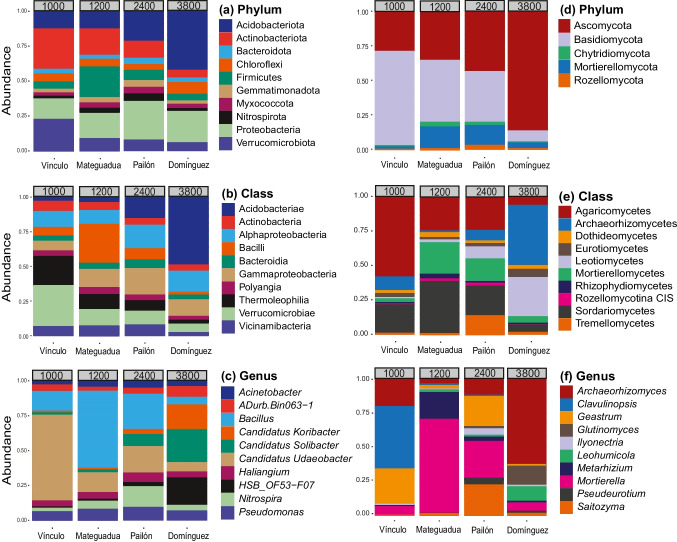
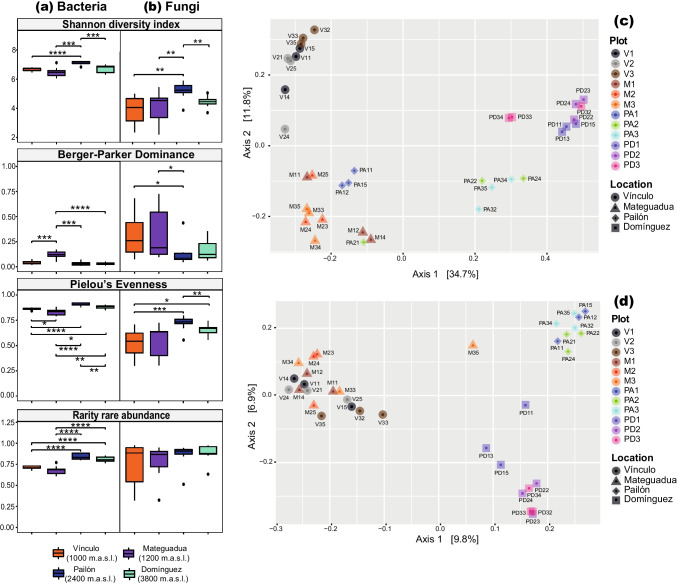
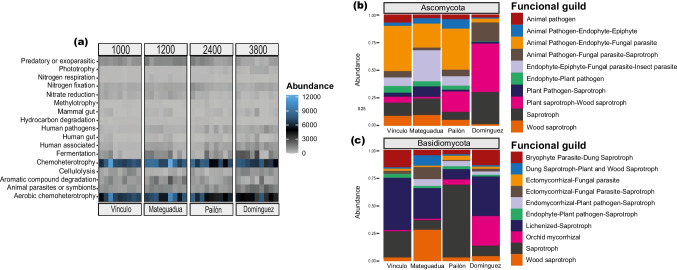
The influence of elevation on natural terrestrial ecosystems determines the arrangements of microbial communities in soils to be associated with biotic and abiotic factors. To evaluate changes of fungi and bacteria at the community level along an elevational gradient (between 1000 and 3800 m.a.s.l.), physicochemical measurements of soils, taxonomic identifications of plants, and metabarcoding sequences of the 16S rRNA gene for bacteria and the ITS1 region for fungi were obtained. The bacterial taxonomic composition showed that Acidobacteriota increased in abundance with elevation, while Actinobacteriota and Verrucomicrobiota decreased. Furthermore, Firmicutes and Proteobacteria maintained maximum levels of abundance at intermediate elevations (1200 and 2400 m.a.s.l.). In fungi, Ascomycota was more abundant at higher elevations, Basidiomycota tended to dominate at lower elevations, and Mortierellomycota had a greater presence at intermediate sites. These results correlated with the edaphic parameters of decreasing pH and increasing organic carbon and available nitrogen with elevation. In addition, the Shannon index found a greater diversity in bacteria than fungi, but both showed a unimodal pattern with maximum values in the Andean Forest at 2400 m.a.s.l. Through the microbial characterization of the ecosystems, the elevational gradient, soil properties, and vegetation were found to exert significant effects on microbial communities and alpha diversity indices. We conclude that the most abundant soil microorganisms at the sampling points differed in abundance and diversity according to the variations in factors influencing ecological communities.
海拔对自然陆地生态系统的影响决定了土壤中微生物群落的分布与生物和非生物因素有关。为了评估真菌和细菌在沿海拔梯度(海拔 1000 至 3800 米)的群落水平上的变化,我们对土壤进行了理化测量,对植物进行了分类鉴定,并对细菌 16S rRNA 基因和真菌 ITS1 区进行了 metabarcoding 测序。细菌分类组成表明,随着海拔的升高,酸杆菌门的丰度增加,而放线菌门和疣微菌门的丰度减少。此外,厚壁菌门和变形菌门在中等海拔(1200 和 2400 米)保持最大的丰度水平。在真菌中,子囊菌门在较高海拔地区更为丰富,担子菌门倾向于在较低海拔地区占主导地位,而被孢霉门在中间地点的存在更为广泛。这些结果与随着海拔升高而降低的 pH 值、增加的有机碳和有效氮的土壤参数相关。此外,Shannon 指数发现细菌的多样性大于真菌,但两者都呈现出单峰模式,在 2400 米的安第斯森林中达到最大值。通过对生态系统的微生物特征进行分析,发现海拔梯度、土壤特性和植被对微生物群落和 alpha 多样性指数有显著影响。我们的结论是,在采样点,最丰富的土壤微生物根据影响生态群落的因素的变化,在丰度和多样性上有所不同。